Sketchnoting combines selected words with simple visual marks to capture the structure of an idea. You do not need elaborate drawings. You need to decide what matters, show how the parts connect and keep qualifications that would change the meaning. A page full of attractive icons can still be a poor set of notes.
Here you will turn an original short talk about a neighborhood sound walk into a finished visual note. You will see the source script, what gets shortened, which marks carry meaning and how a misleading first version is repaired. The talk and observations are fictional teaching examples.
What makes a sketchnote more than decoration
Mike Rohde’s introduction describes a combination of handwriting, drawing, shapes and visual elements. The practical distinction is that the visual choices help organize meaning. A box can group a condition; an arrow can show order; a simple ear can identify observation by listening.
Do not begin by asking which ten icons would look impressive. First ask what you need to remember or explain later. If the note cannot answer that question, more drawing will not rescue it. Plain text may be the right choice for a detail that has no useful visual role.
A sketchnote is selective, but selection must be responsible. Dropping repeated examples may be harmless. Dropping “during this visit” can change a tentative observation into a universal claim. Preserve the difference between a source statement, your inference and an unanswered question.
Start with a complete original source script
Fictional two-minute talk: A small sound walk. This is a compact learning exercise, not a professional assessment of noise or a record of a real neighborhood.
Before the walk, choose one question: where along a short route could two people hold a quiet conversation? Use three stops—a courtyard, a crossing and a covered passage—rather than trying to record everything on every street. At each stop, pause for the same short period and write the main sound, what interrupts the conversation and anything that makes the observation uncertain. Listen and take written notes; there is no need to record other people. Afterward, compare the stops, but remember that traffic, weather and activity can change. A place that felt quieter during this visit is not necessarily always quiet. Finish with one question to check on another visit instead of turning a brief walk into a permanent ranking.
The script contains a question, a preparation choice, a repeated observation routine, a comparison and a limit. Those are the elements the note needs to preserve. The precise phrase “every street” is less important than the boundary of three selected stops.
Choose the information before choosing the layout
Make a quick content pass with four headings: purpose, process, comparison and uncertainty. Capture a few phrases under each. Resist copying the entire script into small text and adding pictures around the edge.
| Source idea | Compact note | Possible visual role |
|---|---|---|
| One question about conversation | “Where can we talk quietly?” | Main title or central question |
| Three selected stops | Courtyard / crossing / passage | Three linked stop markers |
| Same observation period | “Same pause at each stop” | Shared condition above the route |
| Main sound and interruptions | “Hear / interrupts / unsure” | Repeated three-part note area |
| Conditions can change | “This visit ≠ always” | Visible qualification beside conclusion |
| Return with one question | “Check again” | Dashed return link |
The table is a planning aid, not the final sketchnote. Its job is to prevent visual choices from silently deleting meaning. If the source contained an essential number or name, retain it rather than replacing it with an ambiguous doodle.
Pick a layout that matches the relationship
A left-to-right sequence suits this talk: choose a question → visit the stops → compare with limits → plan another check. It makes the workflow visible without suggesting that the three locations are ranked from best to worst.
A radial alternative could place the question in the center, with branches for preparation, observation and review. That would emphasize the parts of the method rather than the order of the walk. Both layouts can be valid if the relationships are labeled clearly.
Do not let a familiar layout dictate the source. A pyramid might imply a hierarchy the talk never states. A central mind-map branch may imply categories where the speaker described a sequence. Ask what a reader would infer from the spatial arrangement before committing to it.
Use a small vocabulary of marks
For this note, use a title, three simple location symbols, containers for observations, arrows for sequence and a dashed line for the future check. Color can separate preparation, observation and review, but words should carry the distinctions as well.
An ear symbol labels listening; it does not represent a measured sound level. A small clock can indicate the shared observation period, but label it so readers know what is timed. A question mark can preserve uncertainty if the accompanying words say what remains unknown.
You can draw these marks imperfectly. Consistency matters more than polish: use the same kind of arrow for the same relationship. If one line means “walk next” and another means “causes,” label the difference rather than hoping readers infer it from the color.
Build the actual note from question to review
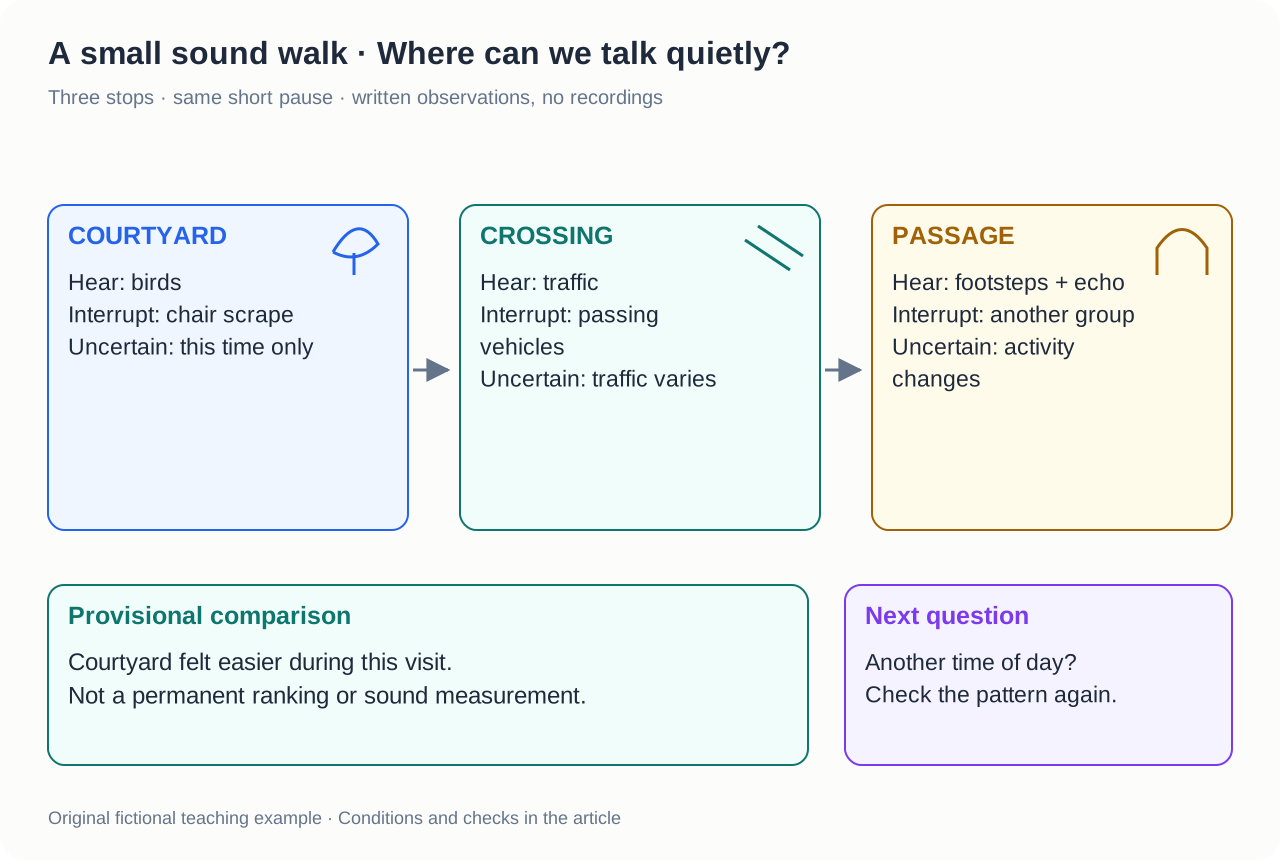
Place the question at the top: “Where can we talk quietly?” Under it, add the shared condition: “Three stops, same short pause; written notes.” This keeps the comparison’s scope visible before any observations appear.
Draw the three stops across the middle. At each, reserve space for main sound, interruption and uncertainty. Leave enough room to write an actual note. A tiny decorative pin with no space for content looks finished before the thinking begins.
For an invented demonstration, the courtyard note says “birds; a chair scrape; only this time of day.” The crossing says “traffic; speech interrupted; passing vehicles vary.” The passage says “footsteps and echoes; another group passing; activity changes.” These are fictional entries, not acoustic measurements.
At the bottom, write a provisional comparison: “Courtyard felt easier for conversation during this visit.” Beside it, preserve “not a permanent ranking.” The final area asks whether the same pattern appears at a different time, linking the note to a future question.
Repair an attractive but misleading version
Imagine the first version places a large trophy above the courtyard and writes “quietest place.” The drawing is memorable, but it overstates the source and invented observations. It also turns a limited comparison into a permanent label.
Repair it by replacing the trophy with a speech symbol, changing the claim to “easier to talk here during this visit,” and adding the revisit question. The visual becomes less dramatic and more useful. A reader can now tell what was observed and what still needs checking.
Another weak version draws three locations but omits what to record at each. Add the repeated prompts rather than another decorative border. The source’s main procedure is the consistent observation routine; without that, the page is merely an illustrated route.
A third version uses an unlabeled arrow from traffic to anxiety. The talk did not establish that claim. Remove it or clearly mark it as a separate question for investigation. A line can introduce an unsupported causal statement as easily as a sentence can.
Choose what to do when you cannot keep up
During a live talk, capture words and relationships first. Leave a small placeholder for a drawing rather than losing the next qualification while perfecting an icon. You can add a simple mark later if it helps identify a section.
Separate later additions from the speaker’s claims. Use a distinct label such as “my question” or a different outline for an inference. Do not retrospectively polish your interpretation until it appears to be a statement the speaker actually made.
If the information is consequential or exact wording matters, keep an appropriate source reference or fuller record alongside the sketchnote. The visual note can support navigation and recall without pretending to replace all detail.
Review the note by using it
Close the script and explain the method using only the note. Can you state the question, identify the repeated routine, distinguish the three stops from a ranking, and explain why the conclusion is provisional? Missing answers reveal a structural gap.
Then compare with the script. Check for invented facts, lost conditions and ambiguous arrows. A useful review is not just “does this look balanced?” It asks whether the picture helps reconstruct the intended meaning accurately.
For a later check, ask someone unfamiliar with the talk what they think each arrow means. If they interpret a route arrow as a cause, repair the label or arrangement. That feedback concerns the communication of the note, not the artistic ability of its author.
Adapt the technique to other kinds of material
For a meeting, a note might separate the question, alternatives, decision and unresolved actions. Keep an actual decision distinct from a proposal. A box containing a person’s suggestion should not look identical to a confirmed assignment if that distinction matters.
For reading, capture a claim with supporting evidence and a qualification. SQ3R can help you form the questions first. For explaining a mechanism, the Feynman technique provides a way to check whether the connections in the drawing reflect understanding.
A mind map usually organizes branches around a center. Sketchnoting can use sequences, clusters, small scenes or mixed layouts. Neither should be chosen because it appears more sophisticated; choose the structure that preserves the source’s relationships.
Start a manageable canvas and keep the source nearby
Use enough space for readable text and a few meaningful marks. On an infinite whiteboard, frames can separate the source notes, first draft and revised visual. Avoid expanding the page until the reading order disappears.
You can build that arrangement manually in CodePic with freehand marks, text, shapes and connectors. This article does not promise automatic talk transcription, instant conversion into a sketchnote or a dedicated template download. The visible finished example is an original explanatory figure.
Keep the first version and its corrections. The next note becomes easier when you know which visual choice helped you recover the idea and which one introduced a misleading implication. That is a more useful improvement target than drawing more icons on every page.