The Feynman technique is a learning routine: explain a concept in plain language, notice where the explanation breaks, return to a reliable source, and explain it again. The useful output is a more accurate explanation and a record of what you still cannot justify. Sounding confident is not the test.
Here you will work through an original example about a fictional library’s reservation system. You will see the rules, a plausible but wrong explanation, the questions that expose its gaps, and a corrected version. The example is a teaching exercise, not a description of a real library’s policy.
What the Feynman technique asks you to do
Start with a bounded question rather than a whole subject. “How does this waiting list assign one returned book?” gives you something you can check. “Understand libraries” does not. Decide what your listener already knows and which result they should be able to predict afterward.
University learning guides describe similar routines with different step labels. The University of York’s guide emphasizes simple explanation, identifying gaps, clarification and repetition. We use those ideas as a practical study convention, without treating one wording or sequence as a standardized assessment.
Plain language should reveal the mechanism. Replacing a technical word with another familiar word is not enough if the causal link remains missing. Keep a necessary term, define it with an example, and ask the listener to use it. Removing every precise word can make an explanation less accurate.
Choose one question and establish the source material
Our fictional library uses these rules for a single copy of a book:
- Readers enter a queue in the order they request the book.
- A request places someone in the queue; it does not promise an immediate pickup.
- When the copy becomes available, the first eligible reader receives an offer.
- That reader has 48 hours from the offer to collect it.
- If the offer expires, the copy is offered to the next eligible reader.
- Once the copy is collected, it is on loan and cannot be offered again until returned.
Assume everyone in the example is eligible and notifications are delivered immediately. These simplifying assumptions are part of the exercise. Real services may have opening-hour rules, multiple copies and different eligibility conditions.
Your learning question is: Why can a reader have a request without having a book ready to collect? A successful explanation should distinguish a place in the queue, a current offer and an active loan. It should also predict what happens when an offer expires.
Write the first explanation without looking
Close the rules and write the explanation you currently believe. Do not polish it into a finished tutorial yet. Leave visible gaps such as “I cannot explain when the timer starts.” That admission gives your next reading a specific purpose.
Here is a deliberately weak first attempt:
When you reserve a book, the library saves it for you. Everyone has two days to collect their reservation. If you do not go in time, the next person gets it. The waiting list tells you which book is yours.
The sentences are short and familiar, but the explanation is inaccurate. It merges requesting with receiving an offer. “Everyone has two days” makes the timer sound as though it starts when a request is made. The last sentence also implies ownership before a copy becomes available.
This is why simplicity alone is a poor quality check. A fluent explanation can hide an incorrect model. Keep this first version so you can compare what changed after checking; do not replace it silently and then rely on a feeling that you learned something.
Use questions that force the mechanism into view
Ask a partner to challenge the explanation, or write questions yourself before reopening the source. Prefer questions that separate two possible interpretations. “Does that make sense?” often produces agreement without revealing what the listener actually understood.
| Probe | What the first explanation cannot settle |
|---|---|
| Can Ana be first in the queue while the book is still on loan? | It does not separate queue position from availability |
| When does Ana’s 48-hour timer begin? | It confuses the request and offer events |
| Can Ben collect the same copy while Ana’s offer is active? | It does not explain the exclusivity of the offer |
| What if Ana collects the copy before the deadline? | It skips the transition to an active loan |
| Does an expired offer mean the book disappears? | It leaves the next assignment unclear |
Record the difficulty in your own words. “I forgot a term” and “I do not understand the transition” need different repairs. The first may need a definition; the second needs a sequence and a reason. A diagram helps only after you know which question it must answer.
Return to the source with a gap log
Reopen the six rules and repair the specific claims that failed. Copying the entire source into a new document is less useful than identifying which rule changes which part of your explanation. Separate what the source states from what you inferred.
| Gap | Source check | Repair |
|---|---|---|
| A request sounded like a pickup promise | Rules 2 and 3 distinguish a queue from an offer | Say “request joins the queue” |
| The timer seemed to start at the request | Rule 4 starts it at the offer | Name the event that starts the clock |
| Collection was missing | Rule 6 makes the copy unavailable while on loan | Include offer → collected → loan |
| Expiry sounded like cancellation of the whole system | Rule 5 assigns the next offer | Explain who is considered next |
If a source does not answer a question, mark it unresolved. Do not invent an attractive rule to complete the story. In this exercise, we have not defined renewal or what happens to an expired reader’s future requests. Those questions remain outside the model until new rules are supplied.
Build and check a corrected explanation
Here is a revised version:
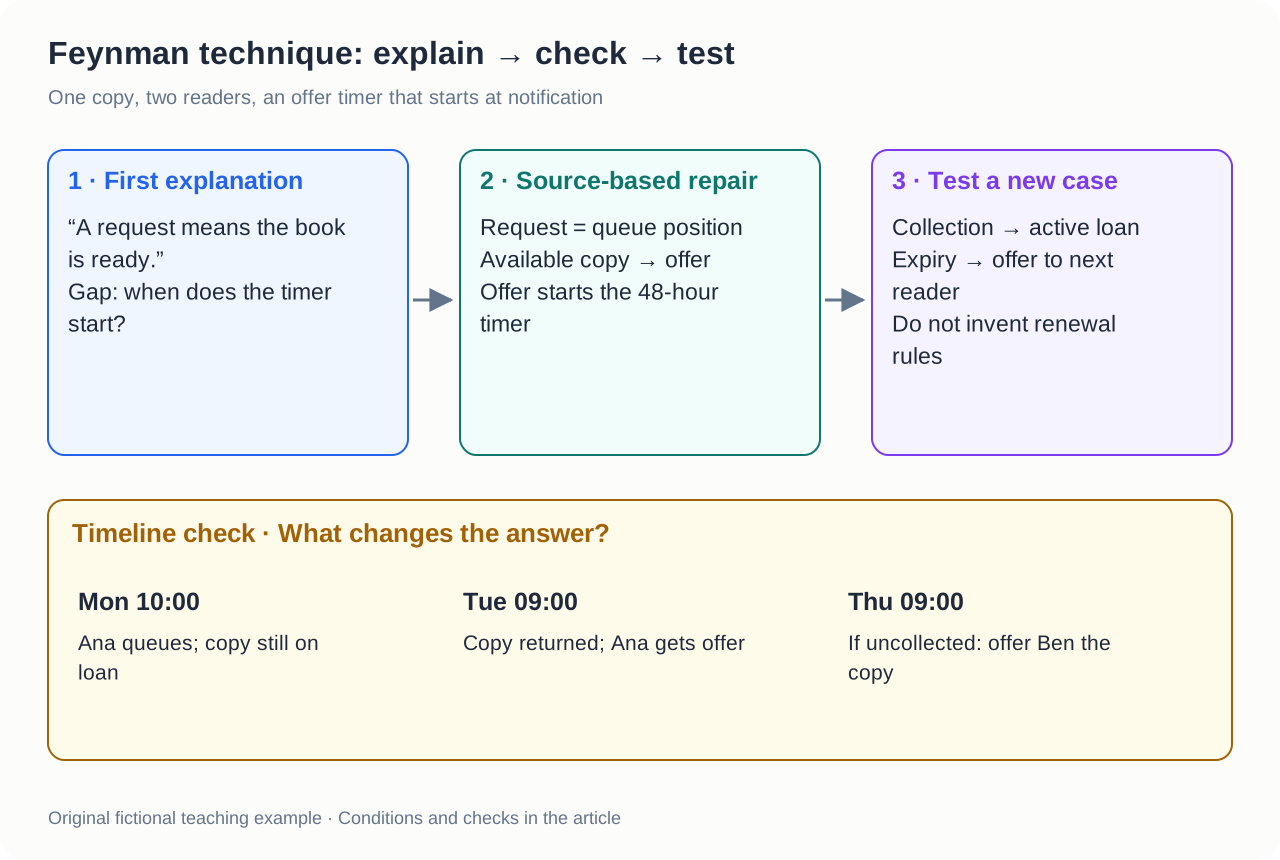
A request gives you a place in the waiting queue. It does not make the book available. When the single copy becomes available, the library offers it to the first eligible reader. Only then does that reader’s 48-hour pickup period begin. If they collect it, the copy becomes a loan; if the offer expires, the library considers the next eligible reader.
Now test the model with a small timeline. At Monday 10:00, Ana is first and Ben second, but the book is still on loan. Neither has a pickup offer. At Tuesday 09:00, it is returned and Ana receives an offer. Her deadline is Thursday 09:00 under the fictional rules.
Suppose Ana does not collect it. At the expiry event, Ben receives the next offer and his own timer begins. He did not spend his pickup period waiting behind Ana. If Ana instead collects it on Wednesday, Ben remains waiting because the copy is now on loan. Both branches should be predictable from the revised explanation.
Check transfer instead of repeating a memorized paragraph
Change one condition and ask for a prediction. Let Ben be first instead of Ana, or let Ana collect the book early. The learner should reason from queue, availability and offer state, rather than recite names and dates from the example.
A stronger check is to ask for the smallest change that would alter the answer. Moving the return time changes the offer deadline. Changing the request time may change queue order. Changing the color of the book cover changes neither under our rules. Explaining that distinction reveals which facts the learner thinks are causal.
Use a new case before looking at your notes. Then check it against the source. A correct sentence immediately after copying a correction is weak evidence of independent understanding. A later explanation can reveal forgotten boundaries, though one successful retest still does not prove permanent mastery.
Use analogies carefully and keep their limits visible
You might compare the queue to people waiting for one shared umbrella. The analogy can explain why joining the line is different from holding the object. It cannot establish the library’s 48-hour rule; that rule comes from the source material, not from umbrellas.
Write both the useful similarity and the point where the comparison stops. Otherwise, a memorable image may introduce new mistakes. A listener might think leaving the line cancels every future request, even though the fictional policy says nothing about that. Ask which prediction the analogy supports before keeping it.
For a broader network of related ideas, a concept map may help organize relationships. For this task, the explanation-and-test loop matters more than how many nodes appear on the page. A beautiful map cannot compensate for an unverified transition.
Fit the routine into a real study session
Use three working areas: explanation, gaps and checks. Keep the first explanation in view while adding a corrected version beside it. Link each repair to a particular source rule and each remaining doubt to a question you can investigate later.
On a whiteboard, text blocks and connectors are enough to show queue → offer → loan, with a separate expiry branch. You can build that manually in CodePic. This guide does not provide an automatic understanding score, a dedicated Feynman generator or a downloadable worksheet.
When studying reading material, SQ3R can help you form questions and recall answers before the explanation exercise. Cornell notes offer another way to keep cues and source notes separate. Choose the structure that exposes your uncertainty rather than using every method at once.
Recognize when explanation needs another kind of practice
Explaining a procedure is not the same as performing it. A learner may describe a mathematical method but still make errors when choosing and applying it. Follow the explanation with a suitable problem, a practical demonstration or feedback from someone qualified for the subject.
The technique also depends on source quality. If the starting rule is wrong, a clear explanation may spread the error more efficiently. Verify consequential claims against appropriate material and preserve uncertainty when sources disagree. Do not use confidence, brevity or another person’s praise as a replacement for checking.
End the session with a specific next action: resolve one missing rule, explain a new case without notes, or practice the skill the explanation describes. Keep the earlier version and the evidence behind each correction. Those records make the next session begin with a question you can answer, rather than a vague intention to study harder.