The SQ3R method structures reading into Survey, Question, Read, Recite and Review. You first inspect the material, turn its structure into questions, read to answer them, recall the answers without looking, and check what you missed. The recitation step is active retrieval, not another pass with a highlighter.
This guide uses an original fictional memo about reusing paper in a school print room. You will turn headings into questions, collect evidence, correct a mistaken closed-book answer and plan a later check. The example illustrates a reading routine; it does not report a real school project or measured memory improvement.
Choose reading material that has a purpose
SQ3R is most useful when you have something specific to understand and can inspect its organization. A chapter, report or explanatory article gives you headings, examples and claims to question. It need not turn every short message into a five-part exercise.
York’s study guide sets out the five stages and describes recall without looking at the material. Our worked notes and review choices are original teaching examples. Treat the routine as a way to check understanding, not as a promise that one reading will permanently store the text.
Before starting, write why you are reading. In our case, a student volunteer needs to explain which paper belongs in a reuse tray and how the school will check the trial. That purpose is narrower than memorizing every word in the memo.
The complete original practice text
Fictional memo: A paper reuse trial. Read the headings first; return to the paragraphs during the Read stage.
Where usable paper was going
During a print-room check, volunteers noticed that some discarded sheets had writing on only one side. They proposed collecting suitable sheets for rough notes. The observation did not establish how much paper the school could save, because no complete count had been made.
A rule for the new tray
For a one-week trial, the room will have a clearly marked reuse tray. Only dry sheets with one blank side and no confidential information may go into it. Sheets with private details must follow the school’s existing secure-disposal process. A volunteer will remove unsuitable sheets rather than ask users to sort through them later.
How the trial will be reviewed
At the end of each day, a volunteer will record how many suitable sheets entered the tray and how many were taken for rough notes. At the end of the week, the group will inspect these counts and users’ questions. It will then decide whether to continue, change the instructions or stop the trial. No result has yet been reported.
The memo’s rules are invented for this exercise. They do not replace an institution’s actual confidentiality or disposal requirements. Keeping that boundary explicit is part of understanding what a text does and does not authorize.
Survey: inspect the structure before collecting details
Look at the title and three headings. Notice that the material moves from an observation to a rule and then to a review plan. Those are different functions. A quick survey should make that structure visible without turning into a full first reading.
Write a short expectation: “This memo explains a proposed paper-reuse process, its conditions and how the trial will be checked.” Do not claim the project succeeded. The word trial and the review heading suggest that the result is still open.
Also inspect what is missing. There is no outcome table, no cost calculation and no report of a year-long program. Those absences help you avoid asking the text to prove something it never claimed. If your assignment requires a savings estimate, you will need further evidence.
Question: give the reading a job
Turn the headings into questions, then add one about a potentially misleading conclusion. Keep the questions short enough to answer, but more useful than repeating a heading with a question mark.
| Heading or cue | Working question |
|---|---|
| Where usable paper was going | What observation prompted the idea, and what does it not establish? |
| A rule for the new tray | Which sheets qualify, and which must stay out? |
| How the trial will be reviewed | What will be recorded, when, and what decisions remain open? |
| Trial, not completed project | Can I claim that the school has already reduced waste? |
Your questions can change during reading. If a paragraph introduces an important qualification, add it. The purpose is to steer attention, not to force the source into an outline written before you knew what it contained.
Avoid making so many questions that answering them becomes transcription. Three or four focused questions are enough for this short memo. A longer chapter may need questions by section rather than one enormous list at the start.
Read: answer with evidence and limits
Now read the paragraphs carefully. For each question, write a short answer and the location that supports it. Use your own wording, while retaining exact terms when a small distinction matters.
| Question | Evidence-based note |
|---|---|
| Why propose reuse? | Some discarded sheets had one unused side; there was no complete count |
| What qualifies? | Dry, one blank side, no confidential information |
| What gets recorded? | Suitable sheets entering and sheets taken, at the end of each day |
| What can happen afterward? | Continue, revise the instructions or stop after the week |
Notice that “one blank side” is not the whole rule. Dropping the confidentiality condition creates a materially different process. Likewise, recording sheets entering the tray is not the same as recording sheets actually taken.
If a claim remains unclear, mark the uncertainty instead of smoothing it over. The memo does not define the exact counting form or the secure-disposal procedure. Those details would need to come from the school’s actual process in a real setting.
Recite: close the memo and retrieve the answers
Hide both the memo and your notes. Explain the main process aloud or write it from memory. Answer the working questions, not just a memorized string of stage names. Mark uncertainty rather than checking the text halfway through a sentence.
Here is an intentionally flawed closed-book response:
The school puts all one-sided paper into a tray. Volunteers count it at the end of the week, and the project shows that the school saves paper.
Three errors are visible when you later compare it with the source: not all one-sided paper qualifies, recording is daily, and the project has not reported an outcome. The response feels plausible because it preserves the broad topic while losing the conditions that matter.
A learner should not erase this attempt before checking. It reveals which distinctions need work. Immediately rereading until the memo sounds familiar would hide those gaps without showing whether they can be retrieved independently.
Review: repair the specific gaps
Open the source and compare the recalled response with the evidence notes. Use a correction log rather than copying every paragraph again.
| Recall error | Source-based correction | Next check |
|---|---|---|
| All one-sided paper qualifies | Dry sheets, a blank side and no confidential information are all required | Explain why a named form stays out |
| Counting happens only at week’s end | A volunteer records two counts daily | State the two counts and their timing |
| Savings have been demonstrated | The memo proposes a trial with no result yet | Separate a plan from an outcome claim |
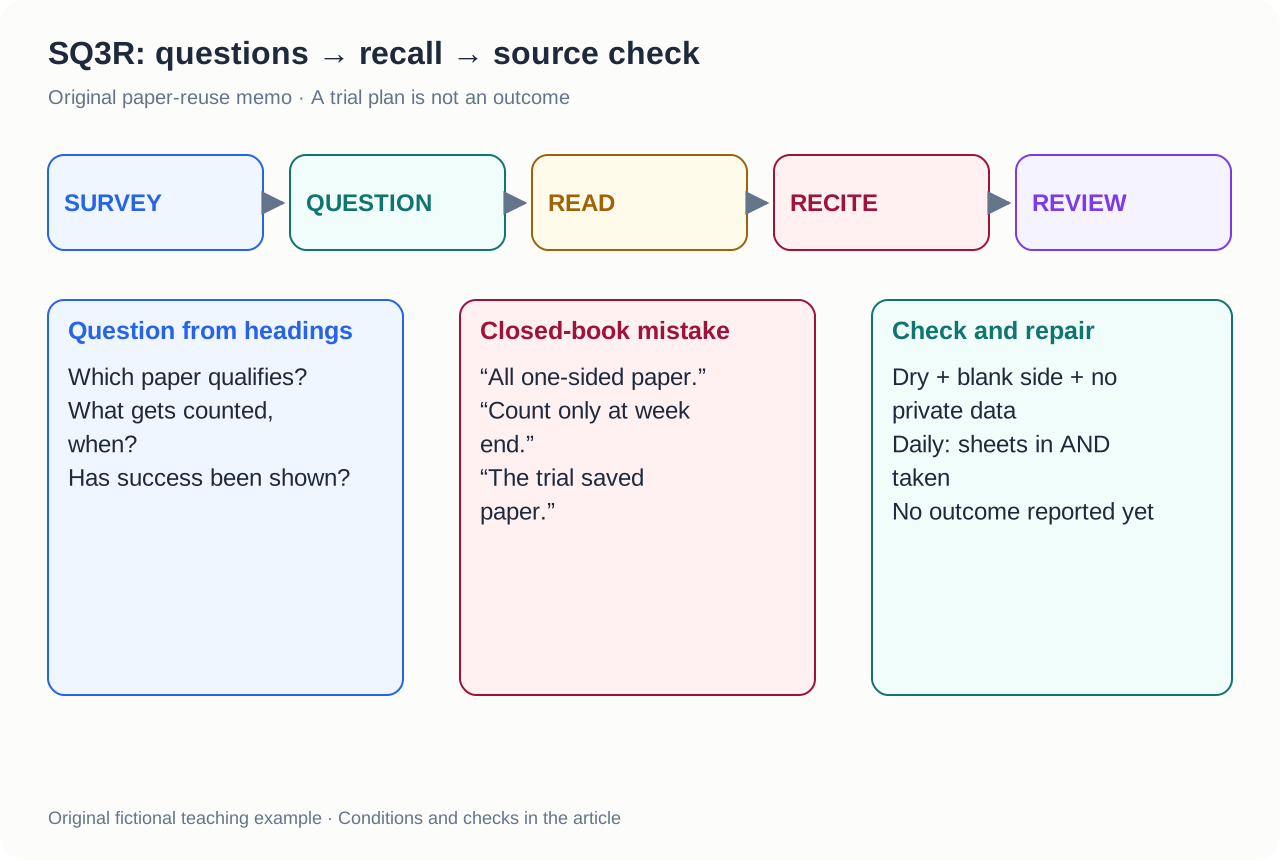
The corrected account can be brief: “The school plans a one-week reuse trial for suitable non-confidential sheets. Volunteers will record daily entries and use, then inspect the records and questions before deciding what to do next.” Add details when the listener’s task requires them.
Schedule a later check with a new case
Choose a later review point that fits the course and task. The next day is one possible planning choice, not a universal interval. Start that check by answering without notes, then use the memo to verify the result.
Try three new cases: a dry sheet with one blank side and no private details; a wet sheet with a blank side; a one-sided form containing personal information. Under the fictional rule, only the first belongs in the reuse tray. Explain the deciding condition for each.
Then ask whether a full tray proves the trial succeeded. It does not: the memo records both entry and use, and the decision also considers users’ questions. A new-case question checks relationships and limits rather than recognition of familiar wording.
For practice that mixes related task types, see interleaving. For explaining one mechanism and probing its gaps, the Feynman technique offers a complementary routine. You do not need to apply every study method to the same page.
Keep notes compact and avoid the common traps
Highlighting can help locate material, but it does not replace an answer to a question. If every sentence is marked, the notes no longer identify what matters. Prefer a few answers with evidence references and a separate uncertainty list.
Another trap is reciting while the source remains in view. Reading a sentence aloud is not the same as retrieving it. Close the material for the attempt and reopen it for checking; keep those two actions distinct.
A third trap is treating review as proofreading a polished summary. Review should test whether the answer is accurate, complete enough for the task and retrievable. It may uncover an assumption, a missing condition or a misunderstanding of what the source actually established.
Choose an appropriate workspace
A page with questions on one side and evidence notes on the other is enough. Cornell notes can support that arrangement, but the layout does not automatically perform Survey, Question, Read, Recite and Review.
On an infinite whiteboard, keep the source structure, question notes, recall attempt and corrections in separate areas. You can organize them manually in CodePic. The article supplies a worked example, not a dedicated worksheet download or an automatic memory assessment.
Before finishing, answer the original reading purpose: can you explain which sheets qualify and how the trial will be checked? If not, identify the exact question that still fails. That gives the next session a clear starting point instead of another unfocused rereading.