The nominal group technique, or NGT, combines individual idea generation with structured sharing, clarification and private prioritization. It helps a group make its preferences visible without relying only on an open conversation. The output is a recorded set of priorities, not proof that the highest-scoring option is objectively best.
This guide runs a complete fictional editorial meeting for a volunteer newsletter. Four people contribute, clarify four options and rank them using an announced point rule. You can inspect every vote, recompute the totals and see how the group turns the result into a limited next action.
Know what the technique contributes
In a free discussion, an early proposal can become the default before quieter participants have formed their own ideas. NGT separates the time for thinking, the time for presenting and the time for evaluating. That separation is the practical feature worth preserving.
ASQ’s method description outlines silent idea generation, turn-taking, clarification and prioritization. The detailed wording and point rule below are our meeting design. They illustrate one implementation, not a claim that every NGT session must use four people or the same scoring scale.
Use it when the question is bounded enough for participants to propose and compare responses. If the team does not understand the problem, first gather information. Asking people to rank guesses can give uncertainty a misleading numerical finish.
Define the question and decision boundary
Original fictional brief: A volunteer repair newsletter has room for one new recurring section next month. What addition should the team test to help beginners attempt a small repair more confidently?
The editor states the boundaries: one section, one month, no paid contributors and no claim that readers will master every repair. Existing safety review remains required. The meeting chooses a section to investigate and pilot; it does not authorize publishing unreviewed technical instructions.
Four fictional participants bring different perspectives: the editor, a volunteer writer, a new reader and the layout volunteer. That is a teaching setup, not a representative survey. Record who is missing from the discussion, because a tidy ranking cannot compensate for an excluded audience.
Give everyone the same question in writing. Clarify what “test” means and which decisions are outside the meeting. Otherwise, one person may rank long-term strategy while another ranks what can be drafted this weekend.
Generate independently before hearing proposals
Allow a quiet period for each person to write ideas. In this example, the facilitator gives five minutes and asks for short proposals describing a reader task. Adjust that period to the group’s needs; speed is not the selection criterion.
The editor writes a beginner glossary. The writer proposes short interviews with experienced repairers. The new reader wants a visual step-by-step example. The layout volunteer proposes a calendar of local practice events. Participants can have additional ideas, but these four become the worked example’s final list.
Do not discuss which idea sounds strongest during this stage. Provide a way to ask a question about the brief without turning the clarification into advocacy for a favored proposal. If the brief changes materially, give everyone time to reconsider independently.
Record ideas one person at a time
Go around the group and collect one idea per turn. Write each in the contributor’s intended meaning. The facilitator can check wording, but should not polish one person’s contribution into an attractive pitch while recording another as a vague fragment.
Give each proposal a stable identifier:
| ID | Proposal | Intended beginner task |
|---|---|---|
| A | A short repair glossary | Understand unfamiliar words |
| B | An experienced repairer interview | Learn how someone approaches a problem |
| C | A visual step-by-step example | Follow one bounded repair process |
| D | A local practice-event calendar | Find a place to learn with others |
Separate recording from debate. If someone has no new idea on a turn, allow a pass. Do not use the number of contributions as a performance score. The point is to create a usable list, not to pressure participants into filling space.
Clarify before asking people to rank
Ask what each proposal includes and excludes. For C, the new reader means one reviewed repair example, with a visible starting condition and checkpoints, rather than an exhaustive repair encyclopedia. For D, the calendar would list verified events, not promise places or instruction quality.
Keep distinct options distinct unless contributors agree that two are genuinely the same. A glossary and an interview may both explain vocabulary, but they deliver different experiences. Combining them just to shorten the ballot would change what people are choosing.
Record remaining uncertainties alongside the list. The team does not yet know the workload for maintaining a calendar or which repair is suitable for a first visual guide. Clarification makes the options understandable; it does not require every feasibility question to be solved before voting.
A useful final check is to ask each person to describe one option in a sentence. If two participants are ranking different interpretations of “visual example,” resolve that difference before the ballot.
Announce the point rule before seeing votes
For this fictional meeting, each person ranks their top three options privately. First receives 3 points, second 2, third 1, and the unranked option 0. Each person therefore allocates 6 points. With four participants, the total across all options must be 24.
This is one explicit rule, not an inherent property of NGT. The team could choose a different scale, but it should announce the scale, what a blank means and how ties will be handled before collecting responses. Otherwise, changing the rule after seeing results can favor a preferred outcome.
Private submission reduces immediate pressure to align with a neighbor, but does not guarantee anonymity. A small group may recognize a person’s choices. Explain what privacy the actual voting method supports, and do not promise anonymity just because participants write silently.
Inspect every vote and recompute the ranking
Here are the invented ballots:
| Participant | A: glossary | B: interview | C: visual example | D: calendar | Row total |
|---|---|---|---|---|---|
| Editor | 3 | 1 | 2 | 0 | 6 |
| Writer | 1 | 3 | 2 | 0 | 6 |
| New reader | 2 | 0 | 3 | 1 | 6 |
| Layout volunteer | 0 | 1 | 2 | 3 | 6 |
| Total | 6 | 5 | 9 | 4 | 24 |
C receives 9 points, followed by A with 6, B with 5 and D with 4. Check the rows and columns before discussing the result. A missing ballot or an extra point can matter in a small group, and the total of 24 provides a simple consistency check.
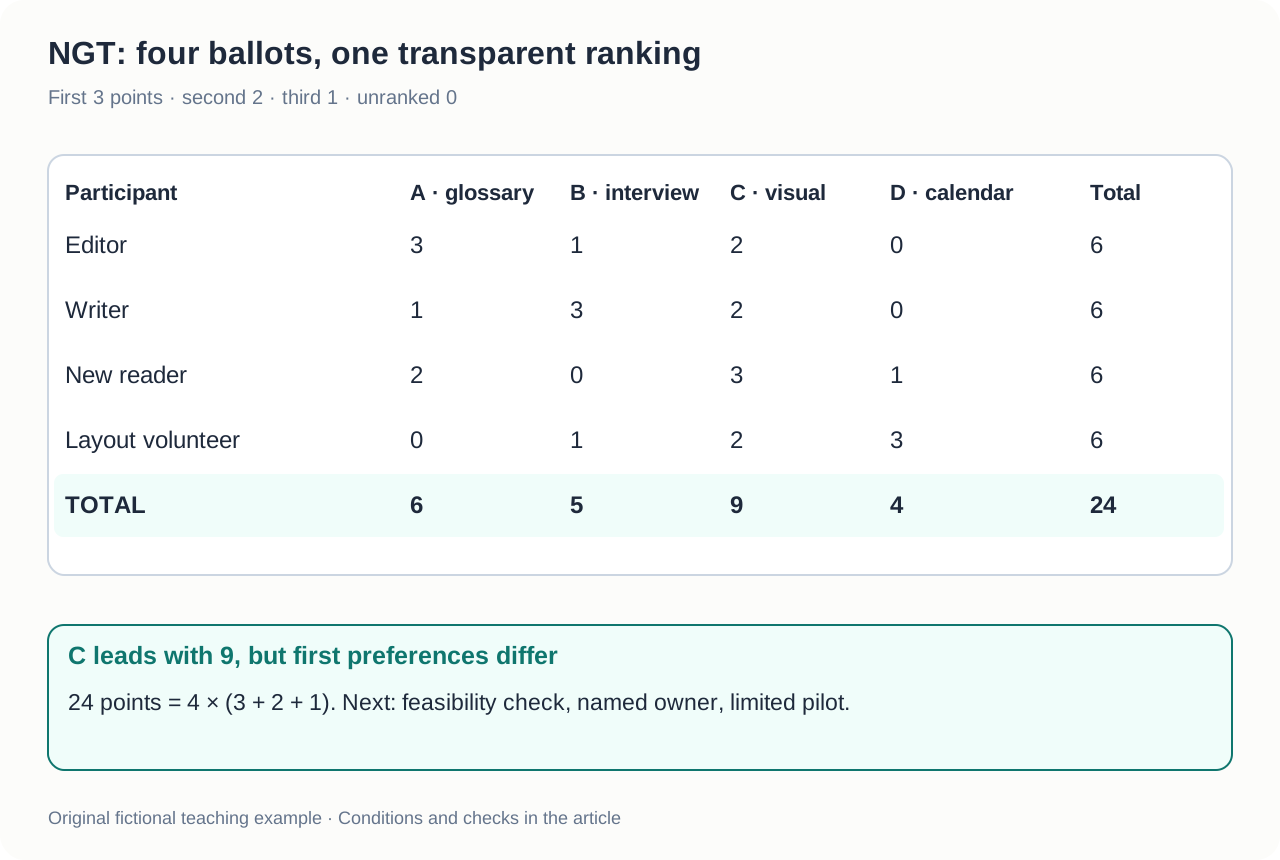
Notice that all four people chose a different first preference. C leads because it receives support across several rankings, not because everyone made it their first choice. Calling the result unanimous would erase that useful distinction.
Turn a preference into a bounded next action
The group selects C for a feasibility check and possible one-month pilot. The editor names a reviewer, the writer scopes a short draft, the new reader tests whether the starting condition is understandable, and the layout volunteer checks whether the visual sequence fits the page.
The point total does not settle safety, cost or editorial accuracy. If the selected idea cannot meet those constraints, the team should document the reason and return to the decision. It should not silently replace C with the editor’s favorite while still claiming that the ranking determined the outcome.
Record the next review question: “Can a beginner identify the starting condition, follow the reviewed sequence and recognize when to stop?” Those checks concern the proposed section’s task. Page views alone would not establish that a repair instruction is usable or appropriate.
Decide how to handle ties and new information
Before a real meeting, state whether a tie triggers further clarification, a limited second ballot or a separate decision rule. Do not invent a tie-breaker based on the result you wish to obtain. Keep the first ballot even if another round follows.
If a material fact emerges after voting, identify which option it changes and let the group reconsider under the announced process. A new estimate of calendar maintenance is relevant to D. A contributor simply repeating their preference more forcefully is not new evidence.
A second ballot is a new round, not an opportunity to overwrite history. Record the changed information, the revised votes and the reason the group reopened the choice. That makes disagreement traceable without pretending the initial result never happened.
Distinguish NGT from nearby methods
Brainwriting emphasizes generating written ideas and potentially building on other people’s entries. NGT includes a structured prioritization stage; it is not just a different label for rotating idea sheets.
A Pugh matrix compares alternatives against a baseline and criteria. NGT’s rankings in this example express participants’ priorities. If the newsletter later compares draft formats on readability, effort and accessibility, a criteria-based comparison may be useful, but it answers a different question.
A Cynefin discussion can help question whether a ranking exercise suits the situation at all. When the problem itself remains unclear, more points on a ballot do not create understanding. Gather observations or narrow the question first.
Keep a usable record on a shared canvas
Set up areas for the question, independently generated ideas, clarified options, ballot rule, results and next action. Keep names out of the public result if your process requires that, while preserving the level of auditability the participants agreed to.
You can assemble the public record with text, shapes and a manually checked table in CodePic. This article does not provide built-in anonymous voting, automatic tallying or a dedicated NGT template. The infinite canvas is a place to keep the reasoning visible.
Leave the meeting with the selected next step, its owner, its constraint checks and a review date. The ranking is valuable because it informs that action while preserving different preferences, not because a number can make the decision unquestionable.