Brainwriting starts with written ideas before discussion. In a 6-3-5 brainwriting session, six participants each write three entries during a five-minute round, then rotate the sheets and build on what others wrote. Six rounds create 108 possible entry slots, not a guarantee of 108 unique ideas.
This guide walks through a fictional board-game club’s welcome problem. You will see one complete 18-entry sheet, the rotation pattern, and a way to choose a small experiment. The examples illustrate the process; they are not results from a real facilitated workshop.
What brainwriting changes about idea generation
Spoken discussion makes contributions depend partly on who speaks first, how quickly someone responds and whether there is space to finish. Brainwriting gives participants an initial writing period and a record that others can revisit.
The University of South Carolina’s facilitation resource describes writing, rotating, building on ideas and reviewing them afterward. Penn State’s indexed method description sets out the familiar six-person, three-entry, five-minute convention. Other versions use different timings and group sizes.
Silent writing does not solve every participation problem. Someone may need more processing time, a different input method or a clearer prompt. Plan those conditions before the session, and do not promise anonymity when names, handwriting or shared-document ownership identify contributors.
Set one question and a few boundaries
Original fictional prompt: How could our weekly board-game club help a newcomer join their first session without interrupting a game already in progress?
Scenario boundaries: The club has one room, no budget for extra staff and a volunteer organizer. New arrivals may come at different times. Any proposal must preserve a way to ask a person for help; do not require a phone to participate.
The task is narrower than “improve the club.” It describes a person, a moment and a difficulty. Ideas about annual membership prices or redesigning every game may be interesting, but they belong in a separate parking area unless they address arrival.
Avoid turning constraints into instructions for one favored answer. “How can a greeter solve this?” already selects a greeter. The open prompt should allow approaches involving timing, information, room layout or a different first activity.
Prepare six sheets and a rotation rule
Give each participant one sheet with the same question at the top, six rows and three entry columns. Label sheets A–F and participants 1–6. These labels organize the exercise; they are not performance rankings.
For the first round, each participant writes on the sheet in front of them. After five minutes, everyone passes their sheet in the same agreed direction. They read existing entries and add the next row. Continue for six total rounds: the initial round plus five rotations.
| Round | Sheet A’s contributor | What happens |
|---|---|---|
| 1 | Participant 1 | Writes three starting entries |
| 2 | Participant 2 | Reads and adds three entries |
| 3 | Participant 3 | Extends or varies the options |
| 4 | Participant 4 | Adds another perspective |
| 5 | Participant 5 | Builds further alternatives |
| 6 | Participant 6 | Completes the final row |
The other sheets move at the same time. At the end, each sheet contains up to 18 entries. Six sheets therefore have up to 108 slots: 6 participants × 3 entries × 6 rounds. Reading time is part of the round, so a facilitator may need to adapt the timing for the group.
One complete example sheet
The following is fictional sheet A, not the entire output of a six-person session. It shows how ideas can develop rather than remain six independent lists.
| Round | Entry 1 | Entry 2 | Entry 3 |
|---|---|---|---|
| 1 | Put a welcome sign near the door | Name a rotating greeter | Offer a short starter game |
| 2 | Show where to wait on the sign | Give greeter a visible badge | Keep starter game under ten minutes |
| 3 | Add the next likely joining time | Let one backup cover the greeter | Use a game that can pause easily |
| 4 | Mark the waiting seat clearly | Give greeter three opening questions | Let two newcomers learn together |
| 5 | Explain that waiting is optional | Ask about preferred game complexity | Keep a one-page example turn nearby |
| 6 | Check that the sign is readable from entry | Offer a quiet way to ask for help | Let newcomer choose watching or playing |
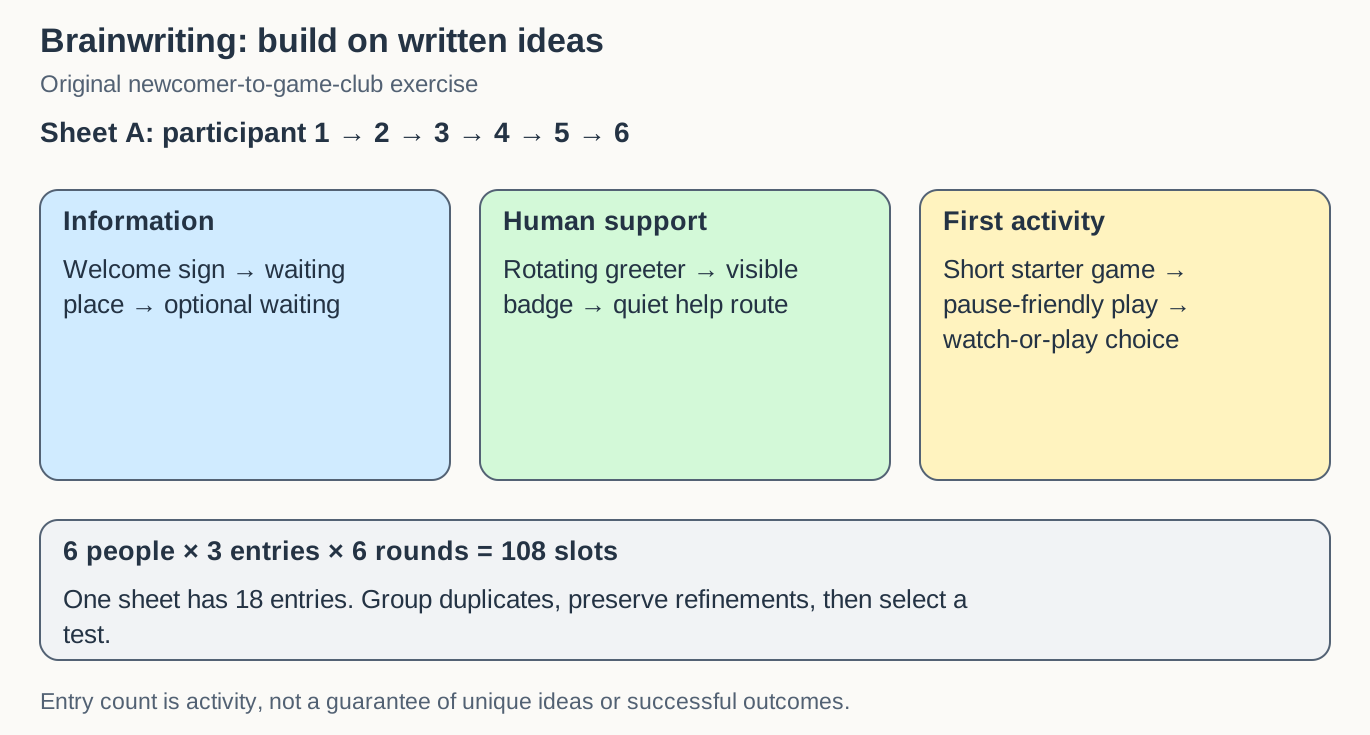
Notice that “visible badge” refines “rotating greeter”; it is not an entirely unrelated invention. “Waiting is optional” challenges an assumption in the sign-and-seat thread. Those contributions can be useful even though they do not increase the number of independent concepts.
The table is an example of finished entries, not a script participants must reproduce. In a real session, incomplete cells and duplicate suggestions are information about how the exercise went. Do not quietly fill them afterward and describe the result as everyone’s original contribution.
Facilitate the silent rounds
Explain what counts as a usable entry
An entry should name an action, object or arrangement that another reader can understand. “Be welcoming” expresses a value but not a proposal. “Offer the choice of watching one round before joining” gives the next participant something specific to develop.
Encourage additions that build, combine or question assumptions. Participants do not have to invent an unrelated idea in every cell. If a contribution responds to an earlier entry, keep that relationship visible with a short reference rather than overwriting the original.
Keep discussion out of the writing period
Use the agreed signal to rotate. Avoid a spoken pitch after every round, which can turn the activity back into a contest for attention. Clarifications about instructions are fine; substantive evaluation belongs after everyone has had writing time.
If someone is stuck, invite a different perspective rather than demanding three clever answers. They might consider a person arriving late, someone who does not want to announce themselves publicly, or a newcomer unfamiliar with the games. Those are prompts to explore, not claims about actual attendees.
Preserve the record
Do not erase an earlier idea because a later participant disagrees. Add the concern or alternative. The sequence lets the group distinguish the initial proposal from later refinements and understand what led to the current option.
For a remote version, agree who writes where and how material moves before the timer starts. A shared whiteboard can hold manually labeled sheet areas, but check the actual tool capabilities. Do not assume automatic rotation, private writing areas or anonymity merely because the surface is digital.
Review without treating every entry as a separate proposal
Collect the sheets and allow time to read. Group entries by the task they address: arrival information, human support, and a low-pressure first activity. A general affinity diagram can support this sorting step.
Keep an idea’s important differences when merging it. “Wait in a seat” and “choose watching or playing” are not identical; the second adds agency. A category that simply says “welcome” may hide that distinction.
Now compare candidates against the original question and constraints. A rotating greeter may help but requires reliable coverage. A starter game may help only if someone can teach it without abandoning their current game. A sign cannot replace the promised person-to-person help route.
Select one experiment and define what to learn
Suppose the fictional club chooses a volunteer greeter plus a short choice between observing and a starter game. Assign an organizer to confirm coverage and a backup before trying it at one session. Keep the trial limited and do not change the whole club at once.
Record whether a newcomer can find a person to ask, what happens when the greeter is busy, and whether an ongoing game needs to stop. Ask participants what remained unclear. These observations address the prompt more directly than counting how many notes appeared on the board.
The trial may reveal that the greeter arrangement is impractical. That does not invalidate the written exploration; it provides evidence for choosing or adapting another option. If the main difficulty is implementation resistance, use force field analysis after selection.
Brainwriting, brainstorming and SCAMPER
Brainwriting changes the initial contribution method. Brainstorming can include spoken exchange. SCAMPER supplies lenses for changing an existing idea. You can combine SCAMPER prompts with silent writing, but explain the combined procedure rather than present it as the only standard method.
A brainstorm board can hold the question, sheets and selected experiment. Label the manual rotation order clearly. The board is an organizing surface, not a dedicated 6-3-5 generator that promises to manage participants or produce validated ideas automatically.
Finish by naming the selected option, its unresolved assumptions, an owner and a review point. The quantity of entries is a record of activity. The useful outcome is an idea developed far enough to inspect and a practical next step for learning whether it helps.
Rehearse the handoff before starting
Before the timed rounds, ask everyone to write one sample entry and have the next person explain it back using only the text. If the explanation differs, improve the entry’s specificity before beginning. This catches an unclear question or abstract wording before six rounds amplify it.
Do one practice pass so everyone knows which row to use and which direction the sheets move. When adapting the participant count or timing, restate the total rounds and expected slots. Describe the adaptation honestly instead of claiming that a different procedure completed the standard six-round exercise.