The Cynefin framework helps a team decide which kind of response fits its current situation. A repeatable procedure, an expert investigation, a small exploratory intervention and an urgent stabilizing action are different responses. Applying the same one everywhere can create trouble even when the team executes it well.
This guide follows an original fictional community workshop facing five different problems. You will build an action-and-evidence record, see why “complicated” and “complex” require different thinking, and revisit an initial judgment when circumstances change. The examples are learning material, not validated assessments of real organizations.
Start with context, not a preferred solution
The Cynefin Company presents the framework as support for making decisions in context. Its official wiki stresses that approaches have boundaries: a useful response in one situation may be unsuitable elsewhere. Treat the framework as a way to question your choice of approach, not as a machine that produces the right answer.
For an introductory working vocabulary, distinguish clear situations with an established relationship, complicated situations needing analysis, complex situations requiring interaction to learn, and chaotic situations needing stabilization. Confusion means you have not yet established what sort of situation you face; it is not another name for chaos.
The domains reference also discusses transitions and liminal states. The introductory examples below do not reproduce that full architecture or replace training. Our diagram is an original decision record, not a redrawing of the official framework image.
A workshop with several different problems
Imagine a community repair workshop staffed by volunteers. It has a booking desk, shared benches, a weekly introductory session and a small supply cupboard. The team wants to improve next month’s operation, but its list mixes very different issues.
A missing booking number can be resolved by checking a known register. A recurring scheduling conflict needs someone to examine several linked constraints. Low attendance may depend on how people interpret and respond to an invitation. A live disruption can require an immediate pause before anyone has a satisfactory explanation.
Do not call the entire workshop “complex” and stop there. Write separate questions at the smallest useful level. The way to handle one desk transaction may be well established while the way to build trust with newcomers remains uncertain. A single organizational label hides that difference.
Clear: apply a known rule and watch its boundary
Fictional issue: Someone arrives for a booked beginner session but cannot remember the bench number. The booking register lists their name, time and bench. There is one matching record, and the desk volunteer has permission to check it.
The team can look up the record, confirm the match and point the person to the correct bench. A short checklist is appropriate because the necessary relationship is already established. Requiring a fresh brainstorming session would make a routine task harder without improving the result.
Write down the exception that stops the procedure: two matching names, an absent booking or a register that no longer reflects the room. In those cases, the volunteer should not invent certainty. Escalate the mismatch and check what changed. The existence of a checklist does not make every future arrival a clear case.
The useful output is a small instruction with an exception route. Measure whether the record and room agree, rather than celebrating how quickly someone follows a procedure whose assumptions are no longer true.
Complicated: investigate a discoverable relationship
Fictional issue: Two sessions repeatedly need the same workbench at the same time, although the planning sheet appears to avoid overlaps. The team has booking records, equipment requirements and setup times, but no one has compared them carefully.
An experienced coordinator investigates. They discover that setup occupies the bench before the public start time and cleanup occupies it afterward. The timetable only checked the advertised session times. The conflict is explainable once the hidden occupancy intervals are included.
The response is to analyze those intervals, revise the allocation and test it against several past clashes. Expertise is useful here because the relevant relationship can be investigated. Voting on which start time feels better would not repair the missing setup and cleanup constraints.
Keep the evidence that supports the diagnosis: which records were checked, what interval was missing and which other explanation was ruled out. If the revised model cannot account for the clashes, return to investigation rather than treating the first expert answer as final.
Complex: learn through bounded interaction
Fictional issue: Newcomers register but rarely return for a second workshop. The volunteers have several plausible explanations: an intimidating welcome, inconvenient timing, uncertainty about what to bring, or simply different expectations. Changing the welcome may also change who attends and how regular members behave.
The team cannot establish a dependable answer by making the planning spreadsheet more detailed. It proposes two modest, reversible trials on different sessions: a short arrival conversation led by a named volunteer, and a plain pre-session message explaining what a beginner can expect. Participants retain the usual way to ask for help.
Before either trial, write what the team will observe. Useful signals include questions asked on arrival, accounts of whether people felt able to participate, and whether the next visit felt easier. Attendance totals can add context, but a small fluctuation does not establish a cause.
Set boundaries as carefully as the intervention. Use a limited number of sessions, a named owner, a review date and a condition for stopping if people feel pressured. Do not call an experiment safe merely because it is cheap. It must be acceptable for the people affected and manageable if it fails.
The result might support extending one practice, changing it or abandoning both. That is a learning outcome, not proof that every future newcomer will respond similarly. Preserve contradictory accounts instead of averaging them into a neat success story.
Chaotic: restore enough order to investigate
Fictional issue: During setup, contradictory last-minute room assignments spread through the team, several volunteers begin moving the same materials, and nobody knows which instruction is current. Normal coordination has stopped working.
The coordinator temporarily pauses the moves, names one communication point and establishes which room assignments are currently in force. The immediate objective is to stop uncontrolled conflicting action, not to settle every underlying scheduling question during the disruption.
Once the situation is stable enough, separate the remaining issues. The scheduling logic may need expert analysis. The way instructions are communicated may need small trials. Some routine checks may be ready for a clear procedure. Stabilization changes what becomes possible next; it is not a permanent management style.
This low-stakes coordination example illustrates a response distinction. It is not an emergency-response protocol. For situations involving actual hazards, the applicable safety procedures and responsible personnel take precedence over an introductory management exercise.
Confused: do not force one label onto the whole issue
Fictional issue: A volunteer reports, “The workshop is failing because our system is bad.” That statement mixes missing bookings, attendance concerns, staff disagreements and one disrupted setup. The team does not yet have a shared description of the problem.
Ask people to describe specific incidents: what happened, what they expected and what they observed. Split the report into smaller questions and compare the accounts. Some parts may be handled with an existing instruction; others need investigation or exploration.
Avoid deciding by majority vote that the entire situation belongs in one domain. A vote can reveal participants’ judgments, but it does not turn an unknown causal relationship into a known one. Keep a temporary “not established” entry where necessary, with a next step for obtaining evidence.
Keep a decision record that can change
Use a record with five fields rather than placing every issue permanently into a box. The aim is to preserve the connection between an observation, a current interpretation and a response that can be reviewed.
| Issue | Current basis | First response | Review evidence |
|---|---|---|---|
| Forgotten bench number | One matching register entry | Apply lookup procedure | Does the room match the record? |
| Hidden bench clash | Occupancy intervals can be checked | Investigate setup and cleanup | Does the corrected model explain past clashes? |
| Newcomers do not return | Several interacting explanations | Run bounded welcome trials | What changes in participant accounts and behavior? |
| Conflicting live moves | Coordination is temporarily ineffective | Pause moves and establish one instruction point | Is coordinated work possible again? |
| “The whole system is bad” | Several different incidents combined | Separate accounts and questions | Which parts now have enough evidence? |
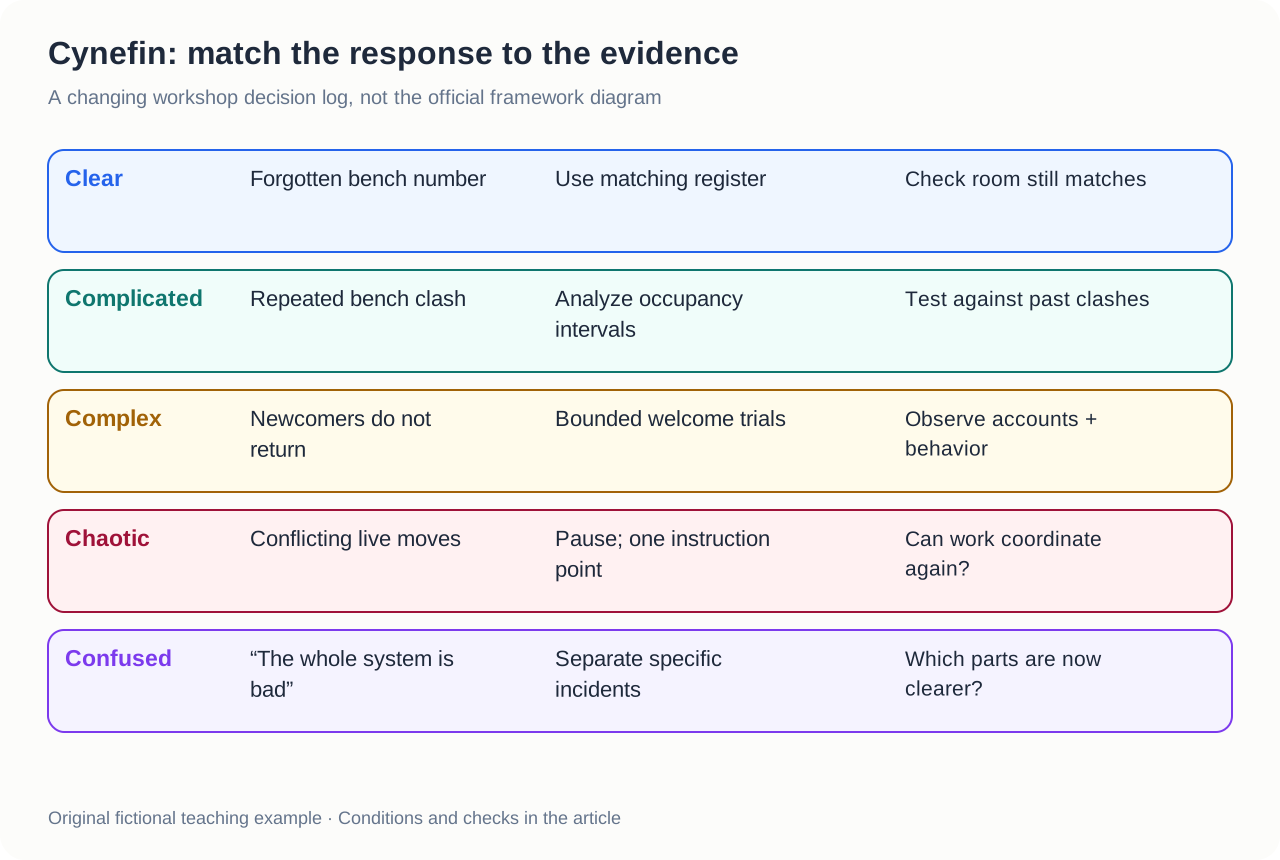
Add an owner and a date to each row. If new evidence undermines the basis, change the response as well as the wording. Keeping the old entry helps the team understand why its approach changed instead of presenting hindsight as something it knew all along.
Recognize the common mistakes
“Complicated” does not mean a situation is merely large, and “complex” does not mean nobody has worked hard enough. In the workshop, adding more timetable analysis helps the occupancy conflict. It does not guarantee an explanation for people’s changing sense of belonging.
Another mistake is calling every small change a meaningful experiment. A trial needs a question, an observable signal, boundaries and a review. Repeating a favored initiative without considering failure teaches little. Record what would make you stop or revise it before the result arrives.
A final mistake is to let yesterday’s success become a universal rule. A welcome conversation that helps one group may feel intrusive to another. Even a clear procedure needs an exception route. Review the conditions under which a practice worked, not just the fact that it once worked.
Connect the framework to a practical next action
A Pugh matrix can compare defined alternatives against criteria when that comparison fits the problem. A nominal group session can collect and rank participants’ priorities. Neither establishes by itself what kind of context the group faces.
For the workshop, begin with one unresolved issue and build the five-field record on an infinite whiteboard. In CodePic, you can arrange text, shapes and links manually, then return to the record after the action. This article does not supply an official Cynefin assessment, certification or automatic domain classifier.
The next meeting should answer a concrete question: what did the team observe that changes its choice of response? If nobody can point to that evidence, preserve the uncertainty and define a smaller investigation. The value of the record lies in helping the team change its approach when the situation calls for it.