A Pugh matrix compares alternatives against a reference option, called the baseline or datum. For each criterion, record whether an alternative is better, about the same or worse than that reference. The useful work is defining the criteria and justifying the comparisons; the total is a summary of those judgments.
Below, a fictional volunteer photography club compares ways to carry a small demonstration kit. You will build the baseline comparison, check both unweighted and weighted totals, and see how a changed priority alters the conclusion. The scores are invented teaching judgments, not product-test results or buying advice.
Define the decision before making a table
The club already uses a simple bag. It is considering a zip case, a soft tote and a rigid box. The decision is which concept deserves a practical prototype check for walking between two nearby rooms, not which commercial product to purchase.
Oakland University’s explanation describes comparing alternatives against a baseline, using positive, neutral and negative judgments and optionally weighting criteria. Our club example supplies its own assumptions, ratings and checks. It is not an engineering validation.
Write the decision’s boundary beside the table. The kit contents, route, user and carrying conditions must stay comparable. If one alternative assumes a much smaller kit, it is answering a different question. A precise-looking score cannot repair an inconsistent comparison.
Separate requirements from preferences
Before comparing trade-offs, identify requirements that every candidate must meet. In a real project, these might concern safe handling, capacity or access needs. An option that fails an essential requirement should not earn its way back through unrelated positive points.
For the fictional exercise, assume all four concepts fit the same small kit and pass the club’s basic handling requirements. Those are stipulated assumptions, not measured facts. A real team would need to check them before interpreting the matrix.
The table then compares preferences among feasible concepts. This separation prevents a comfortable handle from numerically compensating for a missing essential closure. Keep the requirement checks outside the preference total and show unresolved requirements as unresolved.
Choose a meaningful baseline
The current bag is the baseline because club members understand it and can compare a proposed change against it. Its scores are zero by definition in this relative table. Zero does not mean the bag has no comfort, no access or no value.
A baseline should be described clearly enough that participants imagine the same thing. Note its configuration and use conditions. If one person pictures an empty bag and another pictures the full kit, their judgments will not be comparable.
You can choose another reference for a reason, but record the change and rebuild the comparisons. Do not simply shift a column heading while retaining judgments made against the old reference. Relative ratings depend on what they are relative to.
Write criteria with a consistent direction
The club uses four criteria: carrying comfort, ease of access, repairability and protection from light splashes. “Better” means more desirable for the same task in every row. For a cost criterion, lower cost might be better; define that direction explicitly.
Avoid counting nearly identical concerns twice. “Easy to carry” and “comfortable handle” may overlap, depending on the task. If both remain, explain the distinction. Otherwise, one preference receives extra influence simply because it has two names.
| Criterion | What the comparison asks |
|---|---|
| Carrying comfort | Is carrying the same kit on the same route easier? |
| Ease of access | Can the user reach the needed item with less disruption? |
| Repairability | Can a worn part be repaired more readily? |
| Splash protection | Does the concept better protect the same contents under the stated light-splash condition? |
These questions need operational detail in a real evaluation. The exercise keeps them short so you can inspect the arithmetic; it does not turn an opinion into a physical measurement.
Make the relative judgments visible
Use +1 for better, 0 for about the same and −1 for worse than the current bag. Blank means not assessed, not zero. Keep a note explaining the basis of each judgment, especially when participants disagree.
The following ratings are fictional assumptions:
| Criterion | Current bag | A: zip case | B: soft tote | C: rigid box |
|---|---|---|---|---|
| Carrying comfort | 0 | +1 | 0 | −1 |
| Ease of access | 0 | +1 | −1 | 0 |
| Repairability | 0 | −1 | +1 | 0 |
| Splash protection | 0 | 0 | +1 | +1 |
| Unweighted total | 0 | +1 | +1 | 0 |
A has two positive entries and one negative entry, so its total is 1. B also totals 1. C has one negative and one positive entry, totaling 0. The unweighted table does not separate A and B.
For this invented scenario, the team assumes A’s layout improves access but makes a worn component harder to repair. That explanation is part of the fictional input. Before relying on it in practice, participants should inspect a prototype or obtain suitable evidence.
Add weights only when their meaning is agreed
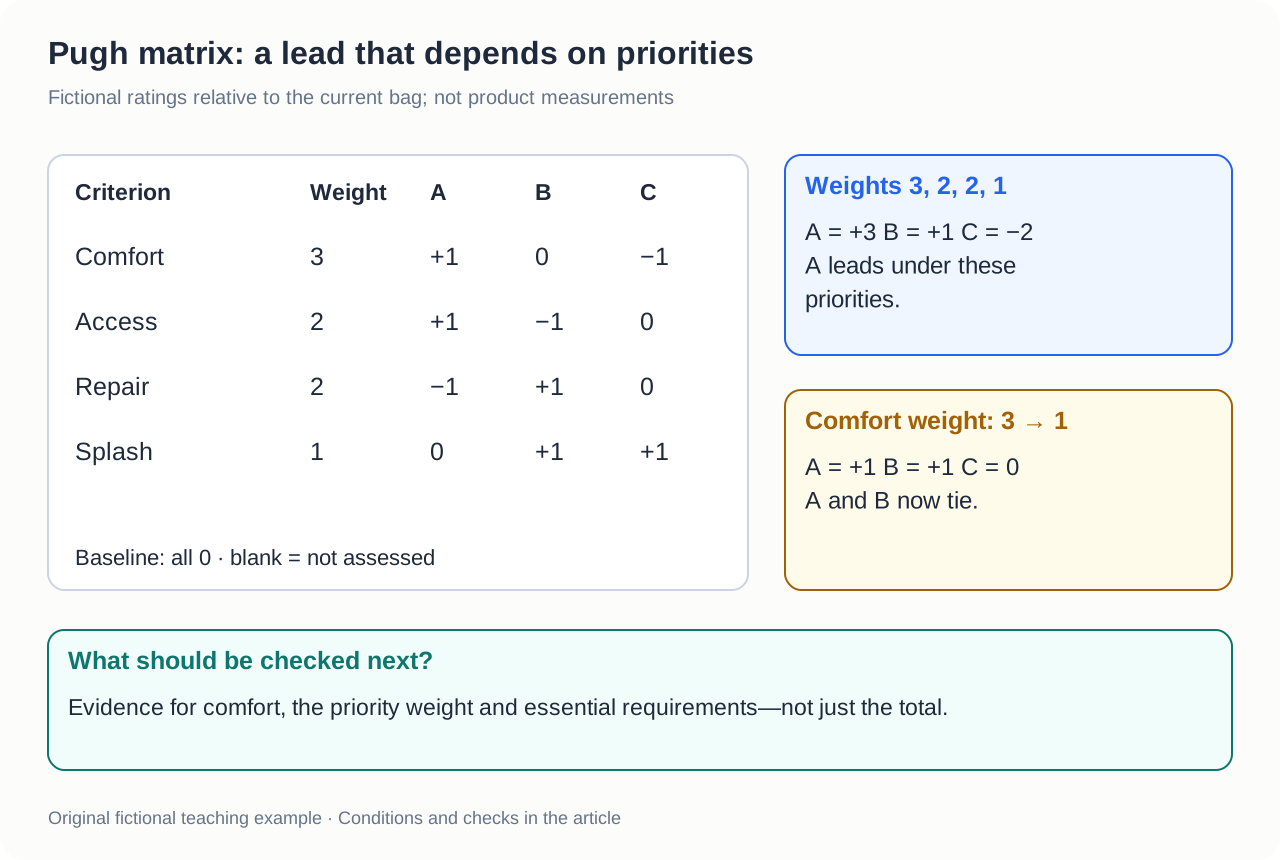
Suppose the club assigns weights of 3, 2, 2 and 1 to the four rows, respectively. Carrying comfort matters most for this use case. The weights express the team’s chosen priorities; they are not measurements discovered inside the bag.
Multiply each rating by its row weight and add the products:
| Criterion | Weight | A contribution | B contribution | C contribution |
|---|---|---|---|---|
| Carrying comfort | 3 | +3 | 0 | −3 |
| Ease of access | 2 | +2 | −2 | 0 |
| Repairability | 2 | −2 | +2 | 0 |
| Splash protection | 1 | 0 | +1 | +1 |
| Weighted total | +3 | +1 | −2 |
For A, the calculation is 3 + 2 − 2 + 0 = 3. For B, it is 0 − 2 + 2 + 1 = 1. For C, it is −3 + 0 + 0 + 1 = −2. Under these particular assumptions and weights, A leads.
A weighted total of 3 is not three times the quality of a total of 1. The signs are coarse relative judgments, and the weights are priorities. Avoid interpreting this simple scoring convention as a calibrated performance scale.
Test how fragile the ranking is
Now reduce the comfort weight from 3 to 1 while leaving the other weights unchanged. A becomes 1 + 2 − 2 + 0 = 1. B stays 1. C becomes −1 + 0 + 0 + 1 = 0.
The apparent lead disappears: A and B tie. That is useful information. The choice depends on how much emphasis the club gives carrying comfort, so the next discussion should examine that priority and the evidence behind A’s comfort advantage.
Do not change weights until the favored option wins and then call the result objective. Record the original and revised cases. If a small plausible change reverses a choice, consider additional investigation or a limited prototype comparison before committing resources.
Uncertain ratings deserve a similar check. If the team does not know whether A is genuinely easier to carry, mark the uncertainty and identify an observation that would resolve it. Do not hide the question by entering zero, which means “about the same” in this table.
Use the matrix to improve concepts, not only eliminate them
The table can reveal a design question: can the club keep A’s access layout while improving the part that is hard to repair? That question is more actionable than declaring B a loser and forgetting why it scored well.
A hybrid is a new concept, however. It does not inherit every positive rating automatically. Changes may introduce new trade-offs, so assess it against the same baseline and criteria. Label new assumptions and retest essential requirements.
Preserve the discarded alternatives and reasons while the decision is active. A different route, user or kit may change the relevant criteria. That history helps future readers reuse the reasoning without assuming that the current winner is best for every context.
Distinguish a Pugh matrix from other decisions
“Decision matrix” is a broader label used for several scoring arrangements. This example specifically uses better/same/worse comparisons against a baseline. A table of independent 1–5 ratings may be useful, but it should not be treated as identical without explaining its scale.
Nominal group technique collects and prioritizes participants’ ideas. Its ballots express preferences rather than the per-criterion relative ratings shown here. A decision tree describes branches and consequences, which is another different task.
If the relationship between an intervention and its result is not established, question whether static comparison is enough. The Cynefin examples illustrate why some situations require investigation or bounded interaction before a confident choice among alternatives.
Build a working record and plan the next check
Keep the brief, requirements, baseline description, criterion definitions, ratings, evidence notes, weights and sensitivity check together. The next action should target the assumption most likely to affect the choice, not simply produce another version of the same table.
You can arrange that record manually in CodePic, using a table or aligned shapes and text. No automatic calculation is claimed here; recompute totals yourself or use an appropriate calculation tool. This article does not provide an Excel file, Google Sheets download or dedicated editable Pugh template.
For the club, A is a candidate for a prototype check under the original weights, while A and B deserve comparison when comfort matters less. Write who will check the uncertain judgments and when the team will revisit them. That makes the matrix a transparent part of the decision instead of a numerical decoration after the choice has already been made.