The jigsaw teaching strategy divides a shared learning task into connected parts. Learners first prepare one part with an expert group, then return to a home group where each member teaches their contribution. The home group needs the combined information to complete its task; it is more than splitting a worksheet into unrelated jobs.
This guide plans an original fictional reading-evening activity for sixteen learners. It includes home and expert group assignments, four short information packets, a combined group answer and individual checks. The people and event rules are teaching inputs, not a real event plan or classroom study.
Begin with an outcome that requires all the parts
The Penn State Jigsaw Strategy guide describes home groups sending members to expert groups and bringing their learning back. It emphasizes preparation and shared responsibility. Our example uses that structure with a specific integrated planning question.
Ask learners to produce one workable reading-evening outline using room, time, access and staffing information. If a group can finish by reading only the timing packet, the other members’ work is decorative. Design the final questions so each contribution matters.
Keep the learning goal visible: students must combine constraints, explain a decision and trace it to the relevant packet. The teacher is checking synthesis and communication, not whether students can act as professional event organizers.
Assign sixteen learners without ambiguous movement
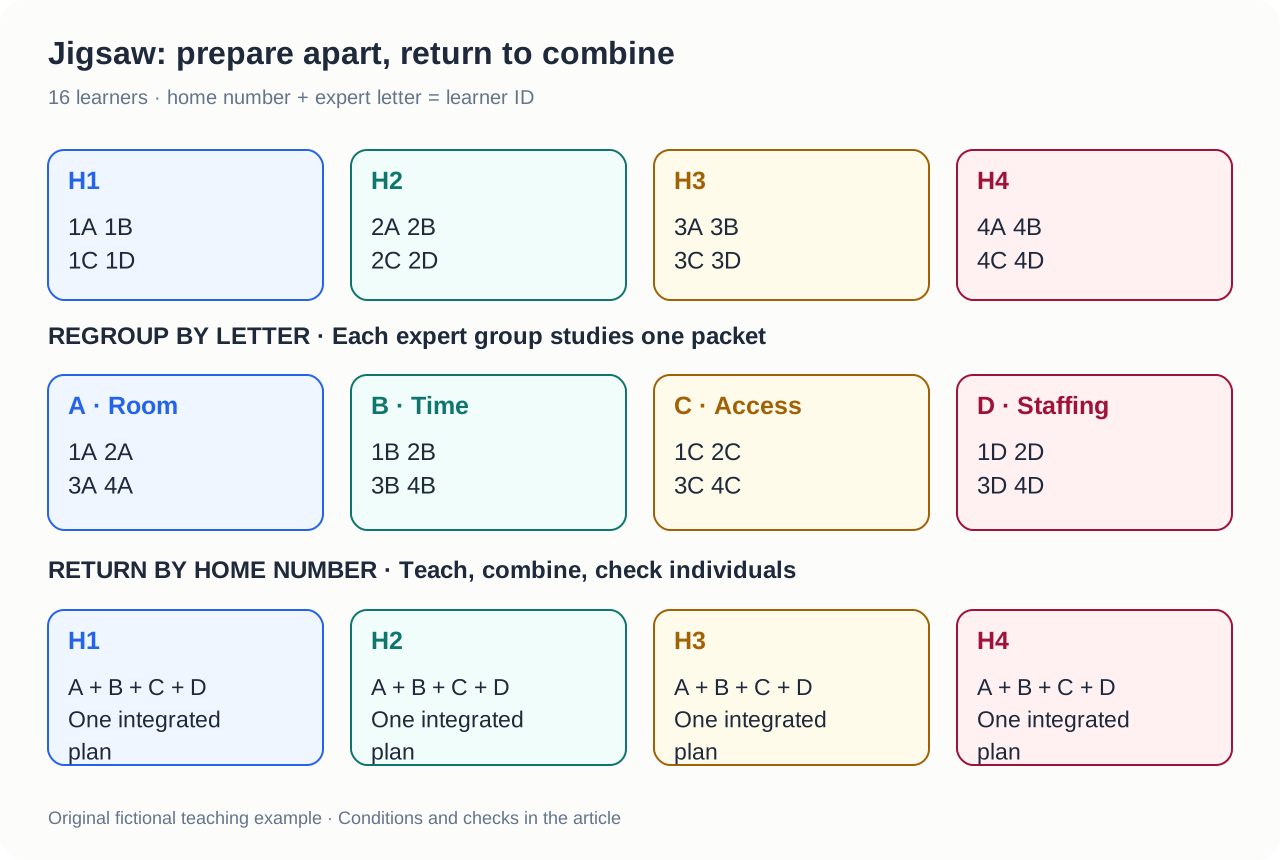
Create four home groups, H1 to H4, each with four learners. Within each home group, assign topics A, B, C and D. Label a learner by home number plus topic, so 2C means the access-topic learner from home group H2.
| Home group | Room expert A | Time expert B | Access expert C | Staffing expert D |
|---|---|---|---|---|
| H1 | 1A | 1B | 1C | 1D |
| H2 | 2A | 2B | 2C | 2D |
| H3 | 3A | 3B | 3C | 3D |
| H4 | 4A | 4B | 4C | 4D |
The expert groups are therefore A: 1A, 2A, 3A, 4A; B: 1B, 2B, 3B, 4B; C: 1C, 2C, 3C, 4C; and D: 1D, 2D, 3D, 4D. Each group has four people studying the same packet.
After expert work, everyone returns to their original home group. Do not send learners to a second new group by accident. Put both assignments on a visible movement record and check that each home group will receive all four topics.
Prepare four short original packets
These packets describe a fictional school reading evening. Treat their numbers and arrangements as given classroom assumptions, not venue-capacity, access or safety guidance for an actual event.
Packet A — Room: The activity uses one library room with thirty chairs. The entrance is beside a small information desk. A presentation area is at the front. The exercise requires a clear route from the entrance to the seating and does not permit storing book boxes in that route.
Packet B — Time: Welcome runs from 18:00 to 18:10. Shared reading runs from 18:10 to 18:35. Questions end at 18:45, and participants leave by 18:50. The five minutes after questions are reserved for leaving, not an extra presentation.
Packet C — Access: A large-print summary is prepared in advance. A quieter seating area should be available away from the main presentation position. Visitors can contact the organizer about participation needs beforehand; the outline should not claim that one arrangement meets every possible need.
Packet D — Staffing and materials: Four volunteers cover the information desk, reading, materials and a floating support role. Twenty printed booklets are available. A digital version can supplement them, but a phone must not be the only way to follow the activity. Materials should be distributed before shared reading begins.
The parts differ because the integrated decision needs different information. Keep their reading burden reasonable and provide support where vocabulary or complexity differs. Equal word counts alone do not make packets equally demanding.
Give the expert groups a preparation product
Each expert group prepares three things: a brief explanation in its own words, two facts the home group must use, and one question that tests understanding. Require a reference to the packet so a confident paraphrase does not silently change a rule.
For B, the explanation could be: “The reading lasts twenty-five minutes, but the final five minutes of the event are for leaving. We cannot extend questions until 18:50.” Its check question is: “Can we schedule another demonstration after 18:45?”
For D, the group should notice the mismatch between thirty chairs and twenty printed booklets without inventing ten extra copies. Possible responses include sharing available print material appropriately, preparing another non-phone option or confirming an adjusted attendance arrangement. The final plan must say what remains to be resolved.
Ask experts to rehearse the explanation with one another. A learner should be able to teach the point and answer a basic question, not merely carry a sheet back. The teacher can inspect preparation and repair a misconception before it spreads to four home groups.
Return home and teach in structured turns
Back in H1 to H4, each member explains their packet while the others record the key constraints and ask a question. Keep the packet available for checking. The expert is a prepared contributor, not an unquestionable authority.
Give listeners a task: after the explanation, paraphrase one fact and explain how it affects the group outline. For C, a listener might say, “We should not place the quieter seating beside the main speaker.” That connects the information to an actual choice.
Do not let the most confident learner take over all four topics. The teacher can ask a listener to explain what they just learned, giving feedback without turning the return phase into another teacher lecture. Preserve time for questions rather than rushing through four monologues.
Combine the information into one accountable answer
The final product is a short outline with a source reference for each decision. It should explain how the parts interact, not paste four packet summaries under separate headings and call that synthesis.
| Planning choice | Packet connection | Why it matters |
|---|---|---|
| Put materials near the desk, outside the entrance route | A + D | Distribution is ready without blocking the stated route |
| Offer material before 18:10 | B + D | The reading can start without using its time for distribution |
| Keep quieter seats away from the presentation area | A + C | Room placement supports the stated participation option |
| Stop questions at 18:45 | B | The leaving period remains available |
| Resolve the booklet shortfall before confirming the outline | A + D | Thirty chairs do not create thirty printed copies |
A fictional group answer might reserve the desk for welcome and materials, place quieter seats toward the side away from the presentation, and keep the floating volunteer available for support. It also flags the print-material shortfall as unresolved rather than claiming that digital access solves it for everyone.
That final uncertainty is a strength when it follows the evidence. A plan that looks complete by inventing missing resources is weaker than one that explains the next question. The teacher can ask what decision must be confirmed before the event outline is treated as ready.
Check what individuals learned from other experts
A group product can conceal uneven understanding. Ask each learner to answer a question from a packet other than their own, then explain a connection between two parts. Keep the question tied to the material rather than testing trivia.
For example, ask a room expert why the booklets should be distributed before 18:10, or ask a time expert why a phone-only resource plan is inadequate under packet D. They should use information learned from peers, not only repeat their original specialty.
An individual exit response might identify one resolved decision and one remaining uncertainty. The teacher can compare those answers with the shared outline and decide which topic needs clarification. Do not infer individual learning solely from a polished group page.
Plan for absence and uneven preparation
If learner 3D is absent, expert group D has three people and home group H3 lacks its own D member. Make that gap visible before the return phase. Do not send the group home with missing information and hope the strongest student invents it.
A prepared D learner can provide a short teaching visit, or the teacher can arrange an appropriate supported explanation and packet access. Choose a manageable solution and preserve individual checking. Simply handing over a completed answer may supply information without the intended peer-teaching process.
If one packet proves much harder, add support, reduce its scope or allow preparation time before the session. If an expert group has misunderstood a key constraint, correct it before the home groups rely on it. Unequal readiness is an instructional issue, not something a grouping diagram fixes automatically.
Distinguish jigsaw from other cooperative routines
Think-pair-share develops a response through a partner conversation. Everyone can work from the same prompt. Jigsaw distributes different material and makes the home group depend on contributions from several prepared members.
Reciprocal teaching organizes shared reading through prediction, questioning, clarification and summary. Its roles describe reading moves, while this jigsaw’s topics describe different information to learn and teach. The two structures are not interchangeable labels for any group discussion.
A lesson plan should specify the material, preparation, movement, teaching task, integrated output and individual check. Build those decisions before choosing a decorative activity layout.
Record assignments and learning on the whiteboard
Keep the home-group roster, expert assignments and return route visible. Add areas for packet references, the combined answer and remaining questions. A learner should be able to locate both where to go and what they need to bring back.
You can build this record manually in CodePic using text and grouped shapes on an infinite canvas. This guide does not claim automatic grouping, attendance handling or a dedicated downloadable organizer.
Finish by checking whether every home group used all four contributions and whether individuals can explain something they learned from another expert. Those checks tell you whether the jigsaw structure supported the intended learning, rather than merely moving sixteen people around the room.