Think-pair-share gives learners time to form an individual response, discuss it with a partner, and bring a contribution to a wider discussion. The three phases do different work. If the pair conversation begins before anyone thinks, or the share phase only repeats the loudest answers, much of that structure disappears.
This guide builds a complete classroom example around choosing a useful library direction sign. It includes the prompt, individual answers, partner questions, a revised response and a teacher’s follow-up. The class and its responses are fictional teaching material, not evidence from a classroom trial.
Decide what students should learn from the discussion
A discussion question needs a purpose beyond getting people to talk. In this example, students practice supporting a choice with information that matters to a particular reader. The teacher wants to see whether they can distinguish an attractive message from a useful direction.
Kent State’s teaching resource describes individual thinking, partner discussion and wider sharing, and emphasizes alignment between the question and the learning goal. Use that structure to plan what each phase should produce. The timings below are an example allocation, not a universal requirement.
Write the success condition before preparing the activity: “A student can select a sign, identify a relevant detail and explain how that detail helps a first-time visitor.” A preference alone is incomplete. So is quoting a detail without connecting it to the visitor’s task.
Give everyone the same small piece of material
Original fictional task: A new student is entering a school building for the first time. They need to find the library before the end of lunch. At the entrance, the school can display one of these signs:
- Sign A: “Our wonderful library welcomes curious readers.”
- Sign B: “Library: turn left at the entrance, then use the second door.”
Ask: Which sign better helps this visitor find the room, and what detail supports your answer? Neither sign includes an image. Assume both are equally readable and visible, so students focus on the information rather than a color or font they cannot inspect.
A defensible answer selects B because it gives a route. A can still serve a welcoming purpose; it simply does not answer the immediate wayfinding question as directly. That distinction lets students consider context instead of deciding that one sentence is always good and the other always bad.
Think: make individual reasoning visible
Give a short quiet period before anyone talks. Each learner writes a choice, one supporting detail and a sentence explaining the connection. A teacher might allow two minutes for this task, while adjusting for reading and access needs.
Three fictional first responses show what the teacher may encounter:
| Learner | Initial response | What is visible |
|---|---|---|
| Mina | “B, because it says where to turn.” | Relevant detail, connection still brief |
| Leo | “A, because it is nicer.” | Preference, but no explanation of finding the room |
| Sam | “B, second door, because you can find it.” | Useful evidence with a vague connection |
Keep these responses. Do not erase them when a partner has a stronger answer. Comparing an initial and revised explanation lets the teacher see what the discussion changed. It also allows a learner to disagree productively instead of copying a polished sentence without understanding it.
For students who need another input method, allow an appropriate equivalent such as a sketch with a spoken explanation. The target is the reasoning, not the speed of handwriting. Plan how the teacher will hear or see that reasoning before the activity starts.
Pair: give the conversation an actual job
Partners take turns explaining their choices. The listener asks one question about how the evidence supports the visitor’s task. “What would the visitor do next?” is more revealing than “Do you agree with me?” because it requires a practical connection.
A fictional exchange between Leo and Mina might go like this:
Leo: I chose A because it sounds friendly.
Mina: It does. If you were standing at the entrance, where would you go after reading it?
Leo: I would still need to ask. B says to turn left.
Mina: What does the second door add?
Leo: It tells me when to stop looking along that side.
The point is not that Mina wins. Leo has identified a difference between welcoming language and route instructions. He can keep the view that A sounds friendlier while revising which sign meets this particular goal.
Ask both partners to record one addition or unresolved question. Do not require a shared answer if they still disagree. A pair can contribute two interpretations and explain the difference. Forced consensus can hide the most useful question in the room.
Improve the answer before the class hears it
Add a brief revision moment between pairing and sharing. Each learner changes their own response using what they now understand. They can mark a changed choice, a clearer reason or a question that still needs investigation.
Leo’s revision could be:
B better helps a first-time visitor find the library because “turn left” gives the direction and “second door” identifies the destination. A is welcoming, but it does not tell the visitor where to go from the entrance.
Sam might keep the original choice but explain the evidence more precisely. That is a real revision even though the letter B remains unchanged. A teacher who only counts changed answers would miss the improvement in reasoning.
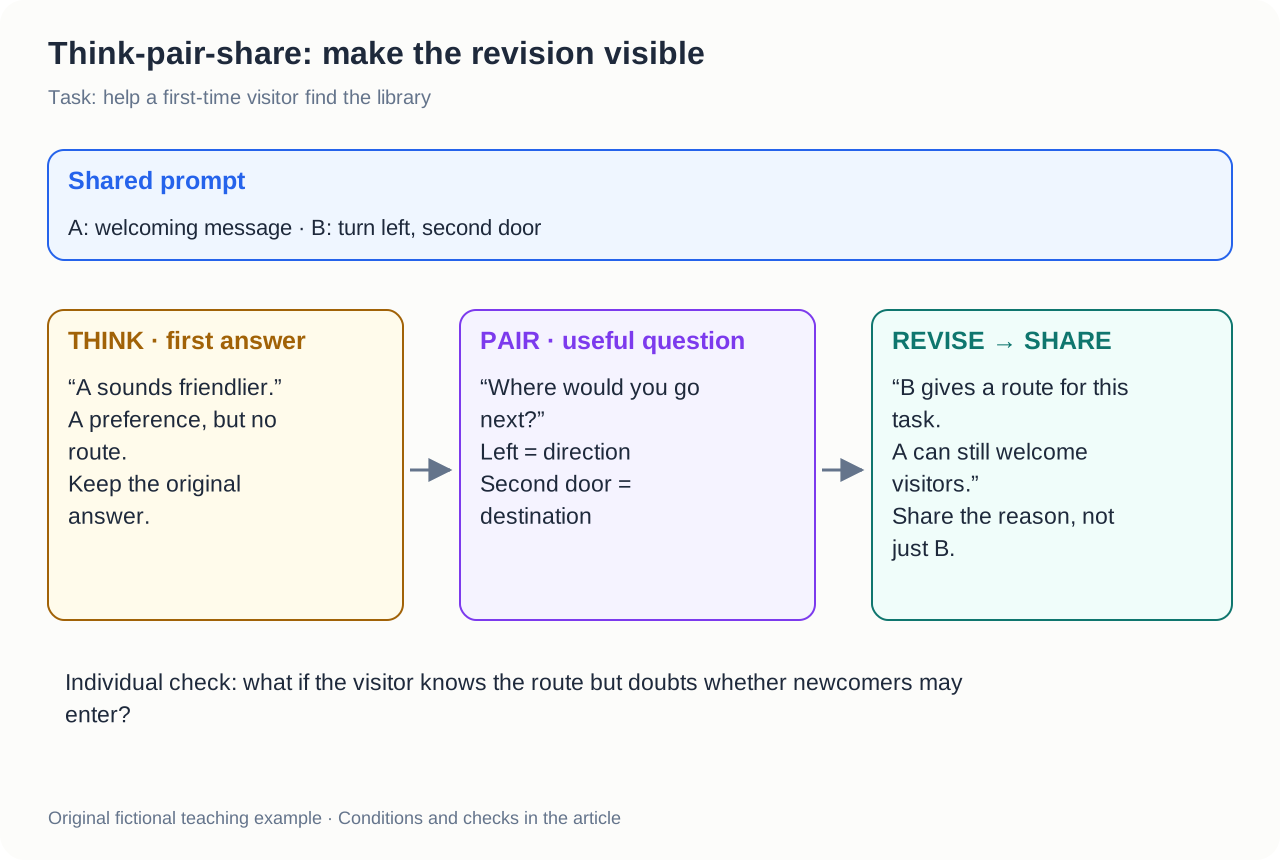
Leave room for a disagreement as well: “B works if the entrance is clear; what if the building has several entrances?” The prompt gave a single entrance, so the question identifies a boundary rather than overturning the answer. It can become an extension after the core task.
Share: surface reasoning and differences
Tell pairs what they will contribute before choosing speakers. One useful instruction is: “Share a detail that changed or clarified your thinking.” Another is: “Share a question your pair could not settle.” Both make the discussion more informative than repeatedly announcing A or B.
Select a small range of responses, with preparation and appropriate access support. The teacher may invite one route-based explanation, one account of a revision and one boundary question. Do not assume a partner can publicly speak for another learner’s understanding without checking with them.
Record the reasoning in short form: visitor’s task → useful detail → expected next action. If students keep repeating the same point, stop collecting duplicates and ask for a contrasting purpose. “When might a welcoming sentence be useful?” helps separate the current question from a universal judgment about all signs.
Sharing need not mean every pair gives a long presentation. The teacher can sample contributions and inspect the remaining notes afterward. Choose a format that fits the learning goal, class size and time rather than expanding the final phase until individual thinking disappears from the lesson.
Check what each learner can now do
Finish with an individual transfer question. For example: “A visitor already knows where the room is but is unsure whether newcomers may enter. Which message would help now, and why?” Students should notice that the task has changed.
A response favoring a welcoming message can now be reasonable. This is not a trick reversal. It checks whether students learned to connect information to a user’s need, rather than memorize that directional language always wins. Read the reason as carefully as the selection.
Keep a compact checklist for reviewing responses: clear choice, relevant detail, explanation of usefulness, and recognition of the stated conditions. Use it to decide what to teach next. Participation counts alone cannot establish whether learners understood the underlying idea.
Adapt the prompt without losing the structure
For mathematics, ask which is larger, three quarters or two thirds, and require a representation. One learner may compare 9/12 with 8/12; another may draw equal-sized bars. The partner’s job is to check that the wholes match and that the representation supports the claim.
For reading, give two possible summaries of a short original passage and ask which preserves its main idea. Keep the passage available during checking, but make the initial response individual. The RACE strategy can support a later written response when the lesson also requires citing and explaining evidence.
For an online or mixed setting, decide how partners will communicate and what happens if a connection fails. A shared board does not itself create private pairs, manage rooms or guarantee equal participation. Provide a way to contribute without relying on an unsupported platform feature.
Fix the failure that actually happened
If no one has an initial answer, inspect the prompt and source material before blaming participation. The question may ask for knowledge students have not encountered. A short teacher model can help, but preserve a fresh question for students’ own thinking afterward.
If one partner dominates, give both a defined turn and a listener question. If the conversation ends at agreement, require a reason or a useful disagreement. If sharing becomes repetitive, sample differences and questions rather than asking for every pair’s final sentence.
A learner may also change their wording without changing their understanding. Ask them to explain a new case individually. That check distinguishes productive revision from copying. Avoid treating public confidence, fast responses or the neatness of a shared note as evidence of learning by themselves.
Keep a small record on the whiteboard
Use three areas labeled first response, partner feedback and revision. Add the common prompt above them and a short transfer question below. Text blocks, simple shapes and connecting lines are enough; the infinite whiteboard leaves room to compare several examples.
You can build this manually in CodePic. This article does not include a dedicated grouping engine or a downloadable worksheet. If the lesson instead requires readers to take turns leading a text discussion, see reciprocal teaching; if it requires specialist groups to teach one another, use the different structure of jigsaw learning.
At the end, preserve the question, a few contrasting first responses, the reasoning behind revisions and the individual check. Those materials tell you more about the next lesson than a board filled only with identical correct answers.