Reciprocal teaching is a structured reading discussion in which learners increasingly take responsibility for predicting, asking questions, clarifying difficulties and summarizing a text. A teacher first makes those thinking moves visible, then supports students as they use them. Assigning four role labels is only a starting point.
Below, an original fictional report about a seed exchange provides a complete practice text. You will see an initial prediction, text-dependent questions, a clarification and a revised summary. The discussion is invented to illustrate the method; it is not a transcript or a claim about measured learning gains.
Establish what the discussion is for
The purpose is to make sense of a shared text. Learners should use its details, identify where understanding is uncertain, and update an interpretation when the next section supplies evidence. Finishing a role card without attending to the reading misses that purpose.
AdLit’s teaching resource describes shared discussion leadership and the four strategies. It also describes teacher modeling before students continue. Use that gradual handover as the organizing principle, rather than expecting role names alone to teach the work.
Our example uses a short informational text. In a longer reading, stop at meaningful chunks where there is enough material to discuss but not so much that the group forgets the question. Choose those stops in advance and adjust them when students encounter an important difficulty.
Read an original text in two chunks
Fictional report: The seed exchange changes its plan. The following details describe an invented community project, not gardening advice or results from a real organization.
Chunk 1:
Last spring, a neighborhood group held a seed exchange. Visitors left packets on a table and took packets home. By noon, several visitors had asked the same questions: What plant was inside? When had the seeds been collected? Had anyone checked whether they would grow? Some packets had clear labels, while others had only a plant name. At the end, many unlabelled packets remained even though visitors had shown interest in those plants.
Chunk 2:
For the next exchange, the group added a short information slip beside each packet. Contributors could record the plant name, collection date and whether they had tried germinating a sample. If they had not tested it, they wrote “not tested” instead of guessing. Volunteers placed incomplete slips at a separate help station. In this fictional account, visitors could now compare what was known and what was still uncertain. The group planned to review their questions after the event before changing the process again.
Keep the wording available during source checking. Students can paraphrase, but they should be able to point to the part that supports an interpretation. The method is not a contest to remember every sentence without looking.
Predict before the next chunk, then revisit
Before reading, show the title and ask what change the group might make. An initial prediction could be, “They will bring more packets because some visitors could not find what they wanted.” Record a reason as well as the prediction.
After chunk 1, test that idea. The text says packets remained and visitors asked about information. It does not establish a shortage. A learner can revise the prediction to, “They may improve labels so visitors know what they are taking.” That revision is more closely connected to the evidence.
Do not reward only predictions that happen to match chunk 2. A prediction is useful when the learner explains its basis and updates it responsibly. Guessing the ending through outside knowledge is different from using what the author has provided so far.
After reading chunk 2, compare the prediction with the actual change. The information slip partly matches the revised prediction, while the separate help station adds something new. Note both. A simple right-or-wrong mark would miss how the understanding developed.
Ask questions that require more than a copied phrase
Begin with a locating question if students need to establish a basic detail: “What information could contributors write on the slip?” Then ask a relationship question: “Why did the group ask people to write ‘not tested’ rather than guess?”
A response to the second question might be: “It separates known information from an unverified claim, so visitors can see the uncertainty.” The phrase “not tested” appears in the text, while the explanation connects that action to the project’s purpose.
| Question | What a useful response should include |
|---|---|
| What remained after the first exchange? | Unlabelled packets, with a reference to chunk 1 |
| Why might a plant name alone be insufficient? | Visitors also asked about collection and testing |
| Did the new slip prove every seed would grow? | No; the text explicitly preserves untested cases |
| Why review questions after the next event? | To learn what uncertainty remains before another change |
Let the group ask questions it cannot yet answer. Mark whether the answer may appear in the next chunk, requires an inference, or lies outside the text. Do not turn every unanswered question into permission to invent a fact.
Clarify a word, sentence or connection
Suppose a learner stops at “germinating a sample.” The group should name the difficulty precisely. Is the word unfamiliar, or is the learner unsure why testing a few seeds matters to the information slip? Those are different clarification needs.
For the word, a suitable classroom gloss is “trying to get a small selection of seeds to begin growing.” Then reread the sentence with that meaning. The report says contributors record whether they tried it; it does not say that one successful sample guarantees every seed will grow.
A sentence-level difficulty might concern “incomplete slips.” The group can trace the reference: these are slips with missing information, which go to the help station. It should not infer that the packets are forbidden, unsafe or worthless. Those judgments are not stated.
Model a specific request: “I understand each word, but I do not understand how the help station solves the missing-information problem.” A partner can respond that it provides a place to ask and complete details, while preserving the limit that some answers may remain unknown.
Summarize the problem, response and remaining uncertainty
After each chunk, ask for the main idea in a few sentences. A summary should preserve the important relationship, not simply list objects such as table, packets, slips and volunteers.
Here is a deliberately weak summary:
People exchanged seeds. There were lots of packets and a table. Next time, volunteers used slips. The exchange was a success.
The ending adds an outcome the fictional report does not establish. The summary also misses why the process changed. A stronger version is:
Visitors at the first seed exchange lacked information about some packets. For the next event, the group added slips that distinguished recorded details from untested claims and provided a help station for missing information. It planned to review visitors’ questions before making further changes.
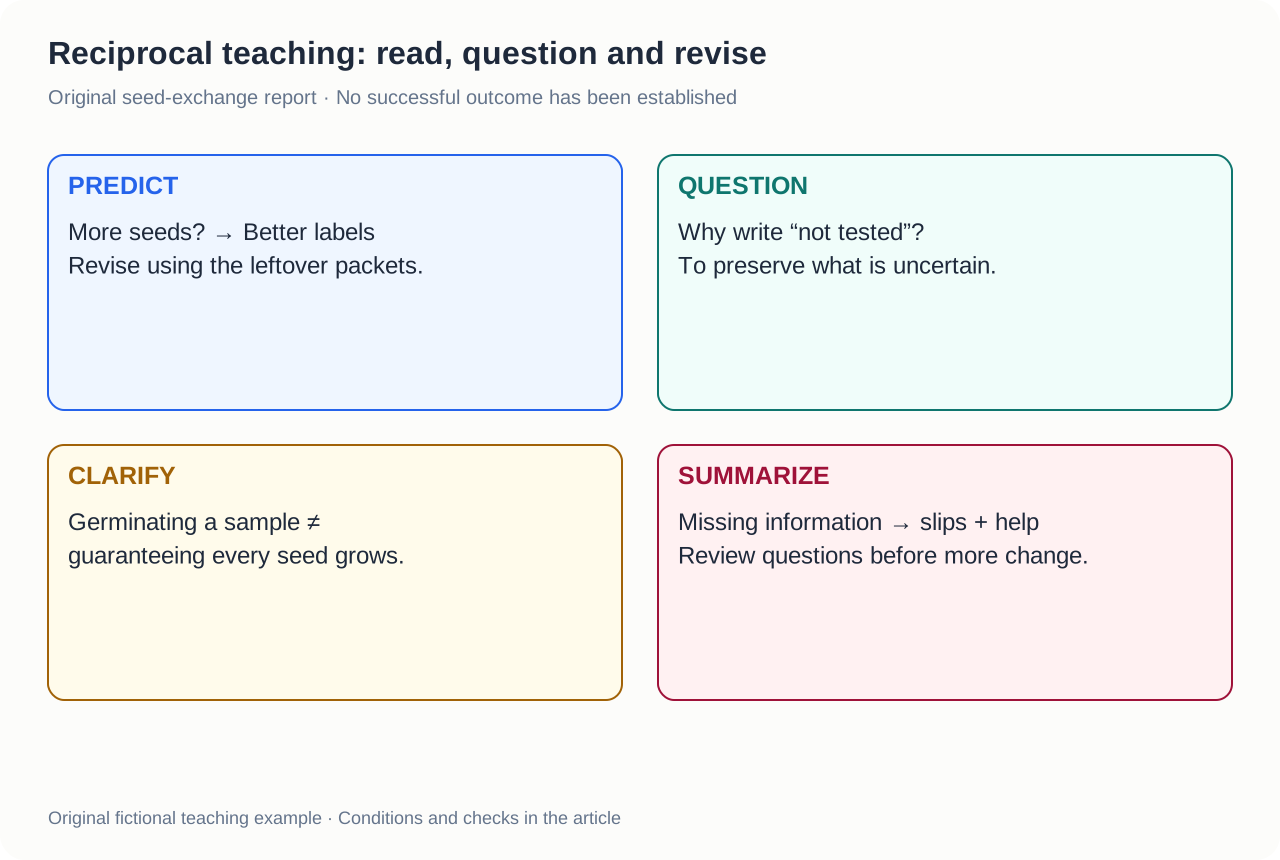
The revised version connects problem and response while keeping the outcome uncertain. For narrative compression, SWBST offers another structure. This informational text does not need to be forced into a character-wants-obstacle story if that distorts its main idea.
Move leadership from teacher to students
Model the first stop aloud: “My first prediction was about quantity, but this sentence points to missing information. I need to revise.” Show the actual check rather than only announce the final answer. Students need to hear how a reader changes course.
Then invite a learner to lead one move while the teacher supports the process. A questioner might ask a copied-detail question; the teacher can prompt, “What would help us understand why the group changed its plan?” Gradually reduce prompts as learners take responsibility.
Roles can help organize turns, but do not make one person the only learner allowed to clarify or summarize. Everyone still reads, checks and contributes. Change roles across chunks or sessions so learners practice the full set of thinking moves.
Plan time and access around the text
For a short passage, a teacher could allocate a few minutes to introduction and modeling, pause after each chunk, and finish with an individual response. That is a planning example. Longer, denser material may need more vocabulary preparation or smaller chunks.
Give students access to the text in a suitable format and provide a way to raise uncertainty without rushing. Silent preparation before discussion can help a learner formulate a question. Do not equate a fast spoken response with better comprehension.
For online work, establish how the shared text and notes will remain available. A board can record the reasoning, but it does not automatically rotate roles or create private discussion groups. Describe only the interaction your actual setup supports.
Check an individual reading move afterward
Ask each learner to write one corrected prediction and its evidence, or explain why the stronger summary avoids claiming success. The teacher can see whether the discussion’s reasoning belongs to individuals rather than only to the group leader.
A second short text is an even more useful follow-up when appropriate. Ask learners to identify one uncertainty and a sensible way to clarify it. They should transfer the strategy, not merely repeat the seed-exchange answers.
If an answer is inaccurate, trace which move failed. Was a prediction left unchanged after contrary evidence? Did clarification add an unsupported fact? Did a summary invent an outcome? Those diagnoses suggest more useful instruction than simply asking students to participate more.
Record the reading process without overloading it
Use four areas for prediction, questions, clarifications and summary. Add the chunk number and a short evidence reference to each note. Preserve changes rather than replacing every earlier thought with a polished answer.
You can organize the material manually on an infinite whiteboard in CodePic. The board is an optional record, not the teaching method itself; this article does not promise a dedicated organizer download or an automated reading assessment.
If you need a brief individual-to-partner discussion, think-pair-share has a lighter structure. If learners first investigate different material and then teach their home groups, jigsaw learning fits that different task. Choose according to what readers need to do with the text.