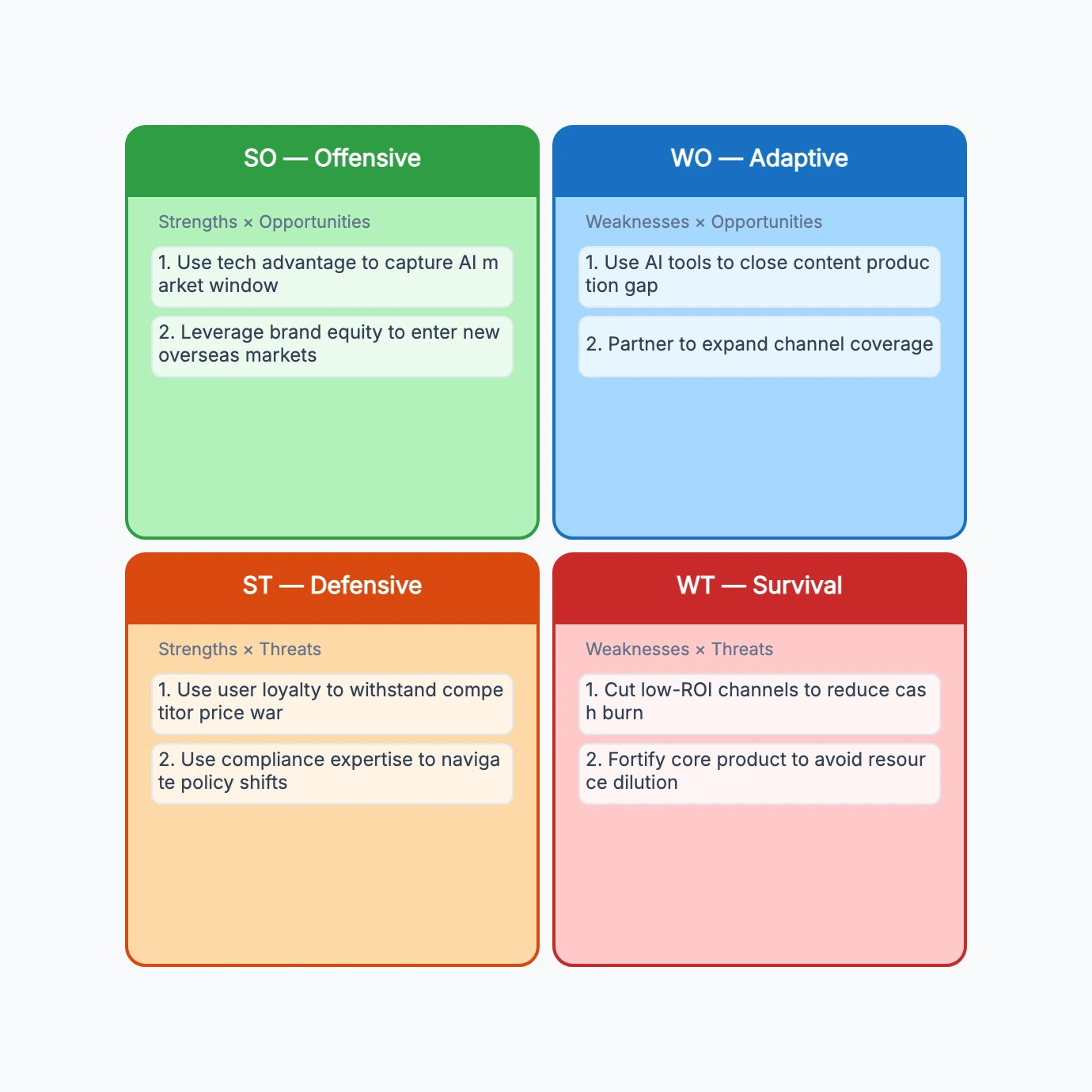
SWOT tells you where you stand. TOWS tells you what to do about it. The difference is the most underrated 30 minutes in strategic planning: you already have the four quadrants filled — now cross-match them and watch strategy emerge from the intersections.
This guide explains how the TOWS matrix works, walks through each of the four strategy types (SO, WO, ST, WT) with real examples, and gives you a template to run your own. If you've ever finished a SWOT session and thought "okay, now what?", this is the answer.
SWOT Is the Diagnosis, TOWS Is the Prescription
| Question | SWOT | TOWS |
|---|---|---|
| What does it produce? | Prioritized internal and external factors | Strategy options built from factor pairs |
| When is it used? | At the start of diagnosis | After the important SWOT items are selected |
| What is a good output? | Specific, evidence-backed observations | An action, target outcome, owner, and review date |
| What usually goes wrong? | Generic lists with no evidence | Vague combinations that repeat the inputs |
Use the table as a handoff test. If the meeting ends with four lists, the SWOT is complete but strategy work has not started. If every proposed TOWS item can be assigned to an owner and tested against an outcome, the cross-match has done its job.
Imagine going to a doctor who runs tests, hands you a sheet of paper listing "high blood pressure, elevated cholesterol, family history of heart disease," and says "good luck." That's a SWOT without a TOWS.
A SWOT analysis (Strengths, Weaknesses, Opportunities, Threats) is the diagnostic step. You identify what's strong, what's broken, what's out there to grab, and what's out there to fear. It's necessary and valuable — but it's incomplete.
A TOWS matrix is the treatment plan. You take each quadrant and ask: "How does this interact with the others to produce a concrete strategy?" The output isn't a list — it's a set of action plans, each tied to a specific strength-weakness-opportunity-threat pairing.
The framework was originally called "TOWS" by Heinz Weihrich, who developed it in 1982 — he started with the external factors (Threats and Opportunities) first and worked inward to Strengths and Weaknesses. The name order reflects his logic: strategy should start with the environment, not with your own capabilities. Over time, "SWOT" became the more popular name, but the TOWS matrix — the strategy-generation step — is the part most teams skip.
The Four TOWS Strategy Types
After filling a standard SWOT, you create a 2×2 matrix and cross-match. Each cell produces a different kind of strategy:
SO Strategies (Strengths × Opportunities) — Attack
The question: How do we use our strengths to capture opportunities?
These are your offensive plays. You've identified something you're good at, and you've spotted something worth going after. The SO cell is where you connect them.
Example: A small marketing agency has a strength — "3-person video production team with broadcast-quality output" — and spots an opportunity — "local businesses are desperate for short-form video but can't afford agencies." SO strategy: launch a fixed-price "30-second video ads for local businesses" package, priced at 1/3 of what generalist agencies charge, powered by a production line optimized for short-form output.
SO strategies tend to be the most energizing and the easiest to get buy-in for. They're also the most obvious — which means your competitors are probably looking at the same ones. Strong SO strategies get their edge from speed of execution, not uniqueness of insight.
WO Strategies (Weaknesses × Opportunities) — Adapt
The question: How do we overcome our weaknesses by exploiting opportunities?
This is where creative strategy lives. The WO cell forces you to look at gaps not as permanent limitations but as things external trends can help you fix.
Example: A B2B SaaS company has a weakness — "no sales team, founder-led sales isn't scaling" — and spots an opportunity — "product-led growth is the dominant GTM in our category and buyers prefer self-serve." WO strategy: instead of building a sales team (expensive, slow), invest in a free tier with a generous usage limit, product-qualified lead scoring, and automated upgrade prompts. Turn the "no sales team" weakness into a "we're the self-serve option" positioning.
WO strategies are where the most interesting ideas often come from, precisely because you're forced to connect things that don't naturally go together. The best WO strategies reframe a weakness as a different kind of strength.
ST Strategies (Strengths × Threats) — Defend
The question: How do we use our strengths to neutralize threats?
These are your defensive positions. A threat is on the horizon — a competitor move, a regulatory shift, a market trend — and you need to protect your position using what you're already good at.
Example: An independent bookstore has a strength — "deep community relationships, hosts 3 events/week with 50+ attendance" — and faces a threat — "Amazon is opening a physical bookstore 2 miles away." ST strategy: double down on community. Launch a membership program with exclusive author events, start a "bookseller recommendations" shelf that Amazon can't replicate, and partner with local schools for reading programs. Don't compete on selection or price — compete on something Amazon's physical stores still can't do well.
ST strategies are about choosing where to fight. You can't neutralize every threat with every strength — pick the pairing where your strength is most differentiated and the threat is most acute.
WT Strategies (Weaknesses × Threats) — Survive
The question: How do we minimize weaknesses to avoid threats?
This is the uncomfortable cell — the one most teams avoid because it's where weakness meets danger. But WT strategies are often the most important because they address existential risks.
Example: A print magazine has a weakness — "declining subscriber base, average reader age 58" — and faces a threat — "print distribution costs rising 15% year over year, paper costs volatile." WT strategy: this isn't a "fix the magazine" problem, it's a "change the business model" problem. Launch a digital-first spinoff for a younger audience, use the print magazine's brand authority to attract subscribers to the digital product, and plan for print to become a premium annual special rather than a monthly publication.
WT strategies are about survival. The right WT strategy isn't "try harder at the thing that's failing" — it's "change the thing before the thing changes you."
TOWS in Practice: How to Run the Cross-Match
Running a TOWS takes 30-45 minutes once your SWOT is done. Here's the step-by-step:
Step 1: Pick your top items. Your SWOT probably has 5-8 items per quadrant. Pick the top 3-4 in each — the ones that, if addressed, would actually move the business. Don't try to cross-match 8×8 items; you'll produce 64 strategies and act on zero.
Step 2: Create the cross-match table. Take a piece of paper or open a whiteboard. Put Strengths and Weaknesses on the left, Opportunities and Threats across the top. Or use the TOWS strategy matrix template and annotate the quadrants.
Step 3: Work one cell at a time. Start with SO (it's the most natural), then WO, ST, and WT last. For each intersection, ask the cell's question and write down the first strategy that comes to mind. Don't edit yet — volume first, quality second.
Step 4: Filter and prioritize. You'll end up with 8-16 strategies. Score each on impact (1-5) and feasibility (1-5). Keep the top 2-3 per quadrant. Everything else goes into a "later" parking lot.
Step 5: Assign owners and deadlines. A strategy without an owner is a wish. Every strategy that makes the cut gets a person's name, a first action, and a review date.
Why Most SWOTs Fail (Hint: They Skip TOWS)
The most common complaint about SWOT analysis — "we spent two hours filling in quadrants and nothing changed" — isn't a SWOT problem, it's a TOWS problem. The team did the diagnosis and skipped the prescription.
Three signs your SWOT didn't go far enough:
- You have a list of observations but no decisions. If nobody left the room with a new task, you only did half the exercise.
- The strategies are vague. "Leverage our brand" is a SWOT item. "Launch a partner co-marketing program with the 3 brands our audience already trusts, starting Q3" is a TOWS strategy.
- Weaknesses and threats were ignored. Most teams over-focus on SO (strengths × opportunities — the fun quadrant) and neglect WO and WT. But WO is often where the most creative strategies are, and WT is where the most important ones are.
The fix is simple: every time you run a SWOT, budget an extra 30 minutes for the TOWS cross-match. Make it non-negotiable. If you're time-crunched, cut the SWOT to 30 minutes and spend 45 on TOWS — the strategy generation is worth more than the observation-gathering.
Free Template: Run Your Own TOWS
Our TOWS strategy matrix template gives you a dedicated TOWS workspace. Fill the four quadrants first, then use the canvas to sketch the cross-match connections — draw arrows from strengths to opportunities, from weaknesses to threats, and annotate the strategies that emerge at each intersection.
The hand-drawn style is an asset here: strategic thinking on a polished corporate template feels like filling out a form. On a sketch-style canvas, it feels like thinking out loud — which is what the TOWS cross-match should be.
Related Reading
- Free SWOT Analysis Template: 8 Tools + Personal, Marketing & Strategy Templates — The main SWOT pillar with tool comparisons and more template variants
- SWOT vs PEST Analysis: Which Framework to Use When — Run a PEST first when your external quadrants need more depth
- Personal SWOT Analysis Template: Free Fillable + Career Examples — Apply SWOT and TOWS to your own career planning
- Marketing SWOT Analysis: Free Template + Real Campaign Examples — Run a marketing-specific SWOT before crossing into TOWS