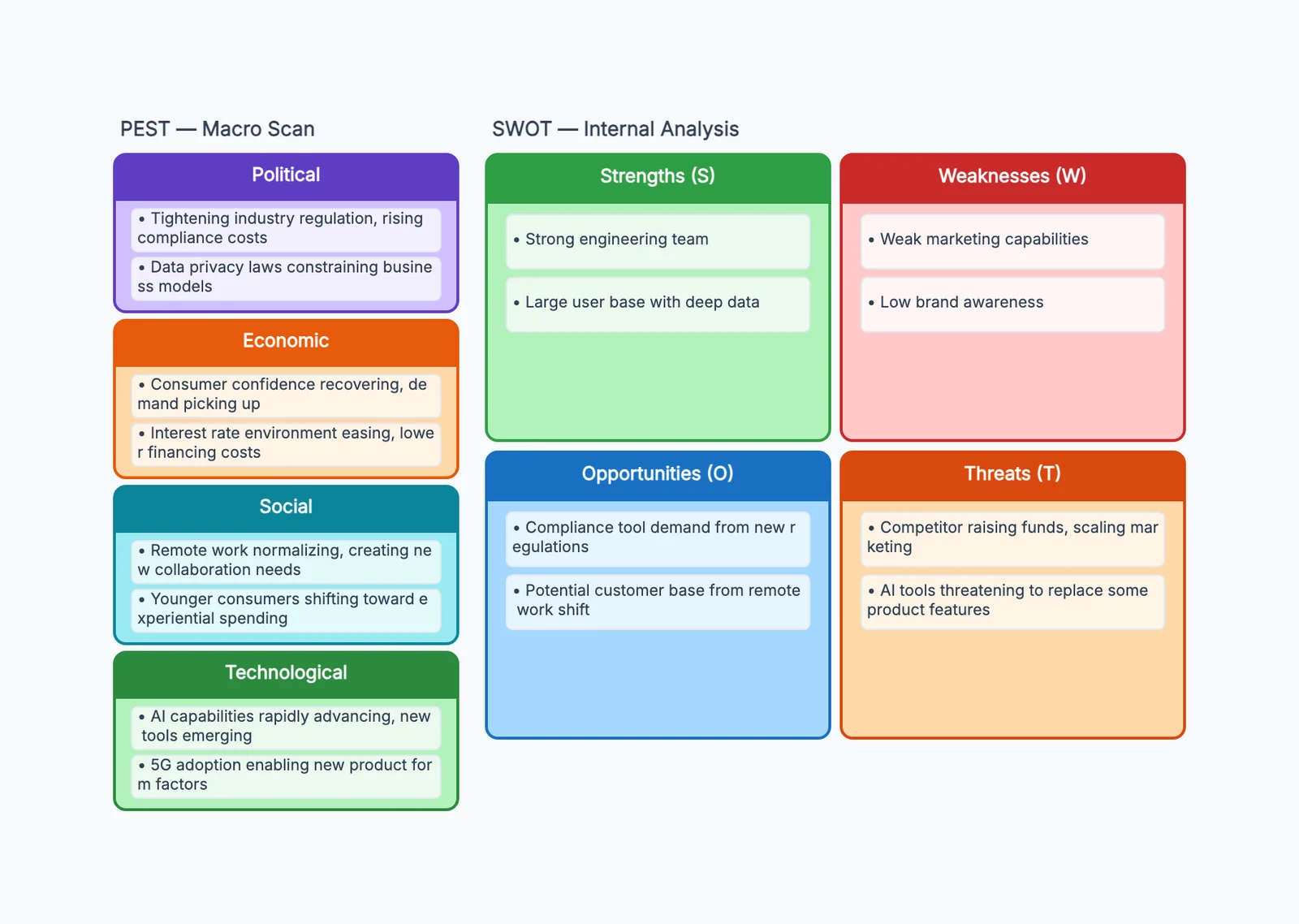
SWOT and PEST are the two most-used strategic analysis frameworks, and they're often mistaken for alternatives. They're not. SWOT splits its attention between what's inside your control (Strengths and Weaknesses) and what's outside it (Opportunities and Threats). PEST is purely an external scan: Political, Economic, Social, and Technological forces you don't control but need to understand.
This guide explains how each framework works, when to use which, and the practical pattern for combining them — with real examples of how SWOT and PEST produce better strategy together than either does alone.
SWOT at a Glance
SWOT is a four-quadrant framework that captures your current position:
- Strengths (Internal, positive): What you're good at. Assets, capabilities, competitive advantages. Things you control.
- Weaknesses (Internal, negative): What you're missing or bad at. Gaps, constraints, vulnerabilities. Things you control but wish were different.
- Opportunities (External, positive): What's available out there. Market trends, competitor gaps, regulatory openings, technology shifts. Things you don't control but can exploit.
- Threats (External, negative): What's out there that could hurt you. Competitive pressure, market contraction, regulatory risk, technology disruption. Things you don't control and need to prepare for.
SWOT's core insight is that strategy sits at the boundary between what's inside and what's outside. The top row (Strengths, Weaknesses) is about capability. The bottom row (Opportunities, Threats) is about context. Good strategy connects the two.
Best for: evaluating a specific product, business unit, or decision where you need to balance internal reality with external conditions.
PEST at a Glance
PEST is a four-category framework that maps the macro-environment:
- Political: Government policy, political stability, trade restrictions, tax policy, labor law, industry regulation. Anything where the government is an actor.
- Economic: Interest rates, inflation, exchange rates, economic growth, unemployment, consumer confidence, disposable income. The money environment.
- Social: Demographics, cultural trends, lifestyle changes, education levels, social attitudes, population growth, age distribution. How people live and what they value.
- Technological: Automation, R&D investment, technology adoption rates, digital infrastructure, patents, emerging tech (AI, blockchain, biotech). The rate and direction of technical change.
PEST's core insight is that strategy doesn't happen in a vacuum. Before you decide what to do, you need to understand the world you're operating in. A PEST doesn't tell you what to do — it tells you what you're dealing with.
Some practitioners add Legal and Environmental to make PESTLE. Legal covers employment law, antitrust, consumer protection, industry-specific compliance. Environmental covers climate change, sustainability requirements, carbon policy, waste management. Use PESTLE when regulation or environmental factors are material to your strategy; for most purposes, PEST is enough.
Best for: entering a new market, long-range strategic planning (3-5 year horizon), or any decision where macro forces are likely to dominate micro ones.
SWOT vs PEST: When to Use Which
The decision is simpler than it looks. Ask two questions:
Question 1: Is the decision specific or exploratory? If you're evaluating a concrete option — launch this product, enter this market, acquire this company — use SWOT. If you're surveying the landscape before you even know what the options are — should we be in this market at all? — use PEST.
Question 2: Are internal factors or external factors the bigger unknown? If the big question is "can we execute?" — SWOT, because it forces the internal conversation. If the big question is "what's happening out there?" — PEST, because it's purpose-built for external scanning.
In practice, the most common pattern is PEST first, then SWOT. Run a 45-minute PEST to map the macro-environment. Take the top findings and feed them into a SWOT's Opportunities and Threats quadrants. Then run the SWOT to layer in your internal reality.
How SWOT and PEST Work Together: An Example
A European fintech company is evaluating whether to expand into Southeast Asia. Here's how the two frameworks connect:
PEST (run first):
- Political: Several SEA countries are introducing open-banking regulation similar to PSD2 — creates a compliance cost but also a level playing field. One target market has an upcoming election with uncertain regulatory outcome.
- Economic: Target markets have 5-7% GDP growth, a rapidly expanding middle class, and 60%+ smartphone penetration — but local currency volatility against the Euro adds FX risk.
- Social: The under-30 population is mobile-first, comfortable with digital wallets (GrabPay, GoPay), and largely unbanked — they've skipped credit cards entirely.
- Technological: Digital infrastructure is strong in capital cities (Singapore, Bangkok, Jakarta) but much weaker in secondary cities. API-based banking is emerging but not yet standard.
SWOT (run second, PEST findings fed in):
- Strengths: PSD2-compliant tech stack can be adapted to SEA open-banking standards faster than local competitors. Experienced regulatory team that's navigated EU compliance.
- Weaknesses: No brand recognition in SEA. No local-language customer support. FX hedging costs erode margins by 3-5%.
- Opportunities (from PEST): 200M+ unbanked/underbanked mobile-first consumers. Open banking regulation creates an entry window before local incumbents build their own solutions.
- Threats (from PEST): Election-year regulatory uncertainty in the largest target market. Currency risk means a 10% swing in EUR/SEA rates could make the business unprofitable. Local super-apps (Grab, GoTo) have the user base to launch competing financial products quickly.
The combination produces a strategy neither framework could produce alone. PEST alone would say "SEA looks promising but risky." SWOT alone would say "we have a strong tech stack but no local presence." Together, they produce a specific plan: enter Singapore first (stable regulation, lowest FX risk), build a local-language version for the Singapore market as a beachhead, and delay expansion into the election-year market by 12 months.
Common Mistakes (and How to Avoid Them)
Treating SWOT and PEST as alternatives. They're not. One is internal + external (SWOT), the other is external-only (PEST). Using one doesn't mean you've "done" the other — they answer different questions.
Running PEST without feeding it into SWOT. A standalone PEST produces a list of observations about the world. Interesting, but not actionable. The value comes from asking "what does this PEST finding mean for our specific situation?" — which is the SWOT step.
Doing SWOT first, then PEST. This order means you're filling in Opportunities and Threats before you've systematically scanned the external environment. You'll miss things. PEST first forces you to look outward before you look at yourself.
Trying to be comprehensive. A PEST with 20 items per category is a research report, not a strategy tool. Limit to the 3-5 items per category that are actually material to the decision at hand. The discipline is in what you leave out.
Confusing PEST items with SWOT items. "Interest rate increase" is a PEST finding. "Interest rate increase threatens our variable-rate debt" is a SWOT Threat — it connects the external force to your specific situation. The gap between these two statements is the work.
PESTLE: When to Add the Extra Two Letters
PESTLE adds Legal and Environmental to the standard PEST. The deciding question: are these factors material enough to your decision to warrant separate categories?
Add Legal (making it PESTLE) when: your industry is heavily regulated (finance, healthcare, energy), you're entering a new jurisdiction with unfamiliar compliance requirements, or your business model touches consumer data, intellectual property, or employment law in ways that could be disrupted by regulatory change.
Add Environmental (making it PESTLE) when: your operations have a significant carbon footprint, your supply chain is exposed to climate risk, your customers or investors care about sustainability metrics, or environmental regulation is evolving in your markets (carbon pricing, waste directives, energy efficiency standards).
For most strategic analyses, PEST is enough. The framework's value is in its constraints — four categories force you to think across dimensions without drowning in detail. Adding categories should be a deliberate choice, not an automatic upgrade.
Free Template: Run Your Own PEST → SWOT
Our SWOT + PEST template works for the full PEST → SWOT workflow. Start by sketching a PEST on one side of the canvas — four boxes for Political, Economic, Social, Technological. List 3-5 key findings in each. Then move to the SWOT quadrants: feed the PEST findings into Opportunities and Threats, and add your internal Strengths and Weaknesses. Draw arrows from the PEST boxes to the relevant SWOT items so the connection is visible.
The hand-drawn style helps here: strategic analysis on a polished corporate grid feels like "producing a deliverable." On a sketch canvas, it feels like thinking — which is what this stage should be.
Related Reading
- Free SWOT Analysis Template: 8 Tools + Personal, Marketing & Strategy Templates — The main SWOT pillar with full tool comparisons
- TOWS vs SWOT: Strategy Generation Explained — Once your PEST → SWOT is done, cross-match the quadrants to generate strategies
- Marketing SWOT Analysis: Free Template + Real Campaign Examples — Run a marketing-specific PEST → SWOT for campaign planning
- Personal SWOT Analysis Template: Free Fillable + Career Examples — Apply PEST thinking to your career: what macro trends affect your industry?