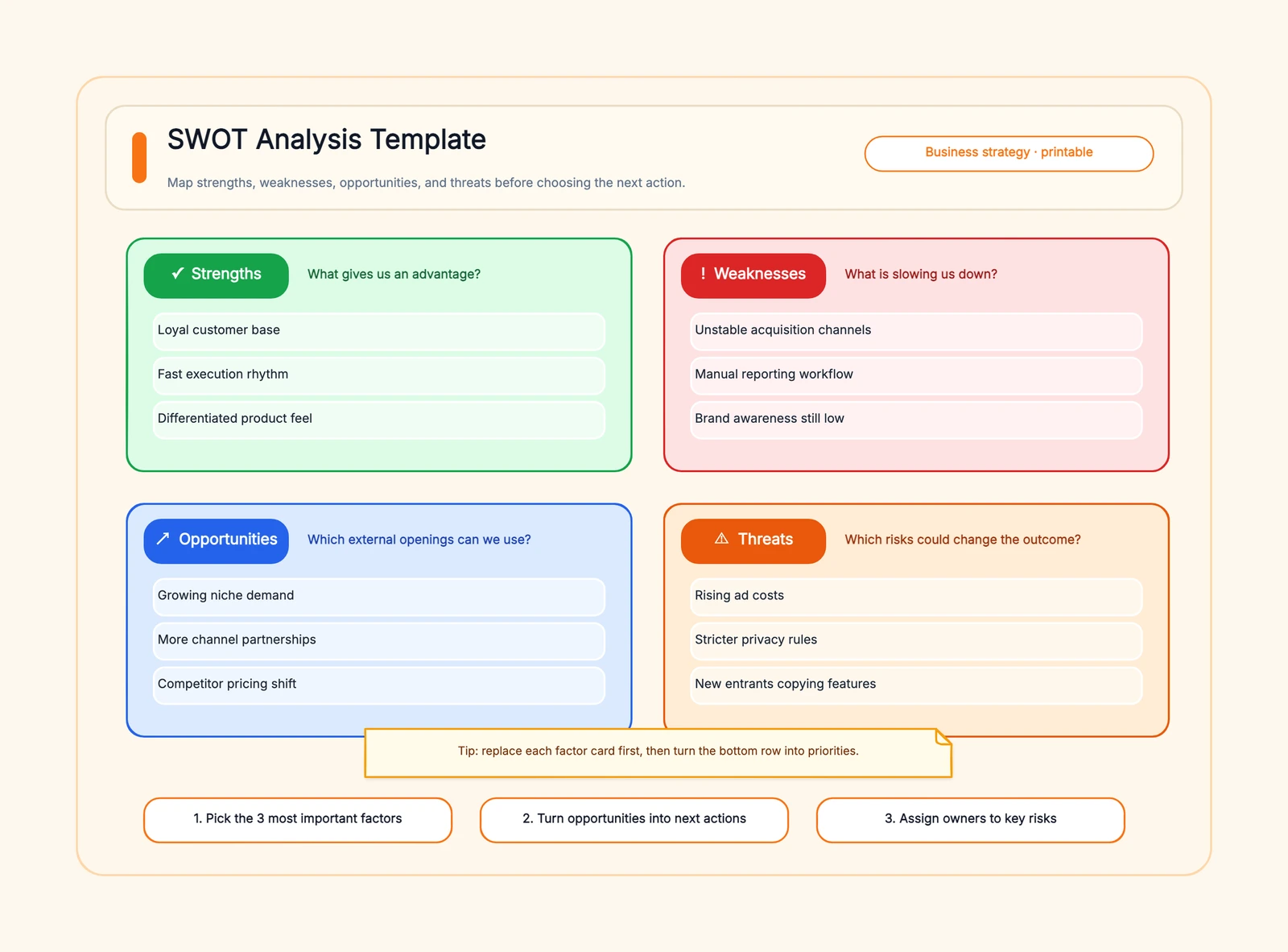
A SWOT analysis is a strategic planning tool that helps you evaluate a situation through four lenses: Strengths, Weaknesses, Opportunities, and Threats. Strengths and weaknesses describe what is happening inside the organization, team, product, or person being analyzed. Opportunities and threats describe what is happening outside it.
That distinction matters. A useful SWOT analysis is not just four boxes filled with random thoughts. It separates what you can directly control from what you must respond to, and it separates what helps you from what works against you. Done well, it turns a fuzzy strategic conversation into a clearer set of choices.
Why SWOT Analysis Works
SWOT works because it forces two simple but easy-to-ignore distinctions.
First, it separates internal factors from external factors. A strong engineering team is internal. A new competitor entering the market is external. You can invest in your team, change your process, or improve your product. You cannot directly control a competitor, a regulation, or a shift in customer behavior.
Second, it separates helpful factors from harmful factors. Some internal factors help you win; others hold you back. Some external factors create openings; others create risk.
Put those two axes together and you get a clean strategic map:
| Helpful | Harmful | |
|---|---|---|
| Internal | Strengths | Weaknesses |
| External | Opportunities | Threats |
The value is not the grid itself. The value is the conversation it creates. A team that says "we have a strong brand" has to ask whether that strength matters for the decision in front of them. A founder who writes "AI trend" under opportunities has to ask what specific customer problem it creates or changes. SWOT slows the discussion down just enough to make vague claims testable.
The Four Quadrants
Strengths
Strengths are internal advantages you can use. They might be capabilities, assets, relationships, brand trust, proprietary data, distribution, team expertise, or operational discipline.
Examples:
- A SaaS company has unusually low churn because customers rely on its workflow every day.
- A coffee shop has a loyal neighborhood customer base and a high-traffic corner location.
- A job candidate has strong writing skills and deep domain experience in a niche industry.
The key question is: what do we already have that gives us an advantage in this specific situation?
Weaknesses
Weaknesses are internal limitations that make success harder. They are not insults or failures; they are constraints you need to plan around.
Examples:
- A SaaS company has a small sales team and long implementation times.
- A coffee shop has no online ordering and limited seating.
- A professional has a weak network in the industry they want to move into.
The useful question is: what internal gaps could stop us from taking advantage of the opportunity?
Opportunities
Opportunities are external conditions you might benefit from if you act. They can come from market changes, customer behavior, new technology, competitor weakness, regulation, partnerships, or distribution channels.
Examples:
- A growing number of companies are replacing spreadsheets with workflow tools.
- A new office building opens two blocks from the coffee shop.
- A professional field is expanding and has more demand than qualified candidates.
An opportunity is not the same as a wish. "Grow revenue" is not an opportunity. "Mid-market customers are actively switching away from a competitor after a price increase" is.
Threats
Threats are external conditions that could hurt you. They are risks outside your direct control, though you can still prepare for them.
Examples:
- A large competitor launches a cheaper version of your core product.
- Rent increases in the neighborhood could erase the coffee shop's margin.
- Automation reduces demand for part of a professional's current role.
The practical question is: what outside forces could make our current plan fail?
Real-World SWOT Analysis Examples
Small SaaS Company
A small B2B SaaS team is deciding whether to expand from startups into mid-market companies.
Strengths: The product is easy to adopt, support response times are fast, and customer retention is strong among small teams.
Weaknesses: The company lacks enterprise sales experience, has limited security documentation, and the product has only basic admin controls.
Opportunities: Mid-market teams are looking for lighter alternatives to expensive enterprise tools. A major competitor recently raised prices, creating frustration among customers.
Threats: Bigger vendors can copy key features quickly. Longer procurement cycles could slow cash flow. Security reviews may block deals if the team is not prepared.
The action is not simply "go mid-market." A better takeaway is: test the segment with a small set of design partners, improve security documentation first, and avoid promising enterprise features the team cannot support yet.
Local Coffee Shop
A neighborhood coffee shop is planning for the next year.
Strengths: It has friendly staff, consistent coffee quality, and many repeat customers who work nearby.
Weaknesses: Seating is limited, the menu is hard to read during the morning rush, and the shop has little presence on delivery apps.
Opportunities: A new apartment complex is opening nearby. Local businesses are looking for catering options for morning meetings.
Threats: A national chain is opening within walking distance. Rent and ingredient costs are rising.
The most useful next step might be a morning catering package and a clearer grab-and-go menu, not a full redesign of the shop. SWOT helps choose the move that fits the shop's strengths instead of chasing every possible idea.
Personal Career Planning
A product marketer is thinking about moving into a growth leadership role.
Strengths: They understand positioning, have run launches, and can write clearly for both sales teams and customers.
Weaknesses: They have limited experience with paid acquisition, forecasting, and managing people.
Opportunities: More companies want growth leaders who can connect messaging, lifecycle marketing, and product data. Their current company is forming a new growth team.
Threats: Other candidates may have deeper analytics backgrounds. If the internal role gets filled quickly, the timing window may close.
The action plan becomes specific: ask to own one lifecycle experiment, find a mentor with paid acquisition experience, and prepare a portfolio of launch-to-revenue outcomes before applying.
How to Create a SWOT Analysis
Step 1: Define the decision or scope. A SWOT for "our business" will be too broad. A SWOT for "should we launch a self-serve plan for small teams?" gives people something concrete to analyze.
Step 2: Gather facts before opinions. Bring customer feedback, sales data, churn reasons, competitor notes, market research, support tickets, or financial numbers. SWOT gets weak when it becomes a room full of guesses.
Step 3: Fill the four quadrants separately. Keep internal items in strengths and weaknesses. Keep external items in opportunities and threats. If someone writes "strong market demand" under strengths, move it to opportunities.
Step 4: Make each item specific. "Good product" is too vague. "Users complete setup in under 10 minutes without support" is useful because it can shape a plan.
Step 5: Look for strategic connections. The best insights often come from pairing quadrants: use strengths to pursue opportunities, fix weaknesses that block opportunities, use strengths to reduce threats, and prepare for threats that hit known weaknesses.
Step 6: Turn the analysis into actions. End with decisions, owners, and next steps. A SWOT that does not change what anyone does is just a tidy meeting note.
Common Mistakes
Writing items that are too generic. "Great team," "limited budget," "market growth," and "competition" could appear in almost any SWOT. Push for details: which team capability, which budget constraint, which market segment, which competitor behavior?
Treating wishes as strengths. "Strong brand" is only a strength if customers actually recognize and trust it. "Innovative culture" is only a strength if it produces better decisions or faster execution. If there is no evidence, mark it as an aspiration, not a strength.
Stopping before action. Many SWOT sessions end with a completed grid and no decision. The grid is a means to an end. Ask: what should we start, stop, protect, test, or monitor because of this analysis?
Confusing internal and external factors. A pricing model you designed is internal. A customer segment becoming more price-sensitive is external. Keeping that boundary clear prevents the analysis from turning into a mixed list of complaints.
Trying to analyze everything at once. SWOT works best around a focused question. If the scope is too broad, every quadrant fills with obvious statements and the output becomes hard to use.
SWOT vs Other Strategy Tools
| Tool | Best For | How It Differs from SWOT |
|---|---|---|
| PESTLE analysis | Understanding broad external forces: political, economic, social, technological, legal, environmental | Focuses only on the external environment; useful before filling opportunities and threats |
| Porter's Five Forces | Evaluating industry attractiveness and competitive pressure | Goes deeper on competitors, suppliers, buyers, substitutes, and new entrants |
| Business Model Canvas | Mapping how a business creates, delivers, and captures value | Describes the business model itself, not just advantages and risks |
| Risk Matrix | Prioritizing risks by likelihood and impact | Helps rank and manage threats after they have been identified |
Use SWOT when you need a balanced view of internal capability and external context. Use PESTLE when the outside environment is the main question. Use Porter's Five Forces when industry structure matters. Use Business Model Canvas when you need to design or explain how the business works. Use a risk matrix when you already know the risks and need to prioritize them.
Frequently Asked Questions
What does SWOT stand for? SWOT stands for Strengths, Weaknesses, Opportunities, and Threats.
When should I use a SWOT analysis? Use it when you need to make a strategic decision: launching a product, entering a market, reviewing a business unit, planning a career move, evaluating a project, or preparing for a planning meeting.
Can SWOT analysis be used for personal goals? Yes. Personal SWOT works well for career planning, job searches, role changes, and skill development. The same rule applies: keep strengths and weaknesses internal, and opportunities and threats external.
How long should a SWOT analysis be? Short enough to discuss, detailed enough to act on. For most teams, 4-7 specific items per quadrant is more useful than a long list of every possible thought.
Who should participate in a SWOT analysis? Include people who see the situation from different angles: leadership, customer-facing teams, operations, product, finance, or the person closest to the work. A SWOT made by one person can be useful, but it is easier to miss blind spots.
What should happen after a SWOT analysis? Convert the grid into priorities. Choose the strengths to lean on, weaknesses to fix or work around, opportunities to test, and threats to monitor or mitigate.
Next Steps
Ready to create your own SWOT analysis? Open the free SWOT analysis maker template, then choose “Use this template” to fill in the four quadrants. For a deeper comparison of free SWOT tools and their features, see our guide on the best free SWOT analysis templates.
If you're looking for complementary strategic tools, the Business Model Canvas pairs well with SWOT — use SWOT to diagnose your current position, then use the canvas to design how your business creates and captures value.