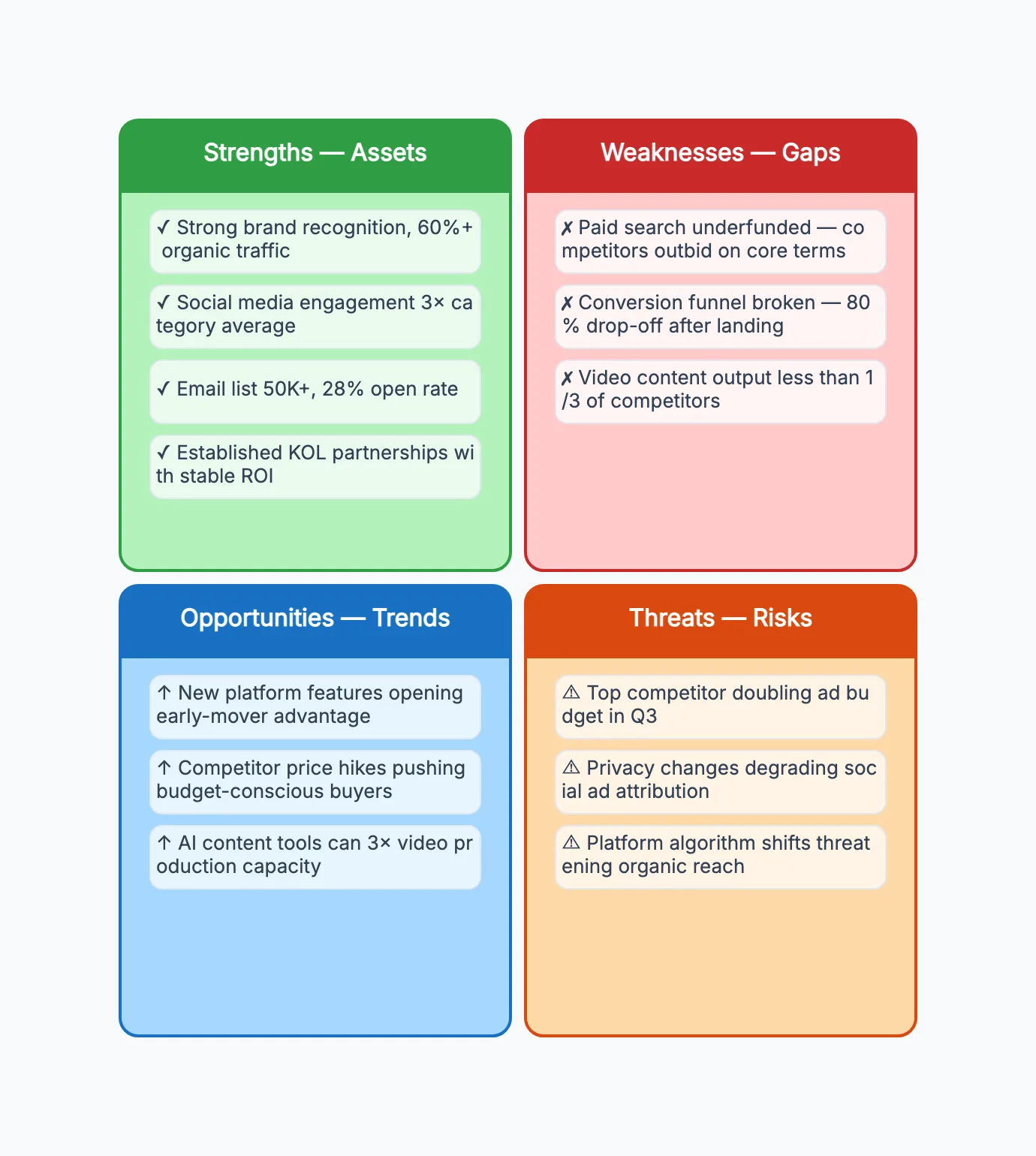
A marketing SWOT analysis takes the same four-quadrant framework businesses use for strategy and narrows it to marketing-specific factors: channel performance, brand strength, audience gaps, competitive positioning, and budget efficiency. It answers a question a general SWOT can't: what should the marketing team actually do differently on Monday?
This guide walks through how to run a marketing SWOT that produces actionable output — not a wall of sticky notes — with a free marketing SWOT template you can open and edit right now. Includes real examples from product launches, brand campaigns, and competitive repositioning.
Open the template. Free fillable marketing SWOT template — four quadrants pre-labelled, ready to fill with your marketing data. Edit in the browser, export to PNG or PDF.
Why a Marketing-Specific SWOT
A general SWOT is too broad to guide marketing decisions. When the "Strengths" quadrant mixes "strong engineering team" with "high Instagram engagement," neither gets the attention it deserves. When "Weaknesses" lumps "underfunded paid search" in with "high employee turnover," the marketing team leaves the room without a clear priority.
A marketing SWOT forces discipline by constraining every item to marketing-relevant factors. The rule: if it doesn't affect how you reach, convert, or retain customers, it doesn't go in this SWOT. This constraint is what makes the output actionable — you finish the exercise with a list of things the marketing team can actually control or influence, rather than a list of company-wide observations.
Run a marketing SWOT at three moments:
- Before a major campaign launch. Align the team on what's already working (amplify these strengths), what's broken (fix these weaknesses before spending), and what external factors could help or hurt the campaign.
- At quarterly planning. A one-hour marketing SWOT at the start of Q2 planning surfaces disagreements that would otherwise emerge mid-quarter in the form of missed targets.
- After a competitor move. A competitor launches a big campaign, drops prices, or enters your space — run a rapid marketing SWOT to assess your position and decide whether to respond.
How to Fill Each Quadrant: Marketing-Specific Prompts
Strengths (Marketing)
These are the marketing assets, channels, and capabilities that give you an edge. Be specific — name numbers wherever possible.
Ask yourself:
- Which channel consistently delivers the lowest CAC or highest ROAS?
- What content or creative format performs disproportionately well for your brand?
- What first-party data do you have that competitors don't (email list, customer research, purchase history)?
- What brand metric is strongest — awareness, consideration, loyalty, NPS?
- What marketing capability does your team have that's hard to hire for?
A good marketing strength is measurable. "Strong social media" is not a strength. "TikTok organic reach averaging 80K views per post with a 4% engagement rate — 3× the category average" is a strength. When every item in this quadrant has a number attached, the quadrant earns its place in the planning discussion.
Weaknesses (Marketing)
Marketing weaknesses are the channels, capabilities, or assets that are underperforming or missing entirely. Honesty here is what prevents you from building a campaign on a shaky foundation.
Ask yourself:
- Which channel is burning budget without delivering?
- What content gap is costing you — what do prospects search for that you don't have an answer to?
- Where is your messaging inconsistent across channels?
- What martech or analytics gap means you're flying blind on a key metric?
- What skill is missing from the marketing team that every competitor seems to have?
Frame weaknesses as fixable gaps, not permanent traits. "Bad at email" is a trait. "Email open rate 8% vs 22% benchmark — haven't cleaned the list in 18 months and subject line testing is non-existent" is a gap with two clear fixes.
Opportunities (Marketing)
Marketing opportunities are external trends, channels, or audience segments you can exploit. This is the quadrant that separates reactive teams from proactive ones.
Ask yourself:
- What audience segment are you under-serving that competitors are ignoring too?
- What new platform feature or channel could you be an early mover on?
- What seasonal or cultural moment aligns with your product that you haven't planned for?
- What competitor weakness can you exploit in your messaging or targeting?
- What broader trend (remote work, AI adoption, sustainability) creates a natural opening for your positioning?
Good opportunities are time-bound. "Expand into video" is a wish. "YouTube Shorts in our category has 2 competitors with weak content and 50K/month search volume — we can be the third with a 4-week pilot" is an opportunity with a deadline.
Threats (Marketing)
Marketing threats are external forces that could undermine your current strategy. Ignoring this quadrant means you're planning as if the market will stay frozen while you execute — it won't.
Ask yourself:
- What competitor campaign or product launch could steal share in the next 6 months?
- What privacy or regulatory change (cookie deprecation, app tracking, AI labelling rules) could break your current attribution or targeting?
- What platform algorithm change would hit your best-performing channel hardest?
- Is your primary channel or tactic becoming more expensive or less effective over time?
- What would a budget cut force you to stop doing — and how painful would that be?
The threats quadrant isn't meant to be a panic list. It's a contingency planning tool. For each threat you list, ask: "if this happens, what's our Plan B?" If the answer is "we don't have one," that's the threat to prioritize.
Marketing SWOT Examples
Example: Product Launch Campaign
A D2C skincare brand is planning the launch of a new sunscreen line. Here's what their marketing SWOT looks like:
Strengths:
- Instagram engagement rate 4.2% (category avg: 1.5%) — UGC-heavy strategy with customer before/after posts drives 60% of organic traffic
- Email list of 85K with 28% open rate — well-segmented by skin type and purchase history
- Strong relationships with 12 micro-influencers who consistently convert at 3× paid ads ROAS
- First-party data: 2 years of skin-type survey responses from 40K customers
Weaknesses:
- TikTok presence is minimal — 3 posts/month, no consistent format, 800 followers
- Paid search is underfunded — competitors outbid on "sunscreen for sensitive skin" and related terms
- No affiliate program — leaving money on the table for review sites and comparison blogs
- Launch calendar is cramped — product ships in 6 weeks but creative isn't finalized
Opportunities:
- "Mineral vs chemical sunscreen" search volume up 40% YoY — no brand owns this content yet
- TikTok Shop just opened beauty category in their market — early-mover advantage available
- Summer seasonal spike + "skin cancer awareness month" in May creates a natural launch window
- Competitor recall on a chemical sunscreen product — market gap for a "safe" alternative
Threats:
- Two larger D2C brands launching sunscreen lines in the same quarter with 10× the ad budget
- TikTok algorithm shift away from beauty content reported in two other markets
- Ingredient regulation change under review could affect SPF labelling claims by Q4
- iOS privacy changes continue to degrade paid social attribution — ROAS looks worse than it is
What the team decided after this SWOT: Double down on Instagram UGC (strength) while launching a TikTok pilot with 2 micro-influencers (opportunity). Write the "mineral vs chemical sunscreen" guide before launch (weakness → opportunity). Prepare a "what's actually in your sunscreen" campaign in case the competitor recall expands (threat → opportunity).
Example: B2B SaaS Rebrand
A project management SaaS is repositioning from "for tech teams" to "for all teams." Their marketing SWOT:
Strengths:
- 4.7 G2 rating with 1,200+ reviews — top 3 in category
- Customer success stories feature recognizable brand names (Stripe, Notion, Figma)
- SEO is strong — ranks top 3 for "project management for developers" and related terms
- Product-led growth motion is working — free-to-paid conversion at 8%
Weaknesses:
- All existing content and SEO equity is in "developer project management" — none in general PM
- Brand is invisible outside tech — zero awareness in healthcare, education, or professional services
- Marketing team is 70% engineers-turned-marketers — strong on product, weak on brand storytelling
- Pricing page scares non-technical buyers — feature comparison grid assumes the reader knows what a "Kanban board" is
Opportunities:
- "Project management for marketing teams" search volume 8K/month, low competition
- Remote work normalization means project management tools are evaluated by non-technical teams
- Competitors are raising prices — a well-timed "affordable for non-engineering teams" message lands
- Partnership potential with Notion, Slack, and Google Workspace — integrations they can co-market
Threats:
- Linear and Height are eating the "modern PM for tech teams" positioning from below
- Notion's project management features are improving fast — the "good enough" threat is real
- Rebrand could alienate existing developer users who feel the product is "leaving them"
- Economic pressure means tool consolidation — companies cutting secondary PM tools
What the team decided: Keep the developer SEO content (strength, don't kill what works) while launching a net-new content track for marketing/creative teams (opportunity). Redesign the pricing page with plain-English descriptions (weakness). Run a "still for developers, now for everyone else too" messaging campaign to prevent existing user churn during the repositioning (threat).
From Marketing SWOT to Campaign Plan
A marketing SWOT without prioritization produces analysis paralysis. Here's how to move from quadrant to calendar:
Score every item on impact and effort. Take each item across all four quadrants and rate it: High/Medium/Low impact (how much would this move revenue or a key metric?) and High/Medium/Low effort (how much time, money, or organizational will does this need?).
Plot the priorities. High-impact + Low-effort items are your Week 1-2 tasks. High-impact + High-effort items go into the quarterly plan. Low-impact items — however easy — get parked. This single step prevents the most common marketing SWOT failure: a list of 40 "things we should do" with no sense of which 3 to do first.
Assign owners and deadlines. Every item that makes the cut gets a person's name and a date. "Improve TikTok presence" is a wish. "Alex: post 3 TikToks/week for 6 weeks, review metrics on March 15" is a plan.
Free Marketing SWOT Analysis Template
Our marketing SWOT template opens in your browser ready to fill. Each quadrant has guided prompts tuned for marketing teams — no staring at a blank canvas, no formatting distractions.
The hand-drawn style is deliberate. A marketing SWOT in polished corporate design feels like a final deliverable. In sketch style, it feels like what it is: a working document for honest strategic thinking. Share it with your team as an image or PDF after the session, and keep the editable link for the next quarterly review.
To use it: Open the template, fill each quadrant with your marketing data, export to PNG or PDF. No signup, no download, nothing to install.
Related Reading
- Free SWOT Analysis Template: 8 Tools + Personal, Marketing & Strategy Templates — The main SWOT pillar with full tool comparisons
- Personal SWOT Analysis Template: Free Fillable Template + Career Examples — Apply the framework to your own career
- TOWS vs SWOT: Strategy Generation Explained — Cross-match your marketing SWOT quadrants to generate campaign strategies
- SWOT vs PEST Analysis: Which Framework to Use When — Run a PEST first when your marketing SWOT needs the macro context