The RACE writing strategy helps you answer a reading question with support: Restate, Answer, Cite and Explain. A response is not finished when it contains a quotation. It must explain why that quotation or detail supports the answer to the particular question.
Use the original passage below to practice all four jobs. You will build a complete response about a library decision, revise an unsupported answer, and see when the longer RACES version adds a useful closing summary. The passage is fictional classroom material, not a report about a real library.
What each RACE step contributes
| Step | Reader’s question | What to write |
|---|---|---|
| Restate | Which question are you answering? | Enough context to identify the task |
| Answer | What is your conclusion? | A specific response to the question |
| Cite | What supports that conclusion? | A relevant, identifiable source detail |
| Explain | Why does that detail matter? | The connection between evidence and answer |
Purdue’s RACES resource uses these four responsibilities plus a summarizing step. Here, RACE is the basic response and RACES is an optional extension when the task needs a closing statement. Neither label replaces your teacher’s instructions.
Restating does not require mechanically copying every word of the question unless an assignment specifically asks for that. For example, “Why does Lena change her plan?” can become “Lena changes her plan because…” That opening identifies the task and starts answering it in one sentence.
Read this short passage before drafting
Original practice passage:
Lena planned to move the library’s Saturday reading circle into the sunny upstairs room. She thought the quiet space would help everyone hear. Before announcing the change, she asked the regular visitors to try the room. Mr. Ortiz paused at the stairs and explained that climbing them was painful. Two children said their grandmother usually joined them with a walking frame. Lena looked again at the downstairs room. Its chairs could be moved away from the busy doorway. She kept the circle downstairs, rearranged the chairs and asked the visitors to test the new layout.
Question: Why does Lena keep the reading circle downstairs, and how does her final action support that decision?
Notice that this question has two parts: the reason for her choice and the meaning of her final action. An answer saying only “because stairs are difficult” addresses the first part. An answer about rearranging chairs alone misses the concern that prompted the change.
Before writing, mark three details: the original goal of hearing clearly, the access problems raised by visitors, and the final request to test the arrangement. You will not necessarily quote all three. Marking them helps prevent a response that treats Lena’s choice as random or assumes she no longer cares about quiet.
A complete RACE writing strategy example
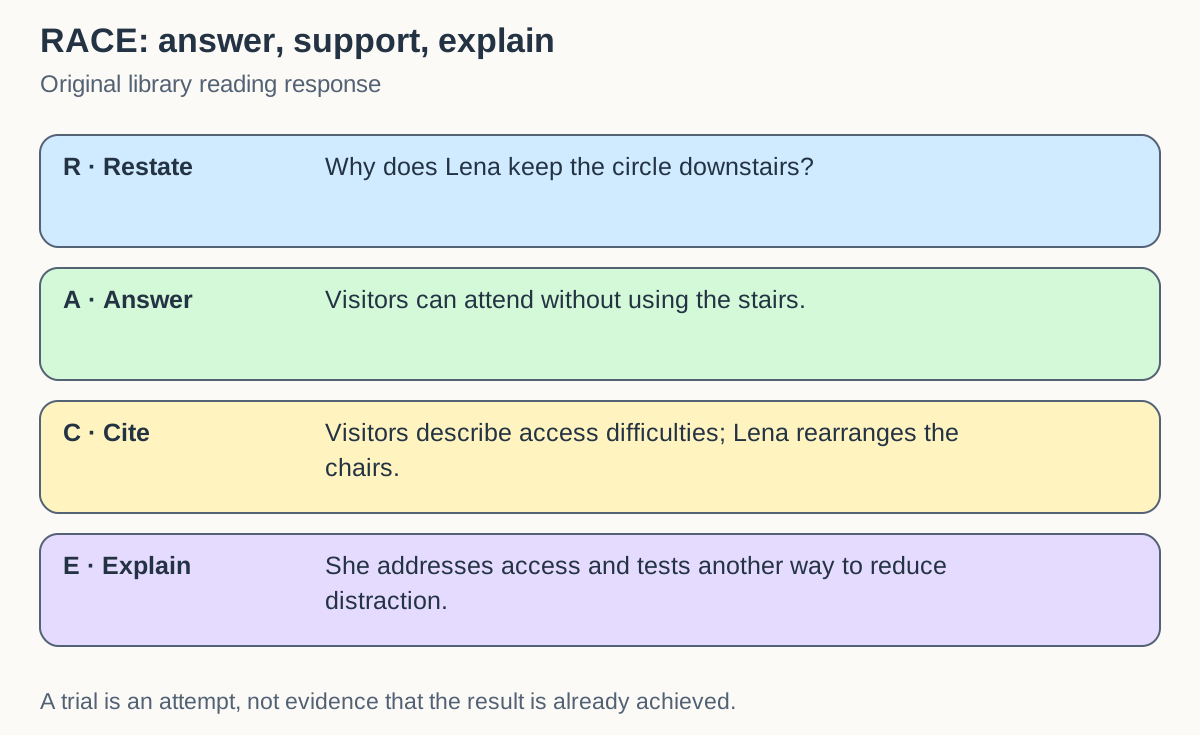
Restate and answer: Lena keeps the reading circle downstairs so that visitors who find the stairs difficult can still attend, while she looks for another way to reduce distractions.
Cite: Mr. Ortiz says climbing the stairs is painful, and the children describe their grandmother’s walking frame. Lena then moves chairs away from the doorway and asks visitors to try the layout.
Explain: The visitors’ comments reveal an access problem with the upstairs plan. Rearranging the downstairs room addresses her original concern about noise without requiring everyone to use the stairs. Asking for another trial also shows that she wants to check whether the revised plan works for the people attending.
This response covers both parts of the question. Its explanation links a constraint, a changed plan and a check of the result. It does not claim that Lena makes the library completely accessible or that the new layout definitely solves every noise problem.
If a teacher requires a direct quotation, replace part of the evidence with a short relevant excerpt and add the required location reference. Keep the explanation. A change in citation format should not erase the reasoning that makes the response useful.
Write the response in four practical steps
1. Break the question into its demands
Circle the main question words and underline any “and,” “compare,” “how” or “why” requirement. Turn each demand into a small checklist item. In our example: explain why downstairs, then explain how the final action supports that choice.
Do not confuse repeating the question with understanding it. A sentence beginning “The reason why Lena keeps the circle downstairs and how her action supports that decision is…” may contain many words without giving a usable answer. Start with the decision and reason instead.
2. Draft an answer that can be supported
Write your best answer before looking for a polished opening. Compare it against the passage. “Lena dislikes the upstairs room” conflicts with her initial enthusiasm. “Lena responds to visitors’ access needs” fits the actual sequence.
If your answer needs a detail the passage never supplies, narrow it. Perhaps the wording should change from “proves” to “suggests,” or from “all visitors” to “the visitors described.” A careful qualification can make an answer stronger by keeping it inspectable.
3. Cite the detail that does the work
An evidence sentence needs enough context to be identifiable. “The text says she moved them” leaves the reader guessing what moved and why. “She moves the chairs away from the busy doorway” preserves the action relevant to the noise concern.
Choose quotation when exact wording matters. Paraphrase when the idea or event matters more, while still identifying its source. Neither technique excuses inventing information or using a quotation that merely shares a word with the question. The CER examples offer more practice distinguishing relevant support from related facts.
4. Explain the connection, then check coverage
Try writing “This matters because…” privately and completing the thought. The final version can use more natural language. Explain what the detail changes in your understanding of the decision.
Finally, return to the question. Has every part received both an answer and enough support? A response may have four labeled boxes and still omit half the task. Checking coverage is more useful than counting whether each letter has exactly one sentence.
Weak answers and specific repairs
Weak answer: “Lena is kind. The text says Mr. Ortiz has trouble on the stairs. This shows that she is kind.”
The answer names a broad character quality but does not explain the decision or the final action. The last sentence repeats the label. Repair it by identifying the access constraint, naming the alternative arrangement and explaining why a visitor trial matters.
Overstated answer: “Lena proves that moving chairs fixes library noise for everyone.”
The passage reports a proposed adjustment and another trial, not a successful measurement. Repair it with “tries to reduce distractions” and “checks the arrangement.” Evidence of an attempt is not evidence of a confirmed result.
Dropped quotation: “She ‘asked the visitors to test the new layout.’ Lena is thoughtful.”
The quotation is relevant, but the connection remains unstated. Add that testing lets the visitors help evaluate whether the revised plan meets their needs. The explanation should name the relationship rather than ask an adjective to do all the work.
RACE, RACES, PEEL and CER: which one fits?
Use RACE when responding to a question and making the source-based reasoning visible. RACES adds a short ending when a longer response needs closure. A suitable summary here would be: “Her decision balances participation with the original aim of a quieter reading space.”
That sentence pulls together the existing answer. It should not introduce a new claim about costs, building regulations or visitors’ medical conditions. A conclusion cannot repair missing evidence by adding a larger claim.
PEEL paragraphs focus on developing a paragraph and linking it to an essay’s main argument. CER focuses on the support-and-reasoning relationship, often in explanations of observations. The structures overlap; select one that clarifies the task rather than stacking every acronym into the same paragraph.
For planning a piece from a particular speaker’s perspective, RAFT writing works earlier in the process. It helps decide who is writing and to whom, whereas RACE helps make an answer accountable to the material.
A practice routine for independent responses
First, hide the completed response and answer the question from the passage. Mark the source detail supporting each answer sentence. Then write a margin note explaining the connection in ordinary language. If the margin note is stronger than your explanation, bring that idea into the response.
Next, exchange drafts with a partner. Ask them to point to the exact words answering both parts of the question. They should not guess what you intended. Have them circle any claim they cannot locate in the passage and underline any explanation that only repeats a detail.
On a whiteboard, keep the question above four labeled areas. Use separate text blocks for answer, source detail and interpretation so you can move them while revising. This is a manual planning activity; it does not require a dedicated RACE generator or a particular export format.
A concept map can help with a response involving several related claims, but a short answer often needs only a small plan. Avoid spending more time decorating the organizer than checking the evidence. The finished prose, not the color coding, must communicate the reasoning.
Before submitting, check the assignment’s quotation, citation, spelling and length requirements. Read the response once without its planning labels. It should sound like a clear answer to a reader’s question, not a list of instructions about how an answer ought to be written.