Somebody Wanted But So Then, often shortened to SWBST, helps you summarize a story by keeping its main thread: a character wants something, encounters a problem, responds, and reaches an outcome. The goal is a compact account of what drives the narrative, not five boxes filled with unrelated details.
Use the original kite story below to build a five-part organizer and turn it into a finished summary. You will also revise a long retelling, separate So from Then, and check when another structure would fit a text better.
What belongs in each part of SWBST?
| Prompt | What to identify | What to avoid |
|---|---|---|
| Somebody | The character central to this thread | Listing every named person |
| Wanted | The goal driving the action | A minor preference unrelated to the plot |
| But | The obstacle or conflict | Any event that merely happens next |
| So | The response and important subsequent events | Assuming the first attempt must work |
| Then | The actual outcome | Adding a moral or happy ending not in the text |
Smekens Education’s teaching resource uses the frame for narrative summaries and distinguishes it from detailed retelling. Its description of the “So” section includes developing events and attempts. We use “response” below as a practical reminder that the action does not have to solve the problem immediately.
The words organize your thinking. A finished paragraph can use more natural transitions. You do not have to preserve every label or squeeze a complicated novel into a single sentence just to keep the acronym visible.
Original practice story: The kite on the roof
Ari had spent Saturday building a blue paper kite for the neighborhood afternoon gathering. Just before leaving, he carried it into the courtyard to check the tail. A gust pulled the string from his hand and left the kite caught on the low shed roof. Ari dragged a chair toward the shed, but stopped when the chair rocked on the uneven stones. He took it back inside and asked his neighbor Mei for help. Mei brought a long-handled brush while Ari held a basket below the roof edge. Together they eased the kite down. One corner was torn. Ari patched it with spare paper and reached the gathering after the first flight had finished. He stayed to help the younger children launch their kites.
All characters and events are invented for this exercise. You have the whole passage, so you can check every claim in the organizer rather than rely on familiarity with a well-known story.
The key question is not “What happened first, second and third?” It is “Which events do I need to explain Ari’s goal, the obstacle and the eventual outcome?” The blue color creates an image, but removing it does not change that chain. The rocking chair matters because it changes Ari’s response.
Fill the organizer before writing the summary
| Part | Selected detail from the story |
|---|---|
| Somebody | Ari |
| Wanted | To bring his handmade kite to the neighborhood gathering |
| But | The wind left it caught on a shed roof |
| So | He abandoned an unstable-chair attempt, asked Mei for help, recovered the kite and patched it |
| Then | He arrived after the first flight and helped younger children launch their kites |
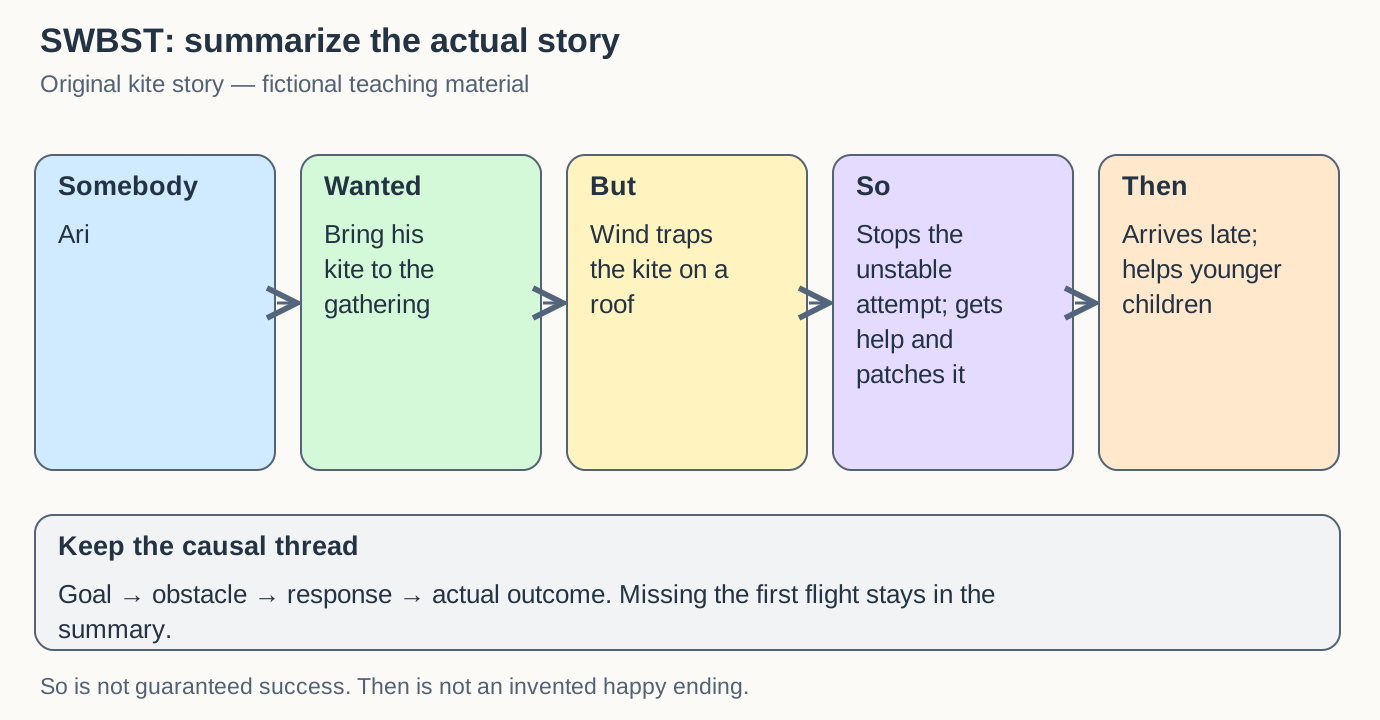
A short framed summary might read:
Ari wanted to take his handmade kite to a neighborhood gathering, but the wind trapped it on a shed roof. After stopping an unstable attempt to reach it, he asked Mei for help, recovered and repaired it, and arrived late enough to miss the first flight but still help younger children.
This version preserves a complication: getting the kite back does not mean the original plan happens exactly as intended. A summary saying “Ari retrieved his kite and won the competition” would introduce both a competition and a victory absent from the story.
How to choose details in five passes
1. Follow one main narrative thread
For a short story, choose the character whose goal connects most of the events. Mei is important as a helper, but the passage follows Ari’s intended outing and response to the lost kite. Listing every person at the gathering would hide that focus.
A longer text may contain several interwoven goals. Identify which thread the assignment asks you to summarize. If it asks for an entire novel, you may need a broader summary with several connected sequences, rather than treating one minor character’s goal as the whole book.
2. State what the character wants specifically
“Have a good day” is so broad that almost any event would fit. “Bring his handmade kite to the gathering” explains why the roof problem matters. A useful goal lets the reader understand what is at stake without a separate essay about motivation.
Sometimes a desire is implied rather than stated. Use evidence from the character’s actions and qualify your language if needed. Do not replace a missing motive with an elaborate personal history the author never supplies.
3. Find the obstacle that changes the plan
The gust and roof create the central interruption. The unstable chair adds a complication to the response. You can mention both when the desired summary length allows it, but avoid giving them equal space with every movement through the courtyard.
An obstacle can be external, internal or interpersonal. It need not be a villain. A character’s uncertainty can create conflict, but you still need textual support for treating it as the force affecting the goal.
4. Preserve actions and consequences together
The “So” section should explain how the narrative moves after the obstacle. In this story, Ari stops one attempt and chooses to seek help. Reducing that to “Mei had a brush” removes his decision and leaves a disconnected object detail.
For a story with several failed attempts, keep the attempts that change the direction of events. Combine repeated actions when they have the same narrative function. You are selecting a causal path, not transcribing a diary of every step.
5. End where the text actually ends
Ari’s kite is recovered and patched; he misses the first flight and helps younger children. Those facts can coexist. Do not remove the delay to make a tidy success story, and do not invent disappointment or a lesson the passage never states.
For an unresolved ending, say what remains unresolved. “The story ends before the decision is made” can be more accurate than completing the plot yourself. A summary reports the source’s outcome; a creative continuation is a different task.
Retelling versus summarizing: revise this draft
Consider an overlong retelling:
Ari built a blue kite on Saturday. He went into the courtyard and checked the tail. The wind blew. The string left his hand. He went inside and got a chair, put it near the shed, noticed it rocked, and carried it back. Mei came with a brush. Ari got a basket. They stood by the shed and lowered the kite. It had a tear, so he got spare paper. Then he went to the gathering.
Many statements are accurate, but the draft buries the original goal and loses the actual ending. Accuracy alone does not make a detail important enough for the summary.
Repair it by combining the wind and roof into one obstacle, combining the attempted retrieval and request for help into a response, and restoring the late arrival and help offered to younger children. Remove color and small movements unless the task specifically asks about imagery or sequence.
Now compare the revised version with the framed summary above. Can a reader explain why Ari acts and what changes? If so, the compression has preserved understanding rather than merely shortened the text.
Common mistakes that change the story
Confusing action and outcome: “So he arrived late; then he asked for help” reverses the sequence. Put the response before its consequence and reread against the original passage.
Adding a moral: “Then Ari learned that friendship is the greatest gift” may be an interpretation, but the story does not state it. Keep an objective summary separate from a theme discussion unless the assignment requests both.
Listing all characters: A long cast list uses space without explaining the goal. Name secondary characters when their actions are necessary to understand the thread; otherwise use a short description or omit them.
Making every ending successful: A failed attempt or incomplete resolution belongs in the summary when it is part of the source. Do not use the frame as a machine for turning every narrative into a victory.
Use an organizer without confusing it with a plot map
A story mountain helps examine rising tension, a turning point and resolution. SWBST helps compress a narrative into its important goal-and-conflict thread. Both can use the same story, but they answer different questions.
If you need to inspect how scenes connect visually, the storyboard template can hold a few key scenes. Label it as planning support, not as a ready-made SWBST worksheet. A hand-drawn five-area plan is enough for the exercise here.
For a question asking why a character makes a choice, switch from summary to a supported answer using RACE. For a new piece written from a character’s viewpoint, RAFT helps set the role and audience. Keep summary, interpretation and creative writing separate so readers know which task you are doing.
Before submitting, remove planning labels if they make the prose awkward, verify every event against the text, and check that the ending has survived the editing. Your summary should let a reader follow the story’s essential movement without pretending to replace the whole reading experience.