A story mountain is a planning diagram that connects a story's opening, rising trouble, climax, falling action and ending. Put specific events along the slope so you can see how a character's problem develops, which choice changes the outcome, and what follows from that choice.
Below, a complete original short story becomes a five-part mountain. You will also see a weak event list revised into a conflict-driven plan. The five-part shape is a useful teaching structure, not a rule that every good story must follow.
What each part of the story mountain does
Twinkl's story mountain overview describes this planning approach and several variations in complexity. Here we use five parts to keep one short narrative readable. The story, event mapping and revision exercise are original examples.
| Part | Its job | A question to answer |
|---|---|---|
| Opening | Establish the character, situation and desire | What does the character want now? |
| Build-up | Create obstacles and rising pressure | What makes getting it harder? |
| Climax | Bring the central conflict to a turning point | What consequential choice or action changes things? |
| Falling action | Show immediate consequences | What happens because of that choice? |
| Ending | Resolve or deliberately reframe the central problem | What has changed from the opening? |
A peak does not require a battle, disaster or enormous surprise. In a quiet story, admitting a mistake can be the turning point. What matters is its relationship to the conflict the story has developed.
Do not confuse the climax with the last sentence. The climax changes the direction of the problem; the ending shows where that change leaves the characters. Separating them helps you avoid stopping immediately after the most important action.
Read the complete original story: The Last Lantern
The following story is written for this walkthrough. It is fictional and can be used as the shared source for the exercises below.
Leila carried the last paper lantern into the community hall with both hands. She had promised to hang it above the tiny stage before the evening storytelling session. Her grandfather had painted a blue river along its sides, leaving a gap where the paper seam met. “Every river needs a crossing,” he had said, handing her a small strip of plain paper to cover it.
The other lanterns were already up. Leila placed hers on a chair and reached for the cord. A sharp tearing sound stopped her. One corner had caught on a loose splinter, leaving a long opening beside the painted river.
She turned the damaged side toward the wall. From the doorway it almost looked whole. If she hung it high enough, perhaps nobody would notice. She pulled the cord through its top loop, but the tear widened and the lantern leaned sideways.
Outside, chairs scraped across the courtyard. The first listeners would arrive soon. Leila found a roll of tape in the cupboard and pressed a piece across the tear. The thin paper wrinkled. She tried another piece. Now a shiny patch covered part of the river, and the corner still would not hold.
Her friend Arun appeared with a box of cushions. “Ready?” he asked. Leila opened her mouth to say yes. Then she looked at the crooked lantern and remembered the plain strip in her pocket.
“I tore it,” she said. “I need help fixing the corner before we hang it.”
Arun put down the cushions. Together they lowered the lantern onto the table, supported the torn edge with the paper strip, and fastened it carefully. The patch was visible, so Leila drew a small crossing over it with a blue pencil from the craft box.
When her grandfather arrived, the lantern hung level above the stage. Leila pointed out the repair before he could ask. He studied the little crossing and smiled. “Now someone can get to the other bank.”
Leila took a seat beside Arun. The lantern was no longer exactly as it had been that afternoon. It was ready for the stories.
Before drawing anything, state the problem in one sentence: Leila wants to prepare the lantern, but her attempt to hide its damage makes the task harder until she asks for help. That sentence is a useful test of whether the planned mountain contains a coherent story rather than a schedule.
Put the story onto the mountain
The diagram can be a simple rising and falling line with five labeled areas. Write events beside it rather than trying to fit the entire story into tiny boxes.
| Mountain position | Specific event | Why it belongs there |
|---|---|---|
| Opening | Leila promises to hang her grandfather's lantern | Establishes a task and a personal reason to care |
| Build-up | The paper tears; hiding it and taping it fail as listeners approach | Obstacles and time pressure make the problem harder |
| Climax | Leila admits the damage and asks Arun for help | Changes her strategy from concealment to cooperation |
| Falling action | They repair the corner and turn the patch into a crossing | Shows the practical consequence of the new strategy |
| Ending | Leila shows the repair and sits down for the session | The task is complete, and she no longer hides what happened |
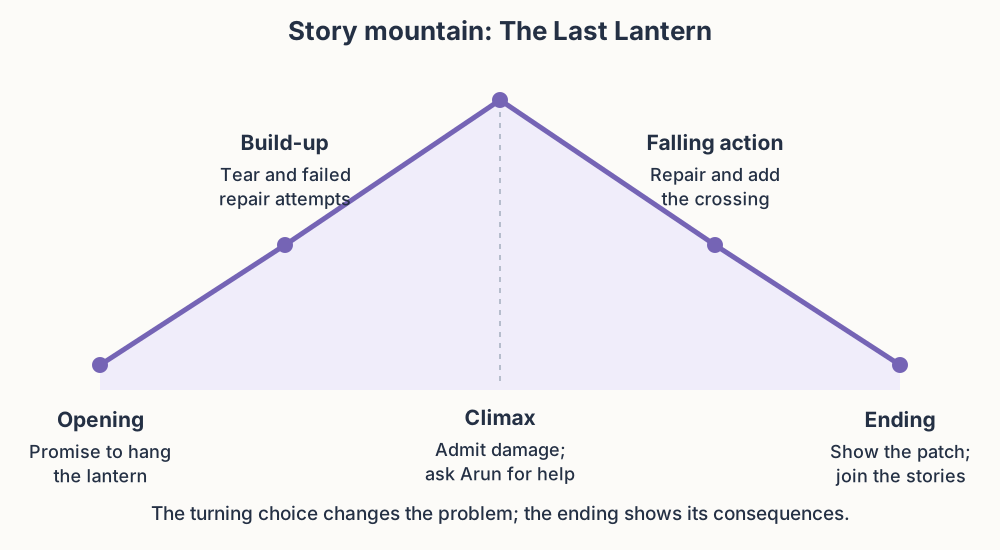
The tearing sound is an important incident, but it is not the climax in this reading. It starts the central difficulty. Hanging the repaired lantern is an outcome. The request for help is the turning point because it changes how Leila responds to the difficulty.
A reader could make a case for a slightly different boundary between build-up and climax. Ask them to support it with events and consequences. The exercise should encourage interpretation, not reward matching a teacher's exact line placement.
Build your own story mountain in five passes
1. Give the character a concrete desire
“Leila wants to be happy” is too broad to plan a scene. “Leila wants to hang the lantern before the audience arrives” gives the reader a visible task and a way to recognize an outcome.
A desire need not be admirable. A character might want to hide a mistake, win an argument or avoid an awkward conversation. What matters is that it can generate meaningful choices.
2. Choose an obstacle that pressures that desire
The torn paper directly interferes with hanging the lantern. An unrelated surprise, such as finding a missing shoe, would add an event without necessarily developing this conflict.
Add consequences to failed attempts. In our example, hanging the lantern widens the tear, and taping it creates a visible patch without solving the support problem. Each attempt changes the situation instead of resetting it.
3. Identify the turning choice before the final outcome
Ask what the character does differently at the peak. Leila does not receive a new lantern by coincidence. She changes her approach and asks someone to help with the existing problem.
Keep the choice plausible using details already present. The plain strip appears in the opening, so its later use does not feel like an object invented only to rescue the ending.
4. Show the consequences on the downward slope
After the request, Arun helps repair the corner. The crossing makes the patch part of the design. These consequences need enough space to make the solution understandable; a single “everything was fine” would skip the actual resolution.
Check whether the consequence follows from the peak. If the lantern repaired itself while the characters talked, the climax would no longer do the explanatory work the story assigns to it.
5. End with a changed situation
The final image returns to the lantern, but it now carries a visible repair that Leila acknowledges. That gives the ending a relationship to the opening instead of merely announcing that the day is over.
Use a novel outline if you later expand the idea into a longer project with multiple arcs. A short story mountain can remain one planning layer; it does not need to contain every chapter or subplot.
Fix a mountain that contains events but no conflict
Here is a weak plan:
Leila arrives at the hall. She takes out a lantern. She hangs it. Her grandfather arrives. Everyone listens to stories.
It has a beginning and an ending, but its middle contains no pressure on the task. Simply placing “She hangs it” at the peak does not create a climax.
A revised plan might be:
| Earlier plan | Revised plan | What the revision adds |
|---|---|---|
| Arrive at hall | Arrive with a promised handmade lantern | A specific commitment |
| Take out lantern | Tear it while preparing to hang it | An obstacle tied to that commitment |
| Hang it | Fail to hide and patch it before choosing to ask for help | Attempts, pressure and a turning point |
| Grandfather arrives | Show him the visible repair rather than conceal it | Consequence and changed behavior |
| Listen to stories | Sit beneath a repaired lantern ready for the session | A concrete closing image |
Conflict does not mean adding cruelty or danger. A practical problem, embarrassment and a deadline provide enough tension for this small story. Match the scale to your intended audience and tone.
Use the mountain to revise a draft
Read the draft and write each major event on a separate note. Put the notes along the mountain. If the build-up contains many episodes that do not affect the central problem, combine or remove some. If the climax depends on information the reader has never encountered, plant that information earlier or change the solution.
Then check the downhill side. A rushed ending often means the draft tells us a decision was made but never shows its effects. Add a scene or a concrete action that lets the reader see the changed situation.
For visual storytelling, move the selected moments into a storyboard or comic-strip layout. Those formats plan what an audience sees in sequence. The story mountain explains why the sequence rises toward a meaningful change; the two tools have different jobs.
When comparing two possible endings, a double bubble map can help separate what stays the same from what each ending changes. Choose the ending that follows from the story's choices rather than the one with the biggest surprise.
Where the mountain helps and where it needs adapting
The format is useful for a short story with one main problem, an introductory writing lesson or a revision discussion. It gives learners a shared way to talk about preparation, pressure, turning points and consequences.
Some narratives use several peaks, circular structures, parallel protagonists or intentionally unresolved endings. Adapt the shape when it stops representing the story. You can draw two mountains, add a second line, or choose another outline instead of forcing every narrative into five equal sections.
The slopes also do not prescribe word counts. The build-up may be much longer than the ending. A classroom exercise can set length limits, but those are assignment constraints rather than a universal property of narrative.