RAFT writing begins with four connected choices: Role, Audience, Format and Topic. Decide who is speaking, who needs the message, what kind of text will carry it and what the text needs to address. Those choices should change the writing, not simply fill four boxes above an ordinary essay.
Below, one fictional community-garden situation becomes a request, a notice and a diary entry. The topic stays the same while the purpose and reader change. You can use the examples to plan a classroom assignment or check whether your draft actually fits its audience.
What the four RAFT choices mean
| Choice | Planning question | A concrete answer |
|---|---|---|
| Role | Whose knowledge and voice shape the piece? | Student garden volunteer |
| Audience | Who will read it, and what do they need? | Coordinator who can approve a trial |
| Format | What form supports that exchange? | Short request email |
| Topic | What specific issue is being addressed? | Trial of a revised watering rota |
NCTE’s ReadWriteThink guide presents RAFT as a way to explore writing perspectives and communication choices. Here we add a separate purpose line to make the examples easier to evaluate. That line is a planning aid, not a fifth letter that every version of RAFT requires.
A topic such as “gardens” is too broad for an actionable prompt. “Ask the coordinator to approve a one-week trial of a revised watering rota” gives the writer a decision, a reader and a limit. It also makes it possible to judge whether the finished text has done its job.
Keep the source facts fixed before changing voices
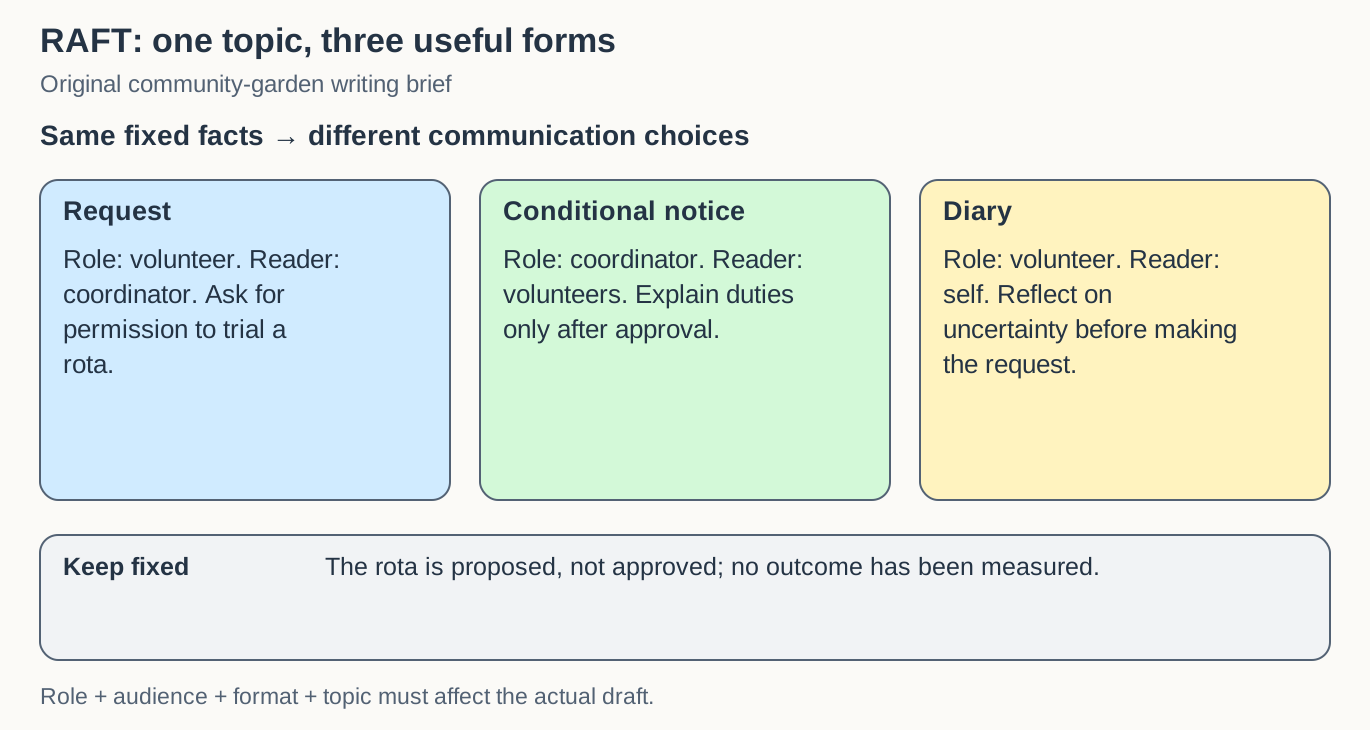
Use this original fictional brief for all three examples:
- A school shares a small community garden with local residents.
- Volunteers currently choose watering days informally.
- Last Tuesday, two volunteers watered the same beds while another bed was missed.
- A coordinator can approve a trial rota but has not yet done so.
- The proposed trial lasts one week and assigns one named volunteer to each day.
- Nobody has measured water use or plant growth during a trial.
These facts prevent creative perspective-taking from becoming accidental misinformation. A diary entry may include invented feelings belonging to a fictional narrator, but it cannot report a successful trial that has not happened. A request may propose a measurement, but it cannot pretend the results already exist.
If students are using a real historical source, identify what the source establishes before asking them to adopt a voice. “Write as a person in that period” does not give permission to manufacture testimony and present it as a quotation.
Three RAFT writing examples from the same topic
Example 1: A volunteer requests a trial
Role: Student volunteer. Audience: Garden coordinator. Format: Request email. Topic: A one-week watering rota. Purpose: Obtain permission for a limited experiment.
Could we try a named watering rota for one week? Last Tuesday, two volunteers watered the same beds while another bed was missed. A single named volunteer for each day could make responsibility clearer. I can draft the rota, check that everyone agrees to their day and collect a short note after each visit. At the end of the week, we could review missed or duplicated visits before deciding whether to continue. Please let me know whether you approve the trial and who should confirm the assignments.
This writer needs a decision from someone with authority. The request therefore includes the problem, a bounded proposal, a way to inspect it and an explicit ask. It does not demand permanent adoption or claim that a rota will certainly save water.
Example 2: A coordinator drafts a conditional notice
Role: Coordinator. Audience: Volunteers. Format: Notice prepared for use if the trial is approved. Topic: How the rota would work. Purpose: Explain responsibilities.
Draft notice — use only after approval: During the trial week, one named volunteer will be responsible for each day’s watering check. Before the rota begins, please confirm that you can cover your assigned day. If you need a swap, agree it with another volunteer and tell the coordinator so the rota can be updated. After your visit, note which beds you checked and whether watering was needed. We will review missed and duplicated visits before deciding what to do next.
The conditional label matters because the brief says approval is pending. A polished notice must not silently change that fact. This text prioritizes what volunteers would do, rather than repeating the full argument for permission.
Example 3: A volunteer reflects in a diary
Role: Fictional student volunteer. Audience: Self. Format: Diary entry. Topic: Last Tuesday’s confusion. Purpose: Reflect on responsibility.
I thought arriving early would make me useful, but another volunteer had already watered the beds I chose. Later, we noticed the far bed had been missed. I felt awkward because both of us had tried to help. I want to suggest a rota, though I am not sure everyone will like having a fixed day. Before I send the request, I should ask what makes the current arrangement convenient for them.
The diary can foreground uncertainty and personal interpretation. It should still preserve the difference between what happened, what the narrator feels and what they plan to do. Its private audience does not make factual contradictions useful.
Build a RAFT prompt that produces different writing
1. Define what students must understand
Choose a learning goal before choosing an entertaining role. If the goal is audience awareness, hold the topic fixed and compare readers. If the goal is explaining a scientific process, the response must demonstrate that process even when the voice is playful.
An unusual narrator can motivate a task, but it can also distract from it. A water droplet speaking to a cloud still needs accurate content if the assignment assesses the water cycle. Decide which details students must preserve and which they may invent.
2. Specify a reader with a real information need
“Everyone” rarely helps a writer select content. Name a reader who needs to decide, understand or act: a coordinator approving a trial, a new volunteer preparing for a visit, or a younger pupil learning the rules.
Write one sentence describing what that reader already knows. A new volunteer needs practical instructions. The coordinator may already know the garden layout but need evidence of the problem and a realistic review plan. Those differences should be visible in the finished draft.
3. Choose a format with useful constraints
A notice needs scan-friendly actions. An email request needs a decision and enough context. A diary can explore an unresolved thought. Do not use “poster,” “letter” and “speech” as interchangeable decorations around the same essay.
For a speech, consider what a listener can remember without rereading. For an email, consider the reply being requested. For a leaflet, consider which information must be visible first. Format creates communication decisions, not merely different page sizes.
4. Narrow the topic and add a purpose
Replace “write about the watering rota” with an achievable action: request approval, explain the proposed process, or reflect on a difficulty. Check that the chosen role has the knowledge and authority required for that action.
For example, a student can propose a trial but cannot announce official approval on the coordinator’s behalf. A role mismatch can create a factual error even when the prose sounds confident. Keep the source brief next to the RAFT plan during drafting.
Revise a draft that misses its audience
Suppose the student’s request begins: “Volunteers must follow my new rota from Monday. Anyone who misses a day will be removed.” The student has assumed authority they do not have and introduced a punishment absent from the brief.
Repair the role by making a proposal rather than an announcement. Repair the audience fit by asking the coordinator for a decision. Repair the content by limiting it to the proposed one-week trial and a review of what happens. The improved request above makes those changes without requiring more dramatic language.
A second mismatch would send the diary entry to every volunteer as an instruction notice. Its uncertainty is appropriate for reflection, but readers still need clear tasks. Preserve useful concerns, then turn them into questions to resolve before a notice is issued.
Assess the writing rather than the filled boxes
Check five things: factual consistency, role credibility, audience usefulness, format choices and purpose. A plan can contain four correct labels while the response ignores every one. Ask the writer to point to a sentence showing how the audience affected their decisions.
For peer review, temporarily remove the labels. Can a reader infer who is writing and what response is wanted? If not, revise the text rather than decorate the organizer. An empathy map may help explore a reader’s concerns, but it is not evidence of what every real reader thinks.
Move from the plan to paragraphs
RAFT sets the communication situation; it does not supply every paragraph’s logic. Use PEEL when a paragraph needs an arguable point and a link to a larger argument. Use RACE when the task is a source-based reading response.
You can arrange the four planning choices as text blocks on a whiteboard, place the fixed facts beside them, and draft each version underneath. The mind map template is an optional starting point for exploring alternatives; no dedicated RAFT template or automatic writing feature is required.
Before sharing the final piece, remove unused planning notes, check the real recipient and verify any statement about approval or results. The best evidence that RAFT helped is a message whose choices make sense for its reader, not an organizer with four neatly colored headings.