The rhetorical triangle helps you examine how a message tries to persuade. In the appeals version, ethos concerns credibility, pathos concerns audience feelings and values, and logos concerns reasoning. A strong analysis identifies the words doing that work and explains why they might matter to a particular audience.
The original school proposal below lets you practice all three appeals, check the evidence, and revise a message that relies too heavily on pressure. Recognizing an appeal does not mean accepting the claim: a statement can sound credible or emotional while still being unsupported.
Which rhetorical triangle are you using?
You may encounter two related diagrams. One maps speaker, audience and message or subject. The other organizes ethos, pathos and logos. They help ask connected questions, but they are not identical labels for three interchangeable corners.
| Appeals model | What to inspect | What it does not guarantee |
|---|---|---|
| Ethos | Relevant knowledge, honesty, responsibility, source use | That the speaker is correct |
| Pathos | Feelings, values, stakes, identification | That an emotional claim is fair |
| Logos | Evidence, assumptions, comparisons, inference | That a number proves the conclusion |
KPU’s writing textbook discusses the three appeals. This article uses that version. If your assignment provides a speaker–audience–message triangle, retain its terms and use the appeals as questions about the relationship rather than replacing the diagram silently.
Before marking a text, name its purpose and audience. A message asking a school council to approve a trial needs a different level of operational detail from a short invitation asking families to attend. The same sentence can serve more than one appeal, depending on its context.
Read this original proposal and its evidence brief
Fictional situation: A student group wants to trial a weekly lost-property collection table near the school entrance. The council can approve a staffed trial. The group has not run it yet.
Practice observations: During two supervised sorting sessions, the group counted 18 unclaimed jackets. Five had readable name labels. These are invented classroom figures, not data from a real school. They establish neither an annual loss rate nor the number of families affected.
Draft proposal:
Our student group helped sort the lost-property cupboard during two supervised sessions. We counted 18 unclaimed jackets, including five with readable name labels. A staffed collection table near the entrance on Friday could make it easier for families to check items while they are already at school. Finding a familiar jacket can spare a child the worry of looking for it and a family the frustration of replacing something still in the building. We propose a two-Friday trial, with staff checking ownership and volunteers recording how many items are returned. Please approve the trial if supervision can be arranged; afterward, we can review the returns and any difficulties before deciding whether to continue.
The proposal makes a limited request. It does not claim that the table will eliminate losses, save a particular amount of money or improve student wellbeing by a measured percentage. Those statements would require evidence not supplied by the brief.
Annotate ethos, pathos and logos in the example
Ethos: The group describes its direct participation in supervised sorting. That gives readers a reason to consider its observations relevant. Mentioning supervision and an ownership check also communicates responsibility for how the proposed activity would run.
Credibility remains bounded. Sorting jackets does not make the group an authority on all family needs or school safety procedures. A good analysis notes both the source of credibility and the limits of that source.
Pathos: The proposal names a child’s worry and a family’s frustration. These are plausible concerns the writer invites the council to consider, not measured outcomes. The wording should remain proportionate rather than inventing a distressed family and presenting that invented story as testimony.
Logos: The count of unclaimed jackets establishes a specific problem. The proposal then reasons that a visible table during an existing school visit could make checking easier. A limited trial and return count provide a way to inspect that reasoning rather than treat it as a guaranteed result.
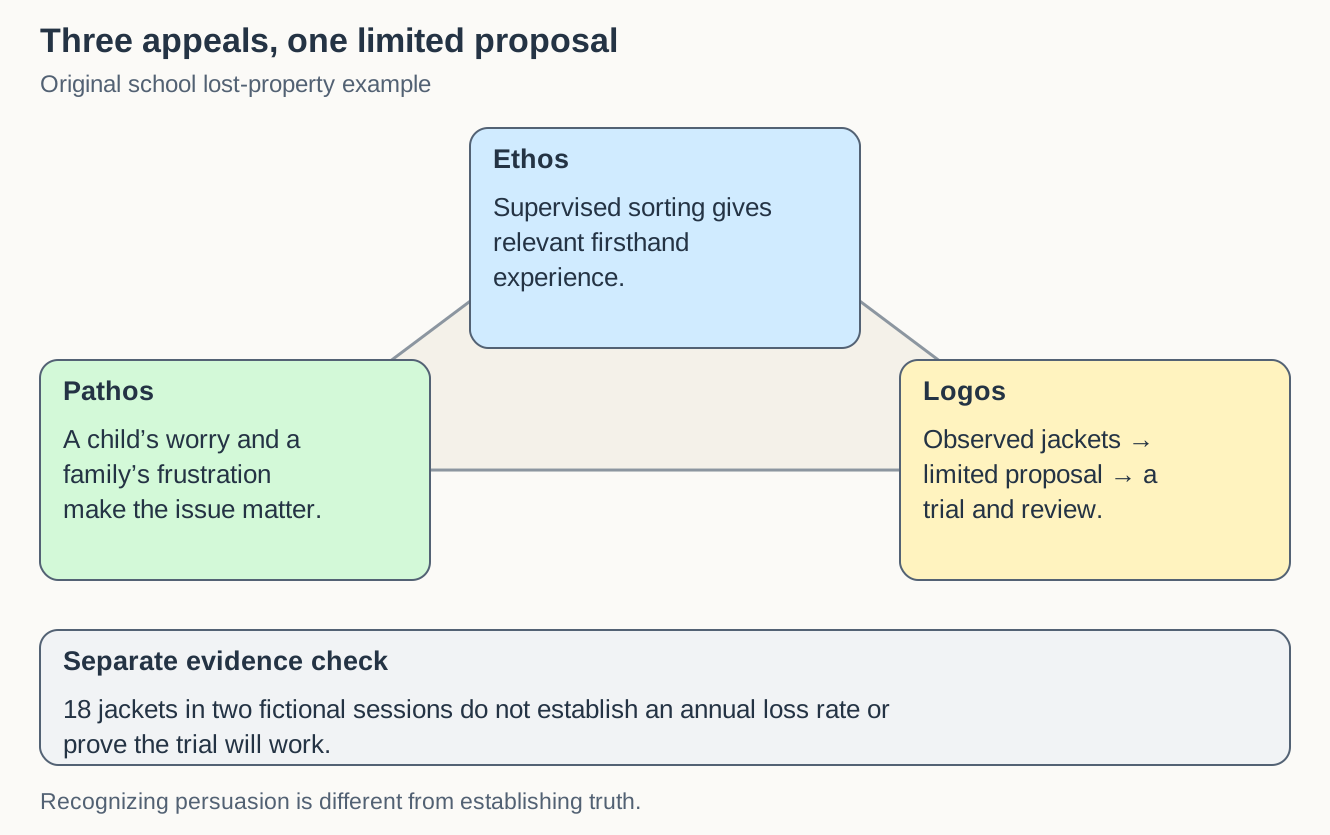
The number 18 is not logos simply because it is numerical. Its role depends on what it supports. It can describe the cupboard at those sessions. It cannot alone show that most families lose jackets or that a collection table is the best possible intervention.
Analyze a passage in five steps
1. Write the actual request in one sentence
What does the writer want the audience to believe or do? Here: approve a staffed two-Friday trial if supervision is available. If you describe the purpose only as “persuade people,” you have not yet identified the practical decision.
Distinguish the explicit request from implications. The proposal does not ask to discard items, publish children’s names or change school policy permanently. Do not analyze an invented larger request because it produces a more dramatic essay.
2. Identify what this audience needs to decide
The council needs to know whether the problem is worth addressing and whether the trial can be run responsibly. Volunteers need task instructions, while families need collection times and ownership rules. A different recipient changes what counts as sufficient information.
A RAFT plan can clarify this communication situation before you analyze appeals. It asks who is writing, to whom and in what form. That prevents an analysis from assuming that every audience responds to the same concerns.
3. Select exact textual evidence for each appeal
Point to a short phrase or paraphrase a specific sentence. “The whole paragraph uses ethos” is difficult to inspect. “The group establishes firsthand involvement by describing supervised sorting” identifies a visible strategy and its function.
Do not force every sentence into one box. An ownership check can contribute to credibility and to the practical reasoning behind the trial. Explain the overlap rather than pretending the color categories are mutually exclusive.
4. Explain the likely effect with appropriate limits
Use wording such as “invites the council to consider” or “may reassure readers concerned about supervision.” Unless you have audience research, you do not know that the sentence actually changed anyone’s mind.
For an analytical paragraph, combine a claim about the appeal, textual support and an explanation. The PEEL paragraph walkthrough shows how to connect that local analysis to a larger argument about the message.
5. Evaluate the support independently
After identifying the persuasive technique, ask whether its underlying claim holds up. Who counted the items? Over what period? Does the proposed action address the observed issue? What important uncertainty remains?
The triangle describes persuasion; it is not a truth detector. A false quotation from a famous person might attempt ethos while failing an accuracy check. A genuine emotional concern may be relevant without proving that one proposed response is effective.
Revise an unbalanced version
Consider this deliberately weak message:
Every caring council member will approve our table. Children are devastated by lost jackets, and this plan will stop the problem forever. We are students, so we know what everyone needs.
The first sentence pressures the audience by equating agreement with care. The second invents a universal emotional effect and an absolute solution. The third turns group membership into authority over every person’s experience.
A useful repair is not to sprinkle in a statistic. Return to the actual observations, narrow the proposal, identify responsibility, and describe how the trial will be reviewed. The revised proposal above gives the audience a reason to act while preserving room to decline if supervision cannot be arranged.
Notice what changes: the writer replaces moral pressure with a bounded request, replaces certainty with an inspectable trial, and replaces universal expertise with a specific experience. The message can still be persuasive without claiming to know more than it does.
A planning board for your own message
Place the audience and decision in the center of a page. Around them, record three questions: why should this reader trust the account, why might the issue matter to them, and how does the evidence support the request? Keep a fourth area for unanswered questions.
A concept map can connect those observations, but do not present a generic map as a specialized rhetorical-triangle template. The important work is the relationship between a passage and its reader, not the geometric precision of the drawing.
For each note, add the passage location and a brief explanation. If a note contains only “emotion” or “facts,” make it more specific. If a note claims an audience reaction as a certainty, replace it with a supported interpretation or collect actual audience feedback.
Check the analysis before submitting
Read the original message again after writing the analysis. Verify that you have not changed the request, removed a qualification or attributed a motive the writer never expressed. State where an appeal overlaps another instead of forcing a tidy classification.
Then check your own evidence and reasoning. The CER guide is useful if your analysis makes claims but leaves the connection to textual details unstated. A persuasive-sounding analysis still needs support.
Finally, ask whether the finished analysis explains something a reader could miss on a first reading. Naming ethos, pathos and logos is the start. Showing how specific choices work, where they fall short and how a revision would address those limits is the substantive result.