A PEEL paragraph develops one point using evidence, explains why that evidence matters, and links the discussion to the larger argument. PEEL stands for Point, Evidence, Explanation and Link. The structure is a planning and revision aid, not a rule that every paragraph must contain exactly four sentences.
This walkthrough uses an original short passage about a school repair club. You will see the source material, a finished paragraph, the job of each sentence, and a weak version revised into a stronger one. Nothing in the fictional passage is a finding about real schools.
What goes into the PEEL paragraph structure?
Think of the four parts as questions a reader needs answered. Point: what are you arguing here? Evidence: what can I inspect? Explanation: why does that material support your interpretation? Link: how does this advance the main argument or prepare the next point?
| Part | Its job | A useful editing test |
|---|---|---|
| Point | Establish one arguable idea | Does it answer the essay question? |
| Evidence | Supply a relevant source detail | Can someone locate it in the material? |
| Explanation | Interpret the detail | Does it add a connection rather than repeat the quotation? |
| Link | Connect paragraph and argument | Does it name the relationship? |
Staffordshire’s academic-writing guide describes this four-part version. Other courses may use analysis or evaluation terminology. Follow the version your course teaches while checking whether the reader receives all the necessary information.
A paragraph can contain several explanation sentences and still follow PEEL. A short response may combine point and link. The organizer should reveal missing thinking, rather than make every sentence sound identical. If your main difficulty is connecting observations to a conclusion, the claim, evidence and reasoning examples explore that narrower problem.
Start with a question and usable evidence
Essay question: How does the repair club change Maya’s understanding of help?
Original practice passage:
Maya carried a broken radio into the after-school repair club. She expected the volunteer to fix it while she watched. Instead, he placed a small tray beside her and asked her to sort the loose screws. When Maya pointed to a frayed wire, he showed her how to check the connection and waited while she tried. At the next meeting, a younger student arrived with a loose bicycle light. Maya pulled an empty chair toward the workbench and asked, “What have you noticed so far?”
Read before choosing your point. The first and last actions provide a useful contrast: Maya initially expects someone else to act, then invites another student to participate. The passage does not establish that she repairs every device successfully, becomes an expert, or changes every student’s attitude.
An appropriate point is therefore modest: Maya comes to see help as supporting someone’s participation rather than taking over their problem. That claim addresses the question and can be tested against details in the passage. “The repair club is amazing” cannot guide a focused evidence search.
A complete PEEL paragraph example
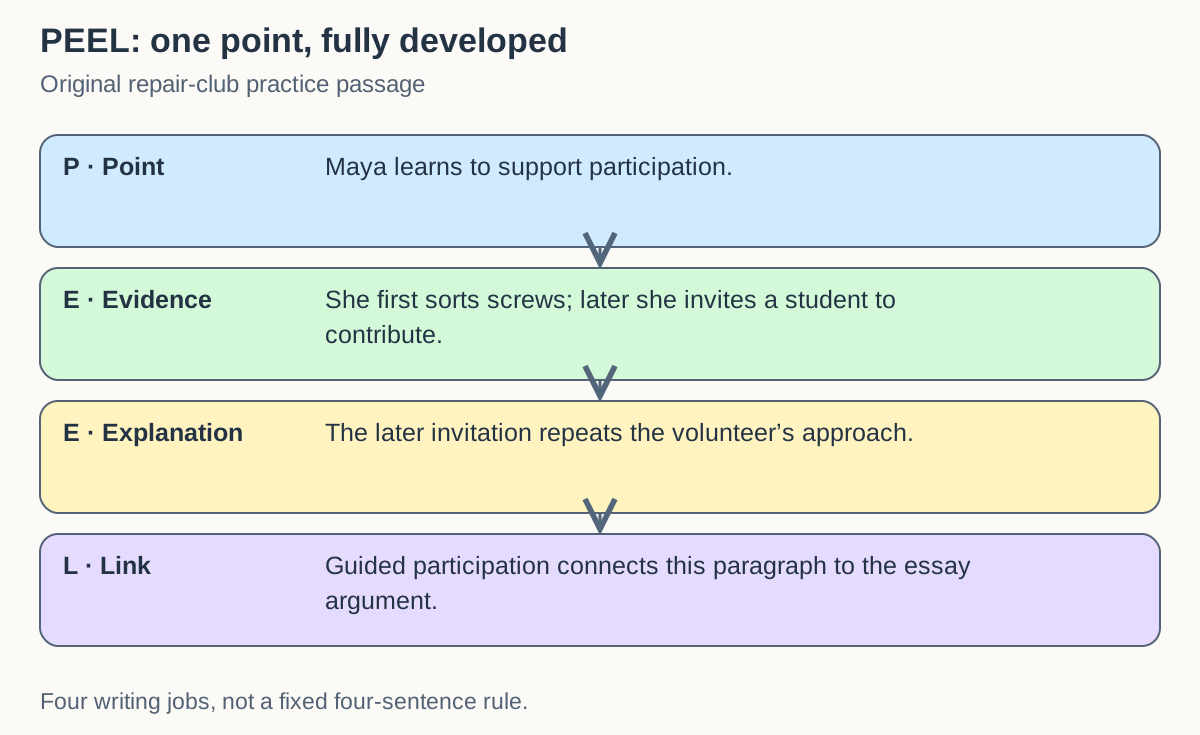
Point: Maya’s experience changes her idea of help from receiving a finished repair to participating in a shared problem-solving process.
Evidence: At first, she expects the volunteer to fix the radio for her, but he asks her to sort screws and investigate a connection. Later, she offers a younger student a chair and asks what they have noticed.
Explanation: The volunteer gives Maya a manageable responsibility and room to make an observation. Her later question repeats that approach: she invites the student to contribute before offering an answer. This contrast suggests that she has learned a way of helping, not simply a repair technique.
Link: Her change therefore supports the argument that the club builds independence through guided participation.
Read without the labels, and the paragraph still has a direction. The opening gives an interpretation, the middle selects a contrast, and the ending connects that interpretation to an essay-level idea. The final sentence does not suddenly introduce an unrelated claim about grades, employment or teamwork.
Notice that the evidence is paraphrased. Quotation is useful when the exact language matters, but copying the longest available sentence is not automatically stronger. For a real text, follow the citation style and location information required by your teacher or publication.
Write your own paragraph in five steps
1. Turn the question into a working answer
Underline the relationship the question asks about: a change, a cause, a contrast or an evaluation. Draft one answer in ordinary language before polishing it. If you can only write a topic label such as “Maya and helping,” you have not yet stated a point.
Use the essay’s wider claim as a boundary. A paragraph about how a character changes should not drift into whether repair clubs deserve funding unless the assignment explicitly connects those questions. Keep the question visible above your planning area.
2. Select the smallest sufficient evidence set
Choose a detail that actually distinguishes your interpretation from alternatives. Here, the empty chair and the question matter because they show Maya’s behavior after the first meeting. A description of the radio’s color, if one existed, would not establish her understanding of help.
Two details can work together. The opening expectation supplies the “before,” and the later invitation supplies the “after.” Add more material only when it answers a reader’s genuine objection or qualifies your claim. Do not paste the entire passage and ask the reader to find the relevant contrast.
3. Explain the inference explicitly
Complete this sentence while drafting: “This detail supports my point because…” Then remove the mechanical starter if the finished paragraph reads better without it. Name what changes and how the selected action makes that change visible.
Distinguish a reasonable inference from invented motive. “She gives the student an opportunity to contribute” follows from her question. “She remembers being ignored by all her previous teachers” invents a history the passage does not provide. Precise explanation is often narrower than a dramatic interpretation.
4. Link back through a named relationship
Choose a link that belongs to this argument. “This matters” is incomplete until you say what it matters for. Our link names guided participation and independence, connecting the paragraph’s particular observation to a broader claim.
If the next paragraph will examine the volunteer’s patience, prepare that connection: “Maya’s later approach also makes the volunteer’s decision to wait important.” The next paragraph must then deliver on that transition. Avoid promising a new topic simply because a transition phrase sounds academic.
5. Read the paragraph without the letters
Remove the planning labels and read aloud. Does evidence arrive with enough context? Does every pronoun have a clear referent? Does the explanation answer a skeptical reader? A successful organizer should eventually disappear into coherent prose.
The same planning process works on paper, in a document, or on a whiteboard. If several paragraphs need ordering, a concept map can show how each point supports the essay’s central claim. It is a planning surface, not an automatic paragraph writer.
Fix a weak paragraph without adding filler
Consider this deliberately weak version:
Maya learns a lot at the repair club. The volunteer asks her to sort screws. This shows that she learns a lot. In conclusion, repair clubs are good.
The evidence is present, but the paragraph has no specific interpretation. “Learns a lot” returns unchanged as its explanation. The final sentence expands from one fictional scene to a general claim about all clubs.
A targeted revision would replace the point with the change in her understanding of help, add her later interaction with the younger student, explain the before-and-after contrast, and link to guided participation. The improved paragraph is longer because it does additional thinking, not because it contains more transitions.
Try another revision test: remove the explanation sentence. If the paragraph seems to make exactly the same argument, the explanation may only be repeating evidence. Replace it with an answer to “Why does this action support this interpretation rather than a different one?”
If the paragraph analyzes persuasion, the rhetorical triangle example helps distinguish an appeal from evidence that the appeal is justified. Describe both the technique and its limits.
Sentence starters that help without taking over
| Need | Starter | What must follow |
|---|---|---|
| State a point | “The contrast suggests that…” | A specific interpretation |
| Introduce evidence | “When…, the text shows…” | An identifiable detail |
| Explain | “The important change is…” | A reason the detail matters |
| Qualify | “This supports…, although…” | A real limitation |
| Link | “This develops the argument that…” | The relevant essay-level claim |
Use starters as temporary supports. Repeating “This shows” in every sentence hides differences between identifying an observation, interpreting it and evaluating its limits. You can often replace the starter with a concrete subject: “Her invitation gives the younger student a role.”
When to adapt or leave the framework behind
PEEL is useful when a paragraph needs a visible argument-and-support relationship. A narrative scene, a methods description, a transition paragraph or a brief definition may have a different job. Do not force a laboratory procedure to end with a literary-style thesis link.
For a reading question that mainly needs a direct answer plus textual support, compare the RACE writing strategy. For deciding who speaks to whom before drafting, use RAFT writing. Those frameworks help at different stages; using all three labels at once is rarely necessary.
Before submitting, check the question, the accuracy of every source detail, the explanation’s logic, and the final connection. Then check the assignment’s required citations and paragraph length. A clean four-box plan is useful only when the resulting paragraph gives the reader a clear, supported idea.