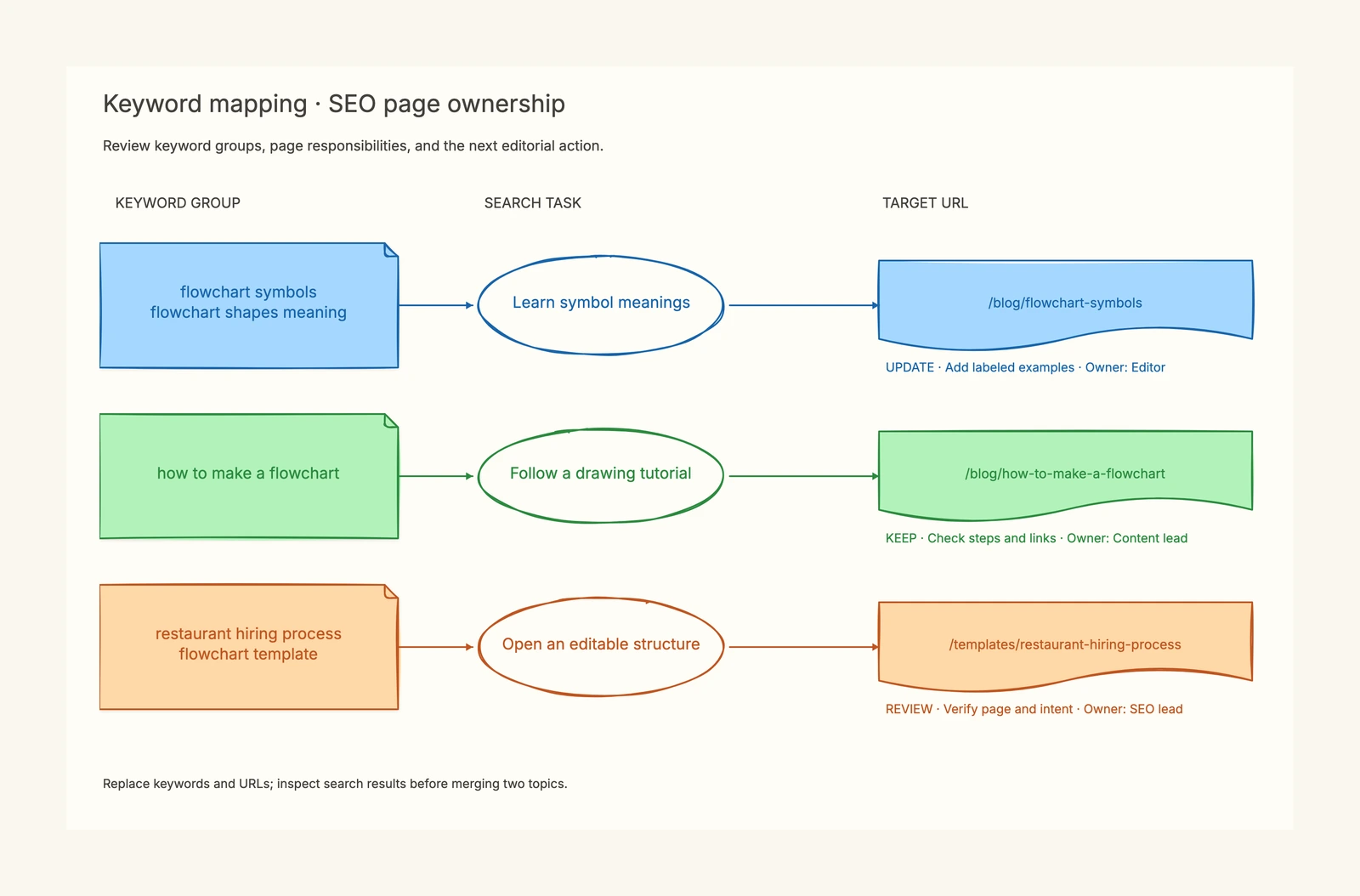
Keyword mapping answers a practical publishing question: which page should serve this search? Group related searches, name the task behind them, and assign that task to an existing or proposed URL. Then decide whether to keep, update, create, or investigate the page.
This guide works through a diagram website rather than leaving you with an empty spreadsheet. The final deliverable is a small map showing how symbol explanations, drawing tutorials, and editable templates divide responsibility. The keyword groups are teaching examples, not a report of measured search demand or current Google results.
What a keyword map should contain
A keyword list tells you what people might search. A keyword map connects those searches to actual work on your website. Without that connection, writers can produce two articles that answer the same question while an important buying task has no suitable landing page.
Ahrefs describes keyword mapping as grouping keywords into topics and assigning them to pages. For implementation, give every row a decision, not just a phrase. The following fields are enough to start:
| Field | Example | Why it is useful |
|---|---|---|
| Keyword group | flowchart symbols; flowchart shapes meaning | Keeps likely variants together |
| Search task | Identify a shape and understand its meaning | Makes the reader's need explicit |
| Page type | Reference article | Guides the structure |
| Target URL | /blog/flowchart-symbols | Names the page responsible |
| Evidence | Search-result notes and review date | Shows why the grouping was chosen |
| Action | Update labeled examples | Turns planning into a task |
| Owner | Content editor | Establishes responsibility |
Keep difficulty and volume in separate evidence columns if you have them. A missing score means missing information, not easy competition. Do not copy one query's difficulty onto every variant in its group.
The editable SEO keyword mapping template provides two populated scenes: a diagram-content map and an ecommerce page map. Use its rows to agree on page ownership; keep detailed keyword exports in your research tool or spreadsheet.
Step 1: Inventory existing pages before finding more topics
Start with the site you already have. Record public URLs, titles, page types, and the task each page actually completes. A drawing tutorial, template gallery, comparison article, and editable template may all mention flowcharts, but each does different work.
For a small site, inspect a manageable section manually. For a larger site, use a crawl or sitemap export as the starting inventory, then review the content behind the URLs. Slugs alone can be misleading: a page called “guide” may contain only definitions, while an “examples” page may include a full tutorial.
Add a status field for pages that are retired, redirect elsewhere, or cannot be indexed. Otherwise the map can assign a keyword to a page that readers never reach. This is an inventory task; it does not mean changing URL structure during the planning session.
For this example, the relevant CodePic pages include a symbols reference, a drawing tutorial, and a restaurant hiring template. They give us three different kinds of destination to evaluate.
Step 2: Write the task behind each keyword group
Translate the query into a sentence beginning with “I want to.” A visitor searching for symbol meanings wants to identify a symbol. Someone searching for a hiring template wants a usable starting structure. A person searching for drawing instructions wants a sequence of actions.
These distinctions matter more than a shared word. The presence of “flowchart” in all three queries does not prove they should share one page. Conversely, two differently worded queries may represent the same task.
Use this initial grouping as a hypothesis:
| Illustrative group | Reader's task | Candidate destination |
|---|---|---|
| flowchart symbols; flowchart shapes meaning | Interpret shapes | Symbols reference |
| how to make a flowchart | Build a first diagram | Drawing tutorial |
| restaurant hiring process flowchart template | Start with an editable hiring structure | Template page |
Do not polish titles yet. First agree on the task. If the team cannot explain the difference between two rows, it may be planning overlapping content or grouping unrelated needs too broadly.
Step 3: Check search results before merging queries
Search the exact queries in the intended country and language. Note the page types appearing prominently: articles, product pages, category pages, tools, videos, or template galleries. Open several results and identify what a reader can accomplish there.
Record which URLs recur across related queries. Repeated suitable results are useful evidence for a shared intent, but they are not an automatic rule. Inspect content quality and task fit rather than merging whenever a particular number of results overlaps.
For example, suppose the symbols query shows illustrated reference pages and the drawing query shows step-by-step tutorials. That supports separate pages. If both variants of symbol meanings return similar reference articles, one strong symbols page may cover both. These are decision examples, not claims about the current results.
Include the date, location, and any uncertainty in your notes. Results can change, and someone reviewing the map next month should understand why today's grouping was reasonable. A short sentence such as “reference pages dominate; tutorial task separate” is more useful than an unexplained green checkmark.
Step 4: Choose the page that can complete the task
Assign a primary destination only after reviewing the content and search evidence. Ask whether the page already delivers the promised result, whether it can be improved without losing its purpose, and whether another existing URL serves that task better.
For the symbols row, an update might add a labeled decision diamond and explain when it is appropriate. The tutorial row might need a clearer start-to-finish example. The template row needs an editable hiring structure and instructions for replacing roles and stages.
That is a useful division of responsibility. The tutorial can link to the symbols reference when explaining shape selection, and it can link to the template when readers want a head start. It does not need to repeat the entire reference or template landing page.
Content mapping is the next layer: it asks where these pages fit in a person's evaluation journey. The content mapping guide explains that distinction. Finish keyword ownership first so the journey plan points to clear destinations.
Step 5: Give every row an editorial action
Use a small action vocabulary that the team understands:
- Keep: the destination already satisfies the task; check accuracy and useful links.
- Update: the page is the right destination but lacks examples, clarity, or relevant information.
- Create: no suitable destination exists and the task merits its own page.
- Investigate: grouping, page ownership, or demand remains uncertain.
- Consolidate candidate: two existing pages substantially overlap; review before making changes.
Write the action as an observable outcome. “Improve SEO” is difficult to review. “Add one annotated hiring example and explain the decision branches” gives an editor something concrete to produce.
Do not treat a consolidation candidate as permission to delete or redirect immediately. Check existing traffic, backlinks, unique information, and the intended replacement. Google's canonicalization guidance concerns duplicate or very similar URLs. It is not a substitute for deciding whether two distinct reader tasks deserve separate pages.
A worked ecommerce keyword mapping example
Now consider an illustrative bedding store. Its content team has ideas about linen bedding but needs to avoid assigning every search to the blog.
| Illustrative query | Task | Page | Action |
|---|---|---|---|
| linen duvet cover | Browse available products | Collection page | Create useful filters and product selection |
| linen vs cotton bedding | Compare materials | Comparison guide | Explain tradeoffs and link to relevant collections |
| how to wash linen bedding | Follow care instructions | Care guide | Verify instructions against actual product labels |
The buying query calls for products. Publishing a long definition article would leave the visitor without the expected shopping path. The comparison task benefits from a guide, while the care task needs instructions grounded in what the store sells.
This is why the target URL column should not be filled automatically from a keyword slug. Keyword mapping includes choosing the appropriate content format. It can reveal that the next useful asset is a collection page or support guide rather than another article.
Review the map after publishing
Keep a dated record of each implemented action. Once pages have accumulated enough useful data, compare the searches and landing pages with the map's assumptions. Did the expected page receive relevant impressions? Are visitors reaching the next useful resource? Is another URL serving the query more successfully?
Avoid changing several connected pages every few days. Allow a sensible observation window and annotate major edits so you can interpret changes. Search fluctuations do not by themselves prove the mapping decision succeeded or failed.
A review can produce several outcomes: keep the group, refine the page, split a task that proved different, or combine genuinely overlapping pages. The map should remain an editorial decision record, not a permanent rule that nobody questions.
Common keyword mapping mistakes
Creating one URL per phrase. Start from user tasks and inspect result evidence. Minor wording changes do not automatically justify another article.
Grouping by a shared noun alone. “Flowchart software” and “flowchart symbols” both contain flowchart, but buying a tool and interpreting shapes are different tasks.
Using the map to promise rankings. A coherent content plan helps execution; it does not establish a guaranteed position or traffic increase. Competition, content quality, and other factors still matter.
Mistaking a spreadsheet for a finished plan. Rows without actions, owners, or evidence tend to become an abandoned list. Assign the next reviewable deliverable.
Ignoring what the page actually offers. A template page must provide a usable structure. A tutorial must teach the task. Google emphasizes helpful content for people; keyword placement cannot replace that work.
Turn the map into a small publishing batch
Choose one section, agree on its reader tasks, and implement the most useful actions first. You can review keyword mapping examples, adapt the editable template below, or move on to three content mapping examples when page ownership is clear.