These content mapping examples show what a completed plan looks like, not just the names of funnel stages. Each map connects a particular audience question to a useful page, a next action, and a measure your team could review.
The three scenarios are an agency-focused SaaS, a linen bedding store, and a family photography studio. They are illustrative exercises, not customer growth case studies. The URLs are sample paths, and no performance numbers or results are implied. You can adapt all three in the editable content mapping template.
How to read the examples
Read each map from the user's question outward. “What should I publish?” becomes easier once you know what the visitor needs to decide. Then inspect the destination and next step: does the asset answer the question, and does the action help the visitor move forward?
Shopify's content mapping guide connects content assets to the audience's needs. In these examples, we add explicit owners and measures so the map can support execution. A page idea without ownership or a meaningful next action is still an incomplete plan.
The stage labels are flexible. Someone might enter at a decision page, return to a comparison, or leave and come back directly. The map is a planning hypothesis, not a claim about the path every user follows.
For the method behind the examples, use the step-by-step content mapping guide. If your uncertainty is about which keyword belongs on which URL, use keyword mapping first.
Example 1: SaaS content mapping for client reviews
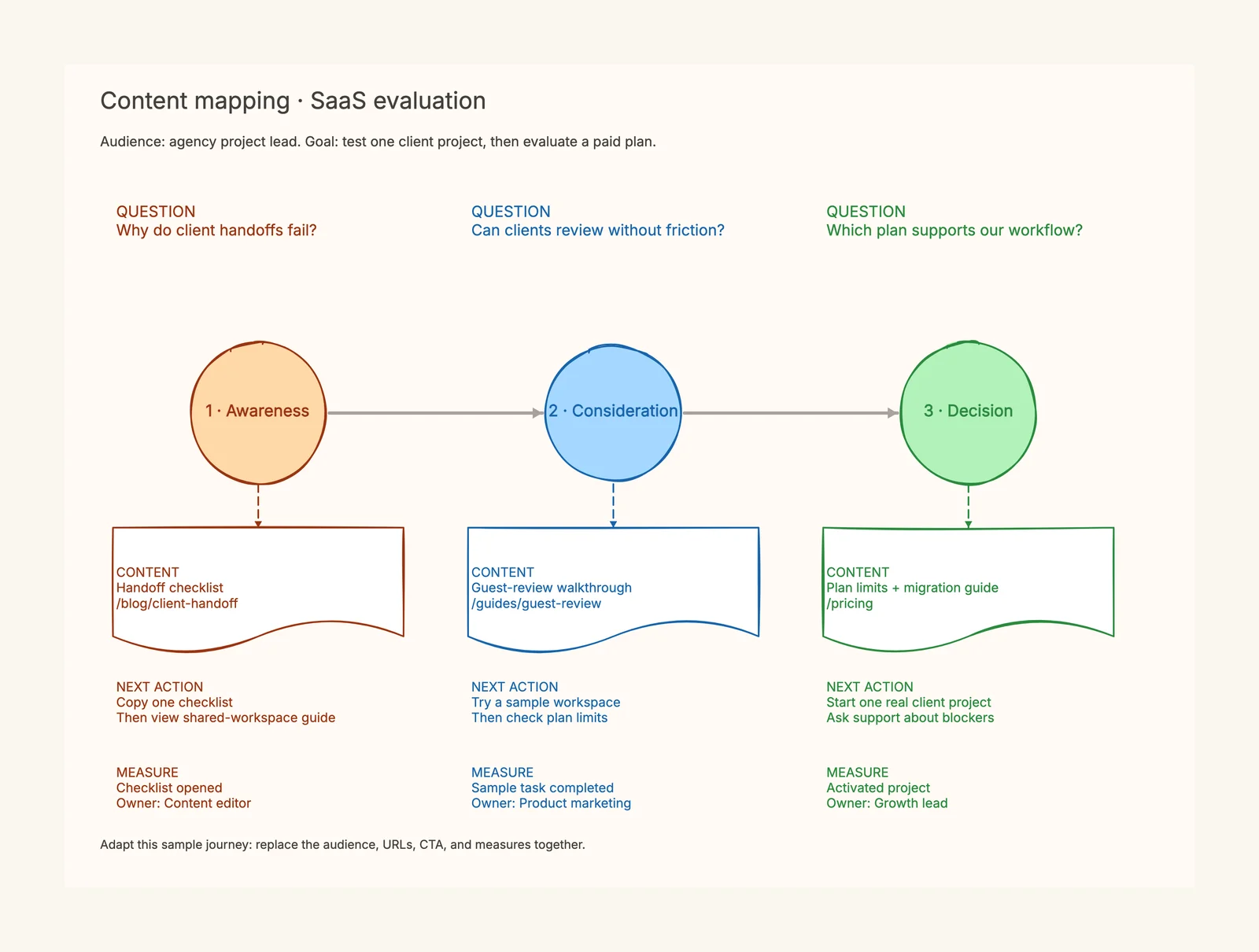
Audience: an agency project lead coordinating client reviews. Goal: complete one real client project in a trial workspace. The central uncertainty is whether the team can improve handoffs without creating extra friction for clients.
The map starts with a practical problem rather than a product feature list. A person looking for a handoff checklist needs a process they can try, even before they decide to evaluate software.
| Stage | User question | Content | Next action | Measure |
|---|---|---|---|---|
| Awareness | Why do client handoffs fail? | Handoff checklist | Copy one checklist; visit a shared-workspace guide | Checklist opened |
| Consideration | Can clients review with little setup? | Guest-review walkthrough | Complete a sample review task | Sample task completed |
| Decision | Which plan supports our workflow? | Plan limits and migration guidance | Start one real project | Activated project |
Make the awareness asset useful by itself
The handoff checklist should include the information needed to review a project: deliverable, deadline, responsible person, required feedback, and approval status. A reader should be able to use that checklist without buying the software.
An appropriate CTA is “copy the checklist.” A relevant follow-up resource shows how the same information appears in a shared workspace. Sending every visitor directly to sales would ignore the task that brought them there.
The content editor owns the checklist. The product team verifies any description of the workspace. Those separate responsibilities help prevent a writer from promising a guest-access behavior the product does not support.
Demonstrate the evaluation task
The consideration asset should walk through one review: create the deliverable, share the appropriate access, collect a comment, and record approval. Show the limits and prerequisites beside the workflow.
The measure is completion of the sample task, not just visiting the article. A high visit count with little task completion might indicate confusing instructions, missing access, or a mismatch between the visitor and the example. Investigate those possibilities before simply buying more traffic.
At decision stage, state current plan limits and migration requirements. The meaningful goal is a project that reaches the intended activation event, defined by the team. Do not quietly equate an account creation with successful adoption if a user still has not experienced the core task.
What this map reveals
The content gap may be a missing walkthrough rather than another introductory article. The map also exposes a product dependency: the sample review must work under the access conditions described. Its value is making those decisions clear; it does not prove a particular conversion improvement.
Example 2: Ecommerce content mapping for linen bedding
Audience: a first-time linen buyer. Goal: choose an appropriate duvet cover and understand its care. This map includes a fourth stage because the customer's questions do not stop after checkout.
| Stage | User question | Content | Next action | Measure |
|---|---|---|---|---|
| Discover | Will linen feel rough? | Texture and wash guide | Read the material comparison | Relevant comparison visits |
| Compare | Linen or cotton for warm nights? | Material comparison | Browse the matching collection | Collection visits |
| Choose | Will it fit my duvet? | Size guide and product details | Select size and add to cart | Add-to-cart event |
| After purchase | How should I wash it? | Verified care instructions | Save or revisit the guide | Care-guide engagement |
Use evidence from the actual products
The first guide needs more than generic descriptions of linen. If the store claims a certain texture or change after washing, it should use reliable product information or clearly described testing. Avoid presenting a broad material claim as a guarantee for every item.
The comparison should explain tradeoffs relevant to the customer. It can connect fabric choice to preference and care requirements without claiming one material is universally best. The next action should lead to the relevant collection, not a home page that makes the reader start over.
For a small catalog, one thorough comparison might be enough. Do not create separate near-identical articles for every minor adjective used in a material query. Review keyword ownership before multiplying pages.
Resolve purchase uncertainty on the product path
The size guide should help visitors match the cover to their existing duvet. Show actual dimensions and explain any product-specific considerations. Keep details consistent with the product page and inventory options.
The ecommerce owner can define a relevant add-to-cart event. That event is a useful step, but it is not the same as a completed purchase. Record checkout or order results separately when assessing business outcomes.
The fourth stage belongs to support. Verify washing guidance against actual labels and supplier instructions. Content can reduce confusion, but do not claim that a guide reduced returns unless you have measured it.
What this map reveals
One row may require a product-page improvement rather than a blog post. Another needs support documentation. The content team should work with merchandising and customer support, because only they can confirm certain details.
Post-purchase engagement also needs interpretation. Repeated visits to care instructions can mean the guide is useful, or it can mean the product instructions are unclear. Combine analytics with customer questions before calling the pattern a success.
Example 3: Local-service content mapping for family photography
Audience: a family arranging a portrait session with young children. Goal: submit a qualified date inquiry with clear expectations. A booking is not useful if the family expects a service the studio cannot deliver.
| Stage | User question | Content | Next action | Measure |
|---|---|---|---|---|
| Prepare | What should our family wear? | Wardrobe examples | View similar family galleries | Gallery visits |
| Evaluate | Can you work with young children? | Session walkthrough and relevant gallery | Review packages and availability | Package-page visits |
| Book | What is included, and when can we come? | Package terms and booking page | Submit a date inquiry | Qualified inquiry |
Connect advice to relevant work
The wardrobe guide should use concrete combinations and explain how the choices fit the studio's style. A generic fashion article may attract readers but do little to clarify what this particular session will be like.
Link from the advice to galleries that demonstrate the relevant service. Use images with permission and avoid implying that a displayed family has endorsed the business. The photographer owns the example selection, while the studio manager checks current service details.
A gallery alone may leave process questions unanswered. Explain how long a session usually runs, what the family should prepare, and how breaks or changing circumstances are handled within the studio's actual policy. Do not invent guarantees about children's behavior or outcomes.
Make the booking decision specific
The decision page should state the current package scope, location, scheduling process, and applicable terms. The inquiry form can ask for preferred dates and service needs so the studio can judge fit.
Define a qualified inquiry before counting it. For this scenario, it might be a request for an offered service, in the service area, with a workable date range. The definition is a business choice, not a universal analytics rule.
Some visitors will arrive directly from a local listing and skip the advice. Make the service and booking pages useful independently; the map should not require users to read every article before contacting you.
What this map reveals
The highest-value task may be clarifying package terms rather than adding another list of photography tips. The map connects educational content with proof of relevant work, then reduces uncertainty about booking.
The same structure can support other services, but the evidence changes. A consultant may need a scope example; a repair business may need service-area and appointment information. Replace the assets rather than copying the photography labels unchanged.
Compare the three content maps
| Decision | SaaS | Ecommerce | Local service |
|---|---|---|---|
| Main proof | Working task demonstration | Product facts and comparison | Relevant work and service process |
| Meaningful next action | Complete a sample task | Choose a suitable product | Submit a suitable inquiry |
| Extra dependency | Product access and plan limits | Inventory, size, care information | Availability and service scope |
| Later content | Adoption and support | Care after purchase | Preparation after booking |
Keep the question, content, next action, and measurement fields across scenarios. Change the proof and goal. That balance makes the planning method reusable without turning three businesses into the same generic funnel.
Adapt an example without copying its assumptions
Choose the scenario closest to your business, then replace the audience and goal first. Collect actual questions, inspect existing pages, and mark missing answers or missing links. Assign an owner to verify each factual claim.
Only after that should you schedule new assets. A gap can be fixed by updating a product page, adding a useful link, or changing a demonstration. A new article is one option, not the default response to every empty cell.
Keep proposed actions separate from measured results. More content mapping scenarios can help with structure, while your own analytics and conversations determine whether the plan is working.
Review the plan before publishing
Check whether every destination has a clear primary task. One page can serve related questions across stages, but a useful supporting detail should not distract from its main purpose. Open the destinations instead of judging the map from page names alone.
Read the CTA in context. A request to purchase should not replace an unanswered preparation question. If the user needs a checklist, gallery, task demonstration, or clear terms, supply that resource before asking for a commitment.
Record the intended action, baseline, and review date. Observe behavior and include customer feedback after implementation. The map provides a plan to test, not promised outcomes. Keep any AI citations separate from visits and business actions; the GEO tools guide explains the measurement boundaries.
The template below contains the three populated scenes. Replace the assumptions and destinations, preserve the useful fields, and finish one connected content path before expanding the board.