The interleaving study method mixes related kinds of practice so you must identify which approach a problem needs before using it. Instead of finishing every question of one type and then moving to the next, you revisit different types within the practice sequence. It is purposeful variation, not an instruction to switch tasks whenever work becomes difficult.
This guide uses the same nine fraction questions in blocked and interleaved orders. You will see the full problem set, answers, strategy choices and an error log. It is an original practice design, not an experiment showing that this exact sequence improves every learner’s results.
Understand what is being mixed
In blocked practice, several similar questions arrive together, so the previous question often signals the method for the next one. A mixed sequence asks you to inspect the new question. Am I finding an equivalent fraction, comparing quantities or adding them?
The University of Arizona’s learning resource describes mixing study topics and contrasts it with studying in blocks. It also cautions against using the strategy as an excuse to abandon difficult work. Our example keeps the material within one related skill family so the choice of approach remains visible.
Do not confuse interleaving with spacing. Spacing concerns when practice returns over time; interleaving concerns the arrangement of different kinds of practice. A plan can use both, but changing today’s order does not automatically create a later review.
Check the foundations before mixing
This exercise assumes the learner can produce equivalent fractions, compare fractions using a common whole, and add simple fractions with a common denominator. If one of those procedures is entirely new, provide explanation and supported practice first.
Mixing methods that have not been learned can turn a useful choice into random guessing. Start with a small set the learner can distinguish, observe where the choice fails, and adjust the support. Difficulty is informative only when you can identify what it concerns.
Write the target clearly: “For each new question, name the task, choose an appropriate representation and check the result.” Finishing quickly is secondary. A correct answer reached by an unexplained guess does not provide the same evidence as a justified strategy.
Use one complete set of related problems
The nine questions below are original teaching exercises. A, B and C identify task types for preparing the plan. For an independent mixed attempt, hide the type labels so the learner must identify the task rather than read the answer from the heading.
| ID | Preparation type | Question | Answer |
|---|---|---|---|
| A1 | Equivalent fraction | Complete: 1/2 = ?/4 | 2/4 |
| A2 | Equivalent fraction | Complete: 2/3 = ?/12 | 8/12 |
| A3 | Equivalent fraction | Complete: 3/5 = ?/15 | 9/15 |
| B1 | Compare | Which is larger: 3/4 or 2/3? | 3/4 |
| B2 | Compare | Which is larger: 2/5 or 1/2? | 1/2 |
| B3 | Compare | Which is larger: 5/6 or 3/4? | 5/6 |
| C1 | Add | 1/2 + 1/4 | 3/4 |
| C2 | Add | 1/3 + 1/6 | 1/2 |
| C3 | Add | 2/5 + 1/10 | 1/2 |
During practice, keep the answer column hidden as well. It is shown here so readers can check the complete plan. In an actual lesson, prepare a question-only version or cover the relevant part of the record.
Compare blocked and interleaved orders fairly
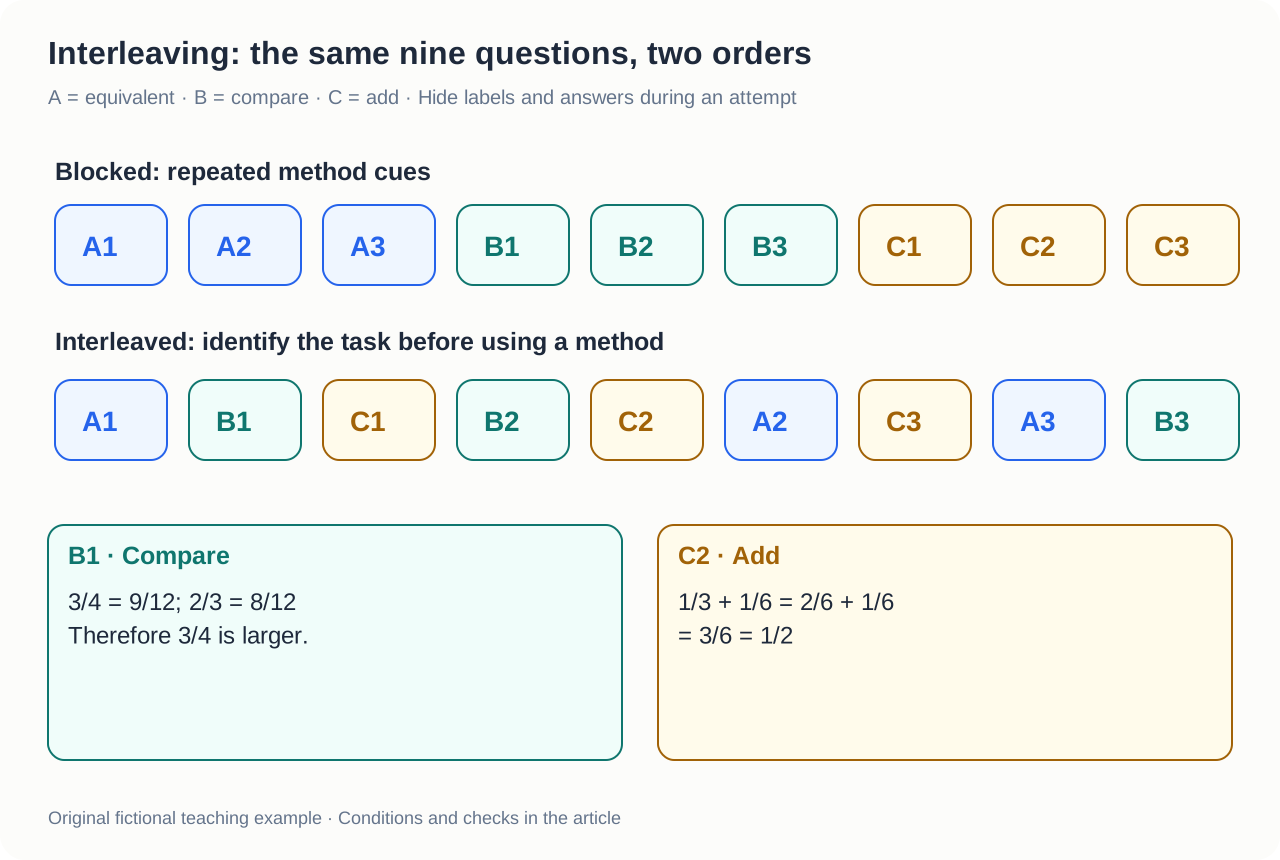
A blocked arrangement is A1, A2, A3, B1, B2, B3, C1, C2, C3. It provides repeated work with each task type before the next type begins. That can be useful during initial instruction or when repairing a particular procedure.
Our interleaved arrangement is A1, B1, C1, B2, C2, A2, C3, A3, B3. Every question still appears once. Only the order changes, so the comparison does not secretly give one plan more content or easier examples.
| Position | Blocked order | Interleaved order |
|---|---|---|
| 1–3 | A1 → A2 → A3 | A1 → B1 → C1 |
| 4–6 | B1 → B2 → B3 | B2 → C2 → A2 |
| 7–9 | C1 → C2 → C3 | C3 → A3 → B3 |
This is not a controlled within-learner comparison if someone solves both lists in sequence: they have already seen the questions. Use it to understand the arrangement. For a later independent check, choose new questions of comparable types rather than claiming a clean experiment from repeated items.
Make the strategy decision before calculating
For B1, the learner should recognize a comparison, not add the fractions. With equal-sized wholes, 3/4 becomes 9/12 and 2/3 becomes 8/12, so 3/4 is larger. The common denominator supports a comparison of like units.
For C2, the task is addition. Rewrite 1/3 as 2/6, then add 2/6 + 1/6 = 3/6 = 1/2. The same equivalence skill supports a different final operation. That relationship is worth noticing rather than treating the task types as unrelated compartments.
For A2, the question already gives the target denominator 12. Multiplying the denominator 3 by 4 requires multiplying the numerator 2 by 4 as well, giving 8/12. Choosing the correct operation begins with reading what is being asked.
Ask for a short plan before the calculation: “I need a common denominator to compare,” or “I need an equivalent form with denominator 12.” The plan makes an incorrect method visible before arithmetic errors obscure it.
Separate selection errors from execution errors
Suppose a fictional learner answers B2 by adding 2/5 and 1/2. They may perform addition correctly but still fail the comparison task. More addition drills alone will not address the initial selection mistake.
Another learner knows C1 is addition but calculates 1/2 + 1/4 as 2/6. That is an execution or conceptual difficulty with unlike denominators. They need an explanation of equal-sized fractional units and supported examples, not merely a different order of questions.
| Observed error | Likely repair to investigate |
|---|---|
| Adds when asked which quantity is larger | Re-read the task and state the required output |
| Adds numerators and denominators directly | Revisit equivalent fractions and equal units |
| Gives 3/6 but fails to recognize 1/2 | Check simplification or equivalent representations |
| Uses labels A/B/C to choose without reading | Remove preparation labels for the independent attempt |
The repair column contains hypotheses, not a diagnosis from one answer. Ask the learner to explain what they did, inspect the work and choose a next task that tests the suspected difficulty.
Use feedback without turning the set into copying
Let the learner complete an appropriate small portion independently, then check it with enough detail to correct the method. Waiting until the end is not always necessary, especially if the same misconception would contaminate every later answer.
When an error appears, work through the reason and then use a fresh item. For a new comparison, try 3/5 and 2/3: they become 9/15 and 10/15, so 2/3 is larger. The learner should state that it is a comparison before calculating.
Copying the corrected answer to B2 is not the same as selecting a method on the new item. Keep the original work, the feedback and the independent follow-up separate. That makes the evidence behind any claim of improvement easier to inspect.
Inspect the reasoning behind a correct answer
A correct selection may come from a valid method or a lucky shortcut. When comparing 4/5 and 3/4, the common-denominator forms are 16/20 and 15/20. A learner who simply says “four is bigger than three” has not supplied a sufficient reason, even though the choice happens to be correct. Return to 2/5 and 1/2 to expose the shortcut. If using bars, keep the wholes equal-sized; the representation's assumptions matter as much as its shaded regions.
Plan a later session instead of exhausting the topic today
A short session might begin with a foundation check, continue with a small mixed set and end with corrections. The next session can revisit the task types with different numbers. Set timing according to the learner’s course and workload rather than treating one interval as universally optimal.
For a later addition question, 1/4 + 1/6 becomes 3/12 + 2/12 = 5/12. For a later equivalence question, 3/4 = 9/12. Those fresh items reuse the underlying relationships without simply repeating the earlier answer list.
Do not infer lasting learning from one successful session. Record whether the learner can select and execute a method after a delay and on unfamiliar items. Keep the conditions comparable enough to interpret the change, including access to notes and the complexity of the questions.
Adapt beyond mathematics with a clear distinction
In reading, related practice could mix identifying a main claim, choosing supporting evidence and judging a summary. The learner should decide which task the prompt requests, not merely alternate unrelated chapters because the schedule has three colors.
In a practical skill, define the relevant variations and ensure appropriate instruction and supervision. Randomly mixing tasks is not a substitute for safe progression. Some sequences depend on prerequisites or physical setup and should not be shuffled casually.
SQ3R helps structure reading and recall; the Feynman technique helps expose gaps in an explanation. Those methods can support learning, but interleaving specifically concerns the order and discrimination of practice types.
Keep a useful practice board
Use columns for question, task identified, plan, working, result and next check. Put the answer key in a separate area during an independent attempt. A study schedule can allocate time, while this record shows what happens inside the session.
You can arrange the sequence manually in CodePic on an infinite whiteboard. The article does not include an automatic exercise generator, grading engine or personalized learning schedule. The worked set and its answer key are visible here.
Finish by identifying the next uncertainty: choosing the task, carrying out the method, checking the result or recalling it later. Adjust practice to that evidence. A more varied list is useful when it teaches a meaningful choice, not simply because it looks less repetitive.