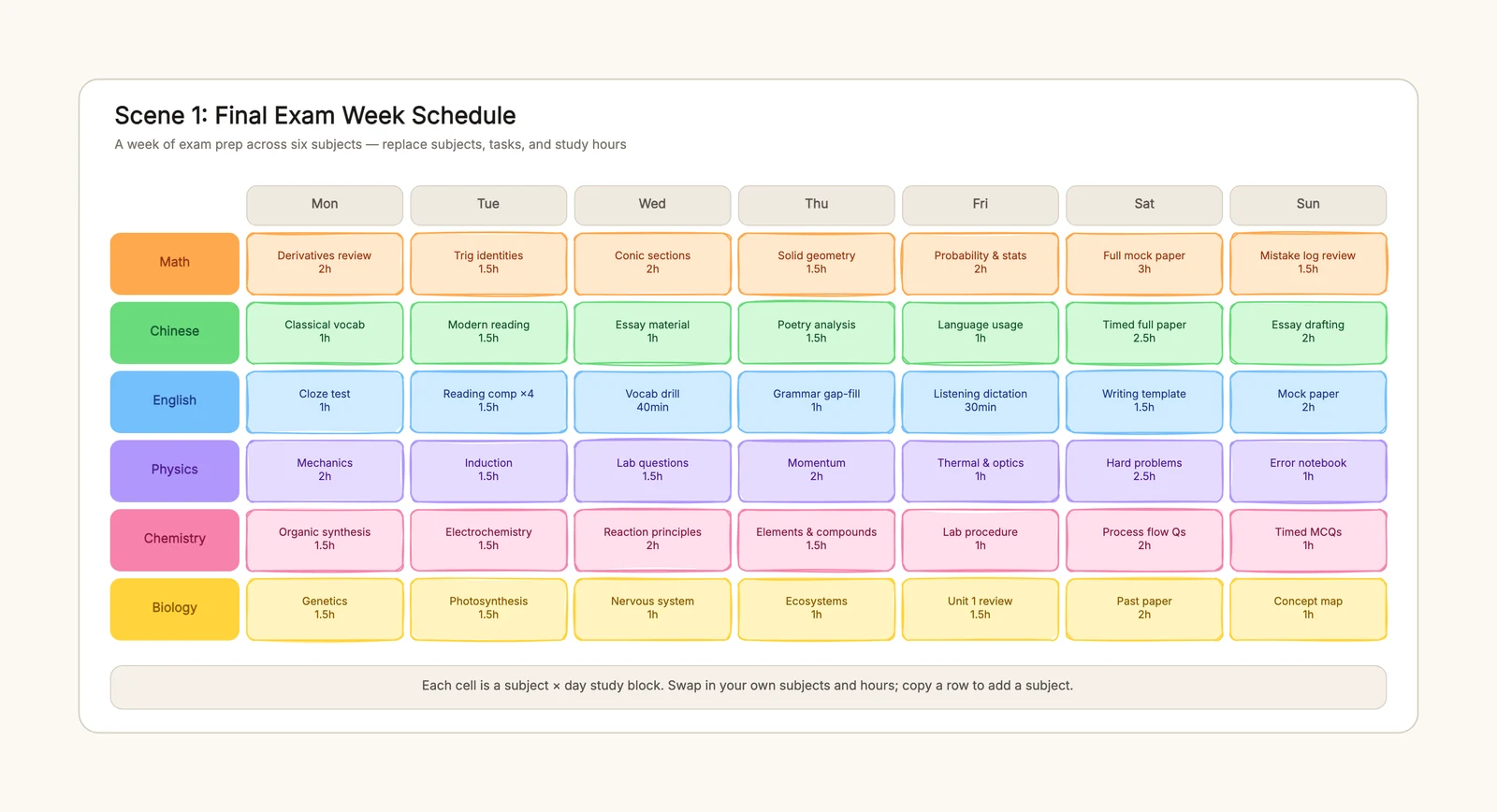
A study schedule is the difference between studying hard and studying the right thing at the right time. It turns "review chemistry this week" into a grid where every cell names one task and how long it takes, so the week does not blur into a pile of good intentions you never quite act on.
This guide walks through how to build a subject × day study schedule from scratch, then shows what it looks like for a final exam week, an MCAT study schedule, an LSAT study schedule, and an NCLEX study schedule. You can start from the study schedule template and edit the subjects, tasks, and hours directly in the browser.
Why a subject × day grid works
Most people plan their studying as a to-do list: "chemistry," "reading," "practice problems." A list tells you what is left but not when to do it or how long it will take. The result is the same subject pushed to Sunday night and the rest of the list never touched.
A grid fixes this by making time visible. Rows are subjects, columns are the days of the week, and each cell is a single study block with a duration. When chemistry is a whole row of colored cells, you can see at a glance that it is getting four hours while physics is getting one. That imbalance is invisible in a list and obvious on a grid.
The grid also forces a decision about every hour. An empty cell is a skipped subject, so you either fill it or admit the subject is being dropped. That small pressure is most of the value.
How to build a study schedule
The structure is the same whether you are prepping for finals or a licensing exam. Only the rows change.
1. List the subjects, not the tasks
Start with the rows. For a final exam week that is six subjects; for the MCAT it is the four sections — Bio/Biochem, Chem/Phys, CARS, and Psych/Soc — plus a practice row; for the LSAT it is Logical Reasoning, Reading Comprehension, and Logic Games. Write subjects first because tasks belong inside a subject, not the other way around.
2. Set a realistic weekly total
Decide how many hours you can actually study in a week, not how many you wish you could. A schedule packed from morning to night collapses in two days. Plan fewer hours than your theoretical maximum and leave gaps for breaks, meals, and the day that goes sideways.
3. Fill one task and a duration into every cell
Each cell should name a concrete task and how long it takes: "Derivatives review, 2h" rather than "math." The duration matters because "study chemistry" expands to fill whatever time is available. Naming the task matters because "biochem" is not something you can sit down and do.
4. Color-code each subject
Give every subject one color and use it on the row label and every cell in that row. Color-coding is not decoration; it is how you read the week's balance in one look. When the board opens and three subjects dominate, you know where the week is tilted.
5. Reserve a practice-test day
Content review without a timed practice test hides your real pacing. Put a full practice section or paper on one day and a review pass on the next. The review is where the score gain happens — redoing the question you got wrong matters more than reading another chapter.
6. Re-balance at the end of the week
Sunday is not just for review; it is for editing next week's grid. Move hours toward the subjects you under-served and trim the one you over-served. A study schedule is a living document, not a poster you hang once.
Final exam week example
A final exam week is the simplest case and the best place to start. The rows are six subjects, and the weekend is reserved for a full mock paper and a mistake review.
Math might run derivatives on Monday, trig identities on Tuesday, conic sections on Wednesday, and a full mock paper on Saturday. Physics spreads mechanics, induction, lab questions, and momentum across the week. Chemistry alternates organic synthesis, electrochemistry, and reaction principles. Biology rotates genetics, photosynthesis, and a past paper. Each cell carries a duration, so the total adds up to a week you can actually live.
The mistake to avoid here is studying only what you like. The comfortable subject always finds an extra hour, and a color-coded grid is what exposes it. When you open the board and see math drowning everything else, that is the signal to move hours back to the weak subjects.
MCAT study schedule
An MCAT study schedule is section-based, because the exam is section-based. The rows are Bio/Biochem, Chem/Phys, CARS, and Psych/Soc, plus a practice-and-review row. Content review lives on weekdays and timed sections on weekends.
Bio/Biochem might be amino acids, metabolism, enzyme kinetics, and DNA replication across the week. Chem/Phys runs thermodynamics, electrochemistry, fluids and waves, and general chemistry questions. CARS is timed passages and main-idea drills — CARS is the section most students under-practice because it feels unteachable, so give it a real block every day. Psych/Soc alternates sociology terms, psychology theories, and research methods.
The practice row is what ties it together: an Anki review most days, an AAMC Q-pack mid-week, and one full practice section each weekend followed by a review pass. For more on the studying habit that sits underneath all of this, the habit tracker template is a natural companion.
LSAT study schedule
An LSAT study schedule is skill-based rather than content-based. There is little to memorize; there are three skills to build — Logical Reasoning, Reading Comprehension, and Logic Games — plus timed practice and blind review.
Logical Reasoning gets drills on question types: weaken, flaw, and sufficient-assumption questions in short sets, then a timed section to measure pacing. Reading Comprehension alternates passages, comparative reading, and outlining practice, since the outline is where most of the comprehension actually happens. Logic Games rotates ordering, grouping, and hybrid games, with diagramming drills to build setup speed.
The key LSAT practice is blind review: take a full practice test, then before checking the answers, redo every question you were unsure about. The day after the test belongs to that review, not to a new test. This is where an LSAT study schedule earns its keep — the schedule protects the review time that most students skip.
NCLEX and other exams
The same grid drops onto almost any exam. An NCLEX study schedule swaps the rows for nursing content areas — fundamentals, pharmacology, med-surg — and fills the cells with question-bank sets and content review, with one full CAT exam a week. A language exam like IELTS or TOEFL uses listening, reading, writing, and speaking as its four rows. A college midterm week uses courses as rows and a concrete deliverable in each cell.
What stays constant is the shape: subjects down the side, days across the top, and a task plus a duration in every cell. The exam decides the rows; the structure does not change.
Common study schedule mistakes
Leaving cells blank
A blank cell becomes a skipped subject. Fill every cell with a task and a duration, even if it is just "review flashcards, 30min." The point of the grid is that the whole week is accounted for.
No time budget
Without a duration in each cell, one subject expands to fill the evening and everything else gets pushed. Write the hours and treat them as the plan.
Studying only what you like
The comfortable subject always wins the extra hour. A color-coded grid exposes the imbalance so you can push hours back to the weak subjects.
No practice-test day
Content review without a timed test hides your real pacing. Reserve one day for a full section or paper and the next for reviewing the mistakes.
Scheduling every waking hour
A schedule packed from morning to night collapses in two days. Leave gaps, plan buffer time, and aim below your theoretical maximum.
A note on who the schedule belongs to
A study schedule is the student's own plan — subjects, tasks, and hours they fill in for themselves. It is a different thing from a lesson plan, which is the teacher's outline for a single lesson. If you are the one sitting the exam, you want the study schedule; if you are the one teaching a class, you want the lesson plan. Both live on the same whiteboard, but they serve different people.
Keep the schedule alive
The schedule that works is the one you edit every week. On Sunday, look back at what you actually did, move hours toward the subjects that got short-changed, and adjust the next week. Pair it with the goal setting template to give each subject a measurable target, and the habit tracker template to keep the daily block showing up.
Start from the study schedule template, replace the subjects and tasks with your own, and fill every cell with a task and a duration. The exams differ — finals, MCAT, LSAT, NCLEX — but the grid that gets you through them does not.