Hexagonal thinking is a discussion activity in which learners arrange six-sided concept cards so touching edges represent relationships they can explain. The goal is a defensible network of ideas, not a single correct picture or the largest possible number of connections.
This walkthrough supplies a complete original activity about a shared community workshop: a short source, nine concept cards, two valid layouts, explained connections and a feedback routine. Use paper pieces or manually arranged shapes on a digital whiteboard. The worked arrangement uses manual placement and a separate explanation sheet.
What hexagonal thinking asks students to do
A hexagon can meet several neighbors, making it useful for exploring how one idea relates to multiple others. However, adjacency alone says very little. Learners must explain the relationship and identify the material that supports it.
In Jennifer Bonaldo's classroom account for NCTE, students use movable hexagonal pieces to discuss connections among ideas. The activity below is our own design and source material. It illustrates the method rather than reproducing the author's literary card set or treating one classroom experience as a guaranteed learning outcome.
Use the activity when learners have enough common material to reason with: after reading, during a unit review, or before writing an explanation. If the terms are unfamiliar, begin with a short definition check. A Frayer model can clarify a confusing concept before students start connecting it to everything else.
A useful learning objective is observable: “Explain three relationships using details from the shared source, and revise one connection after discussion.” “Be creative” is too vague to tell a learner what a successful explanation contains.
The original source for the activity
Give every group the following fictional brief:
A neighborhood workshop lends hand tools and runs beginner repair sessions. It has one cupboard and two volunteers each Saturday. Members reserve tools through a shared form, although some still ask by phone. A volunteer records when an item goes out and checks it when it returns.
Recently, two reservations were made for the same drill because a phone request had not reached the shared record. On another Saturday, a damaged handle was discovered after a tool had already been offered to the next borrower. The team does not know when the damage happened.
The volunteers propose checking the shared reservation record before confirming a loan, using a return check before placing tools back on the shelf, and leaving a clear handoff message when a question remains unresolved. They also want borrowing to stay practical for members who cannot use the form. No new policy has yet been tested.
Everything needed for this introductory round is in the brief. Learners may propose additional possibilities, but should label those as hypotheses rather than facts about the workshop.
Ask students to read individually and underline one observation, one proposed change and one uncertainty. This prepares them to distinguish what happened from what somebody thinks might help. A KWL chart can hold unanswered questions if the activity is part of a longer project.
Make the nine-card concept set
Write one concept on each hexagon. Keep the explanations below on a separate reference sheet so the physical pieces stay easy to move.
| Card | Working meaning in this activity |
|---|---|
| Reservation | A request for an item at a particular time |
| Shared record | The common place where requests and loan status are recorded |
| Access | Whether a member can practically make a request |
| Handoff | Passing relevant unresolved information to the next volunteer |
| Return check | Inspecting the item before making it available again |
| Trust | Confidence that commitments and information can be relied on |
| Responsibility | Knowing who must perform or confirm a task |
| Evidence | A recorded observation or source detail used to support an explanation |
| Uncertainty | Something the source does not establish |
For a first attempt, use these nine pieces without adding more. Increasing the card count can increase logistical work faster than useful reasoning. Later, groups can add one blank card if they can explain a concept that the set fails to represent.
You can make equal-sized paper hexagons, label them by hand, and place them on a large sheet. On a blank whiteboard, arrange hexagonal shapes manually and place text in or beside them. Keep a separate explanation area so the reasons remain visible when you rearrange the pieces.
Run a discussion with a visible decision process
The following timing is a suggested short lesson plan, not a requirement of the method. Adjust it for reading length, age, accessibility and available time.
- Read and prepare, about four minutes. Each learner names one relationship and its supporting detail.
- Place an anchor, about two minutes. The group chooses a central concept and explains why it belongs there.
- Build and challenge, about eight minutes. Learners propose placements, state the relationship, and listen to a challenge before accepting it.
- Select and write, about six minutes. The group chooses three important neighboring pairs and records full explanations.
- Compare and revise, about five minutes. Another group questions one connection; the original group keeps or changes it with a reason.
Assign roles lightly: a source finder, a questioner, a piece mover and an explanation recorder. Rotate them, and allow a learner to speak or dictate instead of relying only on handwriting. Roles should distribute participation without making one student responsible for all the thinking.
A helpful proposal sounds like: “Put Handoff beside Shared record because the unresolved phone request must reach the next volunteer through a common place.” Another student can ask, “Does the brief say that happened, or is that our proposed improvement?” That challenge makes the claim more precise.
Layout A: Put the shared record at the center
Use a central hexagon with six neighbors touching its six edges. For an unambiguous paper arrangement, imagine the six ring positions as north, northeast, southeast, south, southwest and northwest.
| Position | Card |
|---|---|
| Center | Shared record |
| North | Reservation |
| Northeast | Access |
| Southeast | Trust |
| South | Responsibility |
| Southwest | Handoff |
| Northwest | Evidence |
Place Uncertainty outside the ring so it touches Evidence. Place Return check outside the ring so it touches Responsibility. These are the intended relationships; any additional touching edges created by your spacing must also be explained, or separated slightly and treated as unlinked.
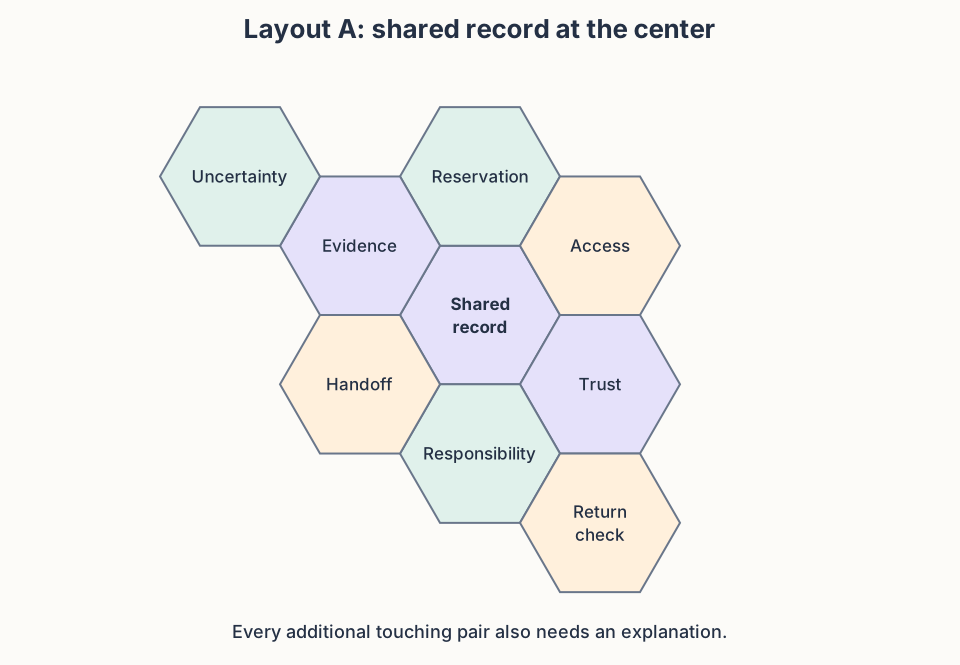
Three complete explanations could be:
Shared record ↔ Reservation: The double booking followed a phone request that did not reach the record. Checking one common record before confirmation could reduce conflicting commitments, although the brief contains no test results for that proposal.
Shared record ↔ Access: A shared form can centralize requests, but some members cannot use it. The team needs a way to include their requests in the same record. Centralization and practical access must be addressed together rather than assuming everybody can use one channel.
Evidence ↔ Uncertainty: A damaged handle was observed before the next loan, but its discovery does not establish when the damage occurred. The group should separate the recorded condition from an unsupported accusation about a particular borrower.
This layout emphasizes information. It does not mean the record is the most important factor in every workshop or that software alone solves the problem.
Layout B: Put responsibility at the center
Build a second arrangement using the same nine cards. Put Responsibility in the center. Around it, place Handoff, Return check, Evidence, Uncertainty, Access and Trust in that clockwise order. Add Shared record outside the ring touching Handoff, then Reservation beside Shared record on the outside.
Now the emphasis changes from where information lives to who confirms work. Explain at least three relationships again:
- Responsibility ↔ Return check: The proposed check needs a named performer or confirmation rule; writing “check returns” does not establish that anybody does it.
- Responsibility ↔ Uncertainty: A volunteer can be responsible for documenting an unresolved question without claiming to know its answer. Responsibility is not identical to blame for the original damage.
- Handoff ↔ Shared record: The next volunteer needs an accessible unresolved-item note. A message stored privately does not automatically become a completed handoff.
Both layouts are defensible if their explanations stay within the source. Compare what each makes easy to discuss and what it pushes to the edge. Do not choose the better layout by counting tiles near the center.
Move from connections to an individual explanation
After group discussion, each learner should produce a short independent response. For example:
The workshop's shared record connects reservations with handoff because information must remain available beyond the volunteer who receives it. The missing phone request shows why the route into that record matters. However, requiring the form alone could exclude members, so the proposed process needs another way to enter their requests. The brief does not yet show that these changes work.
Ask the learner to identify which sentence uses source evidence, which explains a relationship and which limits the conclusion. For a more formal response, use the claim–evidence–reasoning walkthrough.
A mind map can help outline the eventual writing around a central question. Keep its purpose distinct: hexagonal thinking explores a network of explained neighboring concepts; a mind map organizes branches. You do not need to turn every activity into both formats.
Assess reasoning and fix common problems
Use a small feedback rubric rather than an automatic connection count:
| Criterion | Ready to use | Needs revision |
|---|---|---|
| Relationship | Names a specific connection | Says only “they are related” |
| Support | Identifies an accurate source detail | Invents a fact or cites no material |
| Qualification | Separates proposal and uncertainty from observation | Treats an untested change as proven |
| Revision | Explains why a challenged connection stays or moves | Moves a tile without explaining the choice |
If students try to make every card touch every possible neighbor, ask them to reduce the network to the relationships they can defend. If one learner controls placement, require a proposal from somebody else before moving another tile. If groups disagree, compare explanations against the shared source rather than revealing a hidden answer picture.
Watch for superficial word associations. “Trust and tools both begin with T” is a relationship between spellings, but it does not meet this lesson's objective about the workshop. The objective determines what kinds of connections count.