A double bubble map compares two subjects by putting their similarities between them and their differences on the outside. Start with matching comparison criteria, write each feature precisely, and connect it to the subject or subjects it describes. Then use the completed map to build a comparison paragraph.
Below are three original examples: two fictional after-school clubs, two project plans and two characters. The first walks through every feature and a finished paragraph. Copy the structures onto paper or a whiteboard, then replace the supplied details with your own source material.
How to read a double bubble map
Place the two subject bubbles side by side. Shared-feature bubbles occupy the space between them and connect to both subjects. Features specific to the first subject sit farther left; features specific to the second sit farther right and connect only to that subject.
| Region | Meaning | Example from a club comparison |
|---|---|---|
| Left outer bubbles | Features of Club A that distinguish it from B | Individual drawing projects |
| Two subject bubbles | The objects being compared | Sketch club and repair club |
| Middle bubbles | Features shared by both in this comparison | Meet after school on Tuesday |
| Right outer bubbles | Features of Club B that distinguish it from A | Paired repair tasks |
A feature on the outside means it differs within the selected pair and scope. It does not mean no other subject in the world could have that feature. Write “in these two plans” when readers might otherwise mistake a local comparison for a universal definition.
The University of Oklahoma K20 Center's Double Bubble Map strategy uses paired comparison and supports moving from a map into writing. The examples here are original scenarios, with invented details clearly identified rather than presented as surveyed facts.
Choose criteria before drawing bubbles
Without common criteria, students often compare unrelated things: “Club A meets Tuesday; Club B is fun.” Those statements might both be true, but they do not tell a reader how the subjects differ on the same dimension.
For a fair comparison, decide what you want to learn. If a student is choosing an activity, useful dimensions might include schedule, typical task, working arrangement, materials and expected output. A favorite color is less relevant unless it affects the decision.
Make a quick source table first. Mark unknown information with a question rather than placing it among differences. “Club A has no fee” is not a justified difference if the source simply says nothing about Club B's fee.
For younger learners, use three criteria and discuss them orally before writing. For more complex topics, keep a compact criterion sheet beside the map so you can check that the outer features remain paired.
Example 1: Compare two fictional after-school clubs
Assume the following school notice is the entire source. These are made-up club details for practice:
| Criterion | Sketch club | Repair club |
|---|---|---|
| Schedule | Tuesday after school, 45 minutes | Tuesday after school, 45 minutes |
| Location | Art room | Workshop room |
| Usual task | Individual observational drawings | Paired repairs of donated simple objects |
| Materials | Pencils and paper supplied | Hand tools and practice objects supplied |
| Support | Teacher demonstration, then individual feedback | Volunteer demonstration, then pair feedback |
| Final output | A small portfolio of drawings | A repair log describing attempts and outcomes |
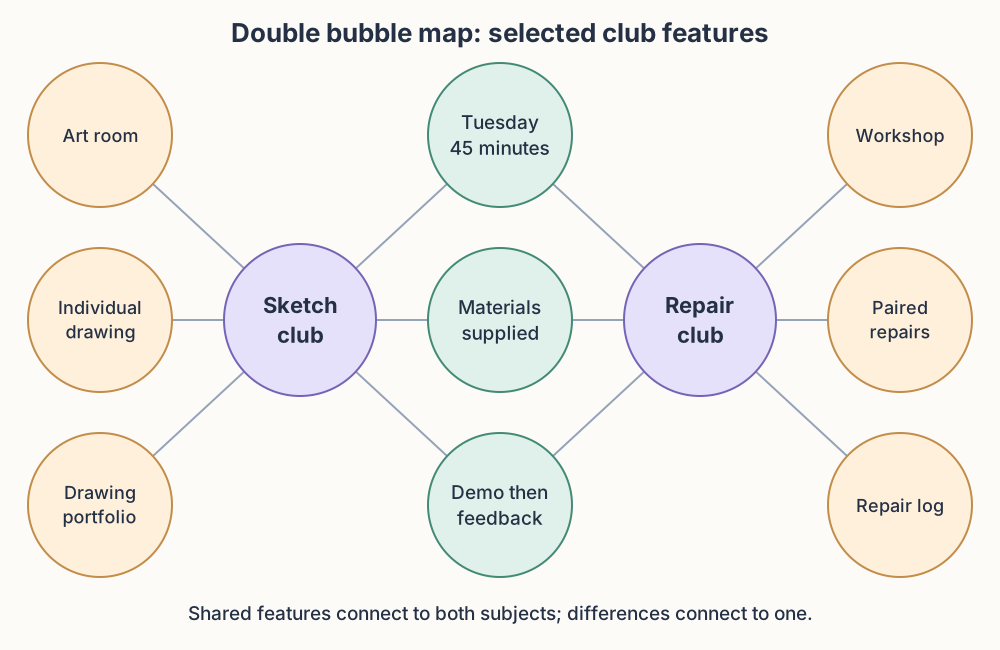
The map should distinguish both shared structure and meaningful differences. Avoid copying the entire table into long bubbles; keep each label short, then retain the source details in an explanation area.
Step 1: Name the subjects and scope
Use Sketch club and Repair club as the two subject bubbles. Add a heading: “Comparison based on the fictional school notice.” This prevents learners from importing assumptions such as “repair clubs always require experience.”
Step 2: Add shared features in the middle
Connect these three middle bubbles to both subjects:
- Tuesday after school, 45 minutes.
- Materials supplied for the activity.
- Demonstration followed by feedback.
The last two require careful wording. The clubs do not supply the same materials or use the same feedback arrangement. Their common feature is the broader structure, with the differences recorded outside.
Step 3: Add paired differences on the outside
On the left, connect Sketch club to art room, individual drawing, pencils and paper, individual feedback and drawing portfolio. On the right, connect Repair club to workshop room, paired repair tasks, hand tools and practice objects, pair feedback and repair log.
Arrange matching criteria at roughly the same height. Working arrangement should face working arrangement, and output should face output. That alignment lets a reader compare without searching the entire page.
Step 4: Inspect each connection
Read every middle bubble as two sentences: “Sketch club has this feature” and “Repair club has this feature.” If either sentence is unsupported, move or revise the bubble. Read each outer pair against the original criterion table to check completeness.
If the center becomes crowded, reduce the number of features or split the comparison into two maps. More bubbles do not automatically create a more useful explanation.
Turn the finished map into a paragraph
The map gives you material, but the paragraph needs a focus. For a student who wants to choose based on how they work and what they make, a finished example is:
The sketch and repair clubs have similar practical arrangements: both meet for 45 minutes after school on Tuesday, supply materials and include a demonstration followed by feedback. Their main difference is the kind of work students do. Sketch club centers on individual observational drawing and produces a portfolio, while repair club uses paired repair tasks and produces a log of attempts and outcomes. A student choosing between them should consider whether they want individual drawing practice or a shared practical repair task, rather than treating the schedule as a deciding difference.
This paragraph groups similarities before the most decision-relevant differences. It does not mention every location and material because those details are secondary to its focus. Another paragraph could compare the learning spaces instead.
For an evidence-based recommendation, use the claim–evidence–reasoning examples to make the decision rule explicit. The map organizes the features; it does not decide which club a particular student should prefer.
Example 2: Compare two plans for the same project
A class needs to gather feedback on a prototype display. Consider two fictional plans, with the same budget and one afternoon available:
| Criterion | Plan A: rotating stations | Plan B: whole-class demonstration |
|---|---|---|
| Shared objective | Collect comments on the prototype | Collect comments on the prototype |
| Available time | One afternoon | One afternoon |
| Presentation format | Small groups visit stations | Everyone watches one demonstration |
| Feedback capture | Each group leaves a short note at a station | Each learner submits a note after the demonstration |
| Main coordination need | Manage movement and station instructions | Make the demonstration visible and audible |
The middle bubbles are same prototype, one afternoon, collect comments and written feedback. The outer left bubbles are rotating small groups, station notes and movement instructions. The outer right bubbles are one shared demonstration, individual notes afterward and visibility and audibility.
A defensible comparison sentence is: “Both plans collect written feedback in one afternoon, but rotating stations distribute attention among small groups while a whole-class demonstration gives everyone the same presentation.”
Do not add “Plan A gets better feedback” without observations or a stated criterion. The map reveals a tradeoff you can investigate. To plan the chosen sequence, use a flowchart after the comparison rather than forcing time order into the bubbles.
Example 3: Compare two characters using a short source
Use this original passage:
Nia and Theo both arrived early to prepare the reading corner. Nia sorted the books by topic and made space for the youngest readers. Theo tested the cushions, moved a low shelf away from the entrance and asked the librarian whether the route was clear. When the first group arrived, both stayed to help them find a book.
Subjects: Nia and Theo. Middle bubbles: arrives early, prepares reading corner, helps readers choose books. Nia's outer bubbles: organizes by topic, plans space for younger readers. Theo's outer bubbles: checks seating, checks entrance route with librarian.
A completed comparison is: “Both characters help prepare the space and welcome readers. Nia concentrates on arranging books and space for younger children, while Theo checks seating and the entrance route. Their different actions contribute to the same shared task.”
The text does not establish that Nia ignores safety or that Theo dislikes books. A character's unmentioned action is not automatically the opposite of another character's action. That distinction matters whenever a map uses a short or incomplete source.
Double bubble map or Venn diagram?
Both can compare two subjects. A double bubble map gives each feature its own node and connections; a Venn diagram places features inside separate or overlapping regions. Use whichever makes the selected comparison easier to read.
A Venn diagram template is an alternative layout for shared and distinct features, not a dedicated double bubble map. If you need an exact double bubble layout, draw subject circles and feature circles manually on a blank whiteboard, then connect them according to the rules above.
For many subjects and many criteria, a comparison table will usually be easier to scan. Do not stretch a two-subject map into an unreadable network just to retain the shape.
Common mistakes and a final quality check
Unsupported opposites: “One subject is organized, therefore the other is disorganized.” Return to the source; absence of a feature is not evidence of its opposite.
Mixed levels: “Both have support” in the center and “only A has feedback” outside. Clarify what kind of support each provides, then check whether the statements conflict.
Unpaired differences: A location on one side facing an opinion on the other. Name the criterion and find comparable information for both subjects.
No writing focus: A finished map with every possible feature but no clear message. Ask the reader's question and select the features that answer it.
Before using the map, check that each shared feature applies to both subjects, each difference comes from comparable evidence, unknowns remain labeled and the paragraph does not claim more than the map establishes.