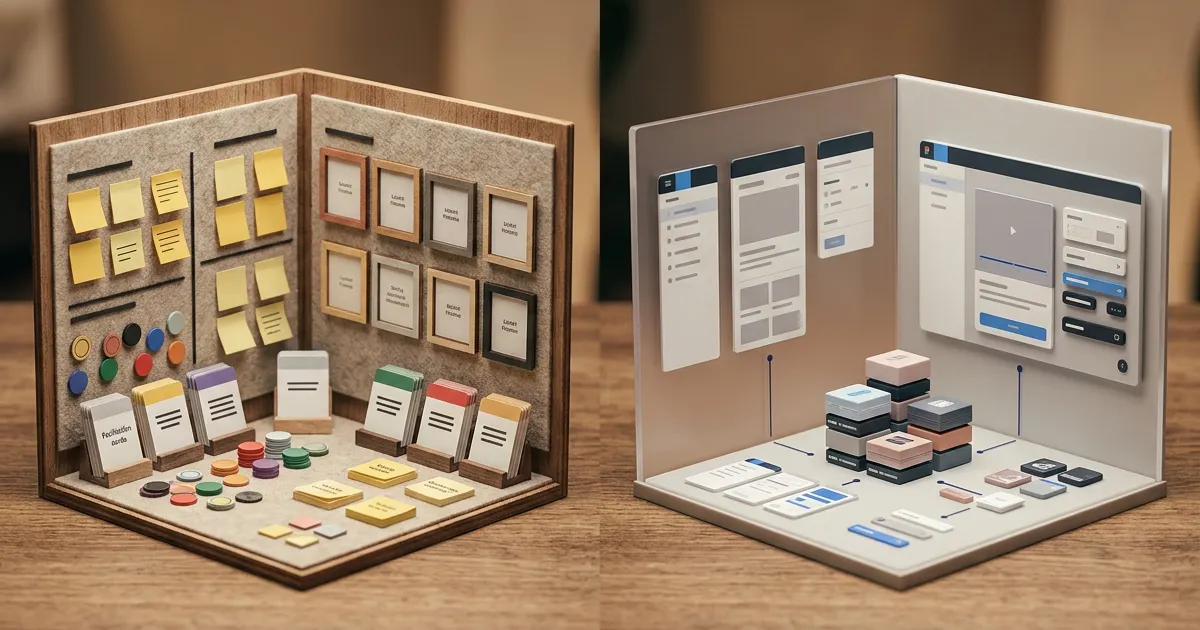
Choose Miro for structured cross-functional workshops, Excalidraw or tldraw for free hand-drawn collaboration, CodePic for templates and AI-assisted diagrams, Lucidchart for formal technical work, or Whimsical for polished product flows. Keep FigJam when the whiteboard must stay next to Figma files and design reviews.
The six alternatives solve different reasons for leaving: the three-file free limit, shallow non-design templates, formal diagram requirements, or a preference for a sketch-like canvas. Start from the missing job rather than a generic feature count.
What to Look For in a FigJam Alternative
Before jumping into specific tools, consider which parts of FigJam actually matter to your workflow — and which parts you're willing to trade.
Figma integration. FigJam's biggest advantage. If this is central to your workflow and you leave Figma, no alternative will fully replace it. If you don't use Figma, this advantage doesn't apply, and the field opens up.
Template depth. FigJam's template library is design-workflow focused. If you need strategy, planning, diagramming, or research templates, most alternatives have more to offer.
Free tier limits. FigJam's 3-file cap is real. If you want a tool you can use daily without hitting a limit, several alternatives offer unlimited free use with no signup.
Aesthetic. FigJam is clean and playful — not hand-drawn. If you prefer the sketch feel for early-stage work, several alternatives nail it.
When FigJam Is Still the Right Choice
A good FigJam alternatives article should not pretend every team should leave FigJam. Many should not. If your design system, critique rhythm, prototypes, and product reviews already live in Figma, FigJam has a real home-field advantage: the board is one click away from the files people are discussing.
The switch becomes worth considering when the whiteboard work starts drifting away from design. Strategy workshops, engineering diagrams, research synthesis, stakeholder mapping, and cross-functional planning often need different defaults from a design critique board. In those cases, the best replacement is not necessarily “more powerful FigJam.” It is the tool that matches the job: Miro for facilitation, CodePic or Excalidraw for fast hand-drawn thinking, Lucidchart or draw.io for formal diagrams, and Whimsical for polished product flows.
Test the Alternative with One Mind Map
Open the mind map below, ask a teammate to add ideas, reorganize the branches, and export the result. Repeat the task in the tools on your shortlist.
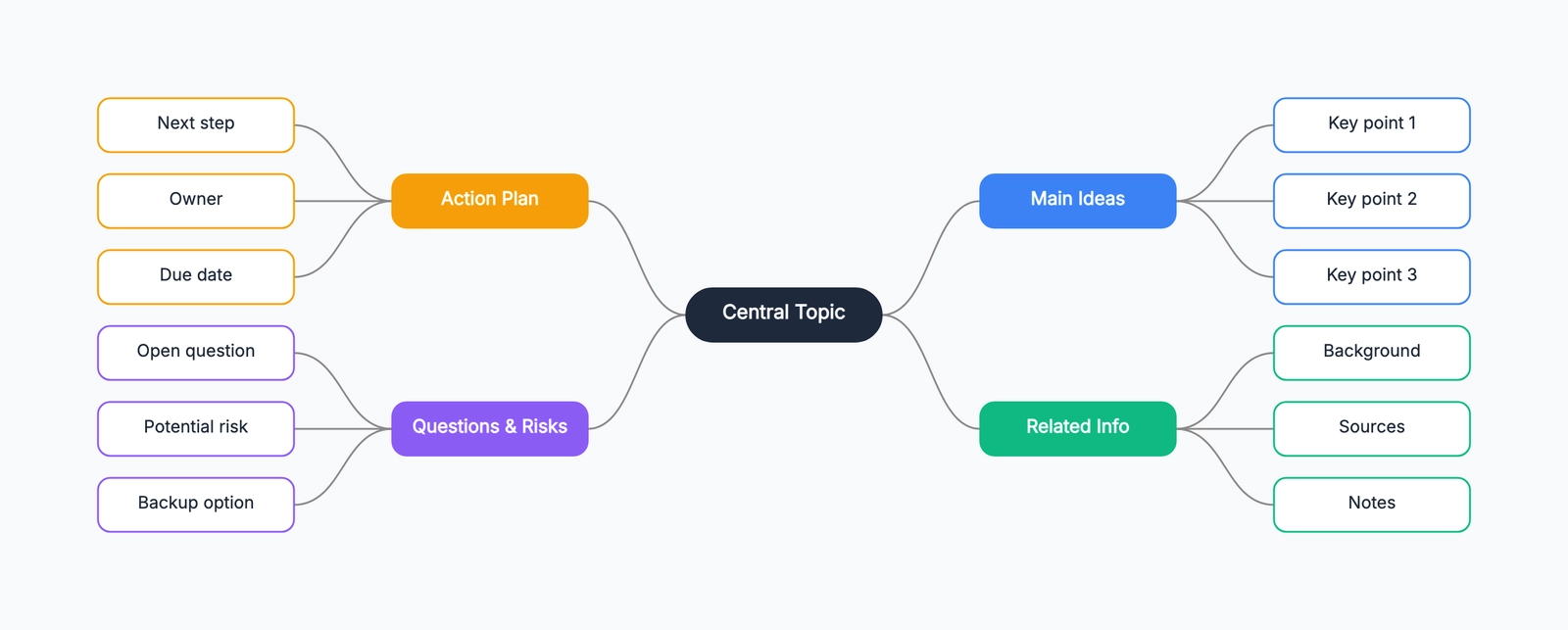
Mind map
Try this templateThe workflow reveals whether Figma proximity, facilitation, hand-drawn speed, technical structure, or free-plan limits should decide the switch.
1. Miro
Free tier: 3 boards (unlimited members)
Style: Clean, professional
Best for: Cross-functional workshops, enterprise collaboration
Miro is the most direct comparison to FigJam in the team whiteboard category, but it comes from the opposite direction. While FigJam grew out of Figma's design ecosystem, Miro grew out of workshop facilitation — replacing conference-room whiteboards and sticky-note exercises.
The template library is significantly larger: 300+ templates spanning workshops, strategy, planning, diagramming, research, and technical architecture. The facilitation toolkit — timer, voting, breakout frames, presentation mode — is the best in the category. If FigJam feels too design-specific and you need a whiteboard that works across departments, Miro is the default alternative.
The trade-off: Miro requires an account, caps free use at 3 boards, and has none of Figma's design-file integration. For a design team already in Figma, staying with FigJam is usually the better call. For a cross-functional team that needs one whiteboard for everyone, Miro is the stronger choice. See our Miro vs FigJam comparison for a deeper breakdown.
2. Excalidraw
Free tier: Unlimited, no signup
Style: Hand-drawn
Best for: Zero-friction sketching, privacy-first whiteboarding
Excalidraw is the antithesis of FigJam in philosophy. No accounts, no file limits, no team management, no platform — open the URL and draw. Everything saves to your browser's localStorage. Real-time collaboration works via shared link and is end-to-end encrypted.
The hand-drawn aesthetic is the defining feature. Everything looks like a sketch, which signals "work in progress" and makes diagrams easier to iterate. For early-stage ideation — the kind of work that happens before anything goes into Figma — Excalidraw is often a better fit than FigJam's polished interface.
The trade-off: no template library to speak of, no Figma integration, no facilitation toolkit, and a minimal shape library. Excalidraw is a sketchpad, not a workshop platform. If you need structure, templates, or deep collaboration features, look at Miro or CodePic instead.
3. tldraw
Free tier: Unlimited on tldraw.com, no signup
Style: Hand-drawn
Best for: Polished hand-drawn whiteboarding, custom tooling foundation
tldraw is the closest sibling to Excalidraw — same hand-drawn feel, same zero-friction entry, same free real-time collaboration via shared link. The difference is in polish: tldraw's UI is slightly more refined, snapping is tighter, and the overall feel is a touch more considered.
Like Excalidraw, tldraw is intentionally minimal. No templates, no facilitation tools, no structured diagram types. It's a canvas for thinking, not a platform for running workshops. The most famous feature — "Make Real" for sketch-to-code prototyping — is more of a demo than a daily-use tool.
If FigJam feels like too much tool for quick sketches and Excalidraw's slightly rougher edges bother you, tldraw is the sweet spot. If you need templates, structure, or Figma integration, look elsewhere.
4. CodePic
Free tier: Unlimited, no signup
Style: Hand-drawn
Best for: AI-assisted diagramming, template-rich whiteboarding
CodePic sits between the bare-sketch tools (Excalidraw, tldraw) and the platform tools (Miro, FigJam). It keeps the hand-drawn whiteboard feel but adds what those minimalist tools deliberately skip: a deep shape library, a template library covering flowcharts, ERDs, sequence diagrams, wireframes, org charts, and more, plus MCP (Model Context Protocol) integration so Claude or Cursor can place editable diagrams on the canvas from plain-language descriptions.
For a design team that occasionally needs to sketch a system architecture or a user flow alongside freeform whiteboarding, CodePic covers more ground on a single canvas. The AI integration is unique — describe a diagram in words and it appears as editable shapes.
The trade-off: collaboration is read-only link sharing, not simultaneous multi-user editing. If real-time co-editing is essential, Excalidraw, tldraw, or Miro are better fits. If you work solo or asynchronously, this isn't a limitation.
5. Lucidchart
Free tier: 3 documents
Style: Clean, professional
Best for: Structured technical diagrams, data-linked visuals
Lucidchart isn't a whiteboard — it's a diagramming tool. But it earns a spot on this list because FigJam users who need deeper diagramming (UML, ERDs, BPMN, network topology) often find themselves switching between FigJam and a separate diagramming tool. Lucidchart consolidates both needs with strong template coverage and data-linked diagrams (import from CSV to auto-generate org charts or system inventories).
The free tier is limited to 3 documents, and paid plans start around $9/user/month. Real-time collaboration is solid with granular permissions. The main trade-off: it doesn't feel like a whiteboard. If the informal, playful canvas is what you like about FigJam, Lucidchart will feel formal and structured in comparison.
6. Whimsical
Free tier: 3 shared team boards, unlimited private boards/files
Style: Clean, polished
Best for: Product managers, UX designers
Whimsical is FigJam's closest competitor in the "polished, design-friendly, multi-format canvas" category. It covers flowcharts, wireframes, mind maps, and sticky notes in a single clean interface. The experience of building diagrams is smooth and well-considered — it feels like a tool designed by people who care about craft.
The template library is smaller than Miro's but covers the product-design workflow well. Paid plans start around $10/month. The free tier is generous for private exploration but caps shared team boards, so it works best when you are testing a few collaborative spaces rather than running a whole team on it. If you're a product manager or UX designer who wants a polished canvas for user flows and wireframes, and FigJam's Figma-centric approach isn't relevant to you, Whimsical is worth evaluating.
Quick Comparison
| Tool | Style | Free Tier | Real-time Collab | Best For |
|---|---|---|---|---|
| FigJam | Clean, playful | 3 files | ✓ | Figma-native design teams |
| Miro | Professional | 3 boards | ✓ | Cross-functional workshops |
| Excalidraw | Hand-drawn | Unlimited | ✓ (E2E encrypted) | Zero-friction sketching |
| tldraw | Hand-drawn | Unlimited | ✓ | Polished hand-drawn canvas |
| CodePic | Hand-drawn | Unlimited | Read-only link | AI-assisted, template-rich |
| Lucidchart | Professional | 3 docs | ✓ | Structured technical diagrams |
| Whimsical | Clean, polished | 3 shared team boards + private files | ✓ | Product/UX design workflows |
How to Choose
The FigJam alternative that fits depends on why you're looking:
If Figma integration doesn't matter to you: The field opens up entirely. Excalidraw and tldraw for zero-friction sketching. CodePic for hand-drawn with templates and AI. Miro for cross-functional workshops.
If FigJam's 3-file limit is the problem: Excalidraw, tldraw, and CodePic are all unlimited and free with no signup. If you need structured collaboration, Miro's free tier also caps at 3 boards — you'll need a paid plan either way.
If you need templates beyond design workflows: Miro has the deepest library. CodePic covers technical diagramming templates. Lucidchart goes deepest on formal technical documentation.
If you want a hand-drawn aesthetic: Excalidraw and tldraw are the purest expressions of this. CodePic keeps the sketch feel while adding structure.
If you want the simplest possible tool: Excalidraw. Open a tab, draw, done. No accounts, no limits, nothing to manage. It's the tool FigJam isn't trying to be.
Related Reading
- Miro vs FigJam (2026): Which Whiteboard Tool Fits Your Team? — In-depth head-to-head of the two leading team whiteboards.
- Excalidraw Alternatives: The Best Hand-Drawn Whiteboard Tools — Detailed alternatives from the Excalidraw side.
- Best Free Online Whiteboard Tools in 2026 — Roundup of free options.
- tldraw Alternatives in 2026: Hand-Drawn Whiteboards Compared — Six tldraw alternatives compared.
- Best Diagramming Tools in 2026: A Practical Comparison — Broader comparison across diagramming tools.