Choose Excalidraw for encrypted hand-drawn collaboration, tldraw for a polished freeform canvas, draw.io for deep technical diagrams, or CodePic for templates and AI-assisted editable diagrams. Miro and FigJam make more sense when a team wants to evaluate a managed workshop workspace and can accept board limits.
The important difference is not whether each product has a free plan. It is what the plan lets you keep, share, export, and edit after the first session. This comparison checks those limits across seven free online whiteboards.
How We Compared the Free Plans
Each tool was checked against the workflow a free user must complete: open or sign up, create a board, save it, share it, collaborate when supported, and export or retain the result. A feature does not count as free if the final action requires an upgrade.
The comparison separates four limits that are often mixed together: how many boards remain editable, whether collaborators need accounts, whether live co-editing is included, and who controls storage. Those differences matter more than the total number of toolbar icons.
What "Free" Actually Means Here
Before getting into specific tools, a quick note on terminology. "Free" in this article means:
- Truly free, no time limit: The whiteboard is free to use indefinitely, not a trial.
- No payment required for core features: You can draw, save, export, and share without reaching a paywall.
- Free tier with real limits disclosed: Some tools have a free tier that's genuinely useful but capped (e.g., 3 boards). These are included because the free tier is substantial enough to rely on, but the limits are called out clearly.
Tools that offer only a 7-day or 14-day trial are not included. If you need to enter a credit card to start, it's not on this list.
Free Is Not One Thing
The phrase best free online whiteboard tools hides several different meanings of free.
There is free with no account, where you can open a tab and draw immediately. Excalidraw, tldraw, and CodePic are strongest here. This is the best fit for quick thinking, teaching, screenshots, and one-off collaboration.
There is free with platform limits, where the product is powerful but capped by boards, files, or workspace rules. Miro and FigJam belong here. These are useful when you want to evaluate a team workflow before paying.
And there is free because the tool has a different business model or format, like draw.io. It is not a classic whiteboard, but if your goal is structured diagrams at no cost, it deserves a place in the comparison.
Once you separate those meanings, the best free online whiteboard tools become much easier to choose.
Test the Free Plan with One Mind Map
Open the mind map below, invite another person, rearrange several branches, and export the result. Repeat that workflow before committing a team to any plan.
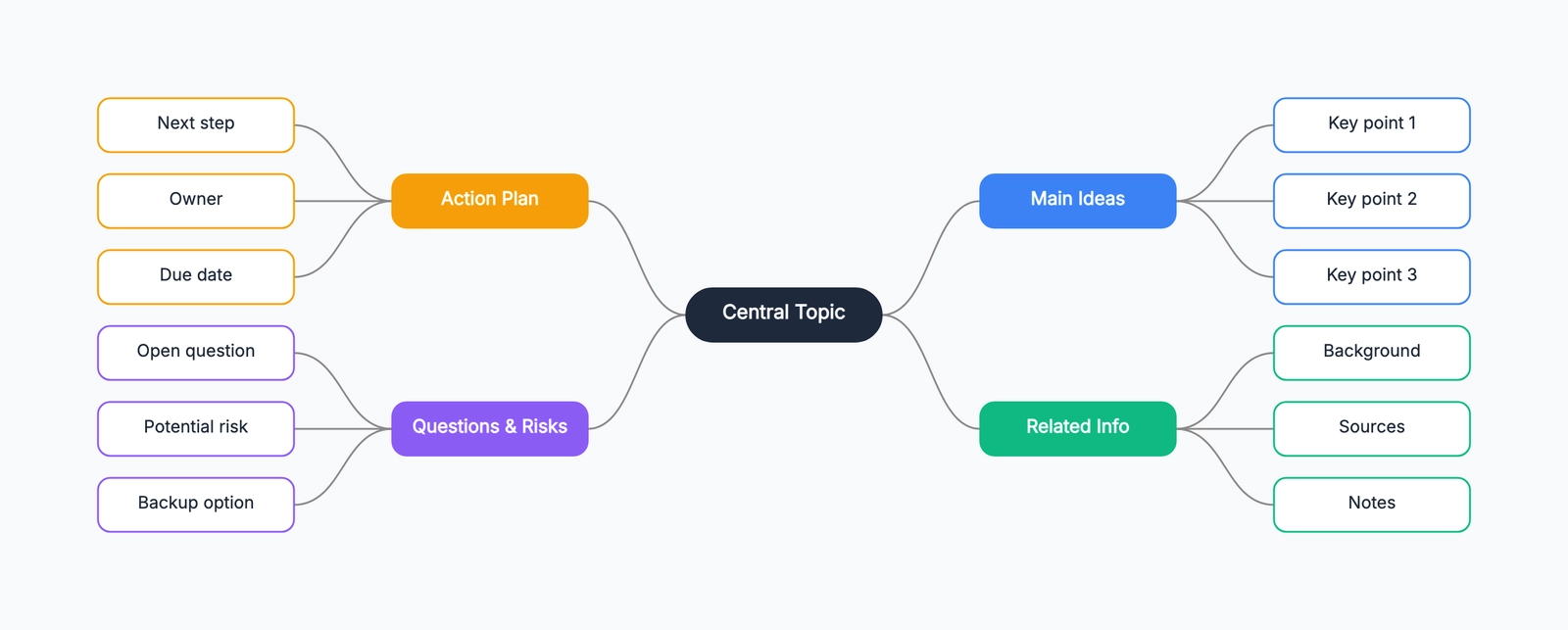
Mind map
Try this templateThis exposes account requirements, guest access, board limits, editing friction, and export restrictions more reliably than a free-plan feature table.
1. Excalidraw
Free tier: Unlimited, no signup Collaboration: Real-time, end-to-end encrypted, via shared link Style: Hand-drawn
Excalidraw is the benchmark for free online whiteboards. Open the URL, draw — no account, no setup, no limits. Everything stores in your browser's localStorage. Real-time collaboration works by sharing a link, and it's end-to-end encrypted — the room key lives in the URL fragment, so Excalidraw's servers never see your unencrypted content.
The shape library is intentionally minimal: rectangles, ellipses, diamonds, arrows, lines, freehand, text, images. This is a feature, not a limitation — the bare toolset keeps you focused on thinking rather than formatting. If you need flowchart symbols or ERD shapes, there's a community library system at libraries.excalidraw.com where you can import shape sets with one click.
The trade-off: no persistent cloud storage (your drawings live in your browser unless you export them), no native app (PWA only), and no AI on the free tier beyond the Mermaid-to-diagram converter. Excalidraw+ (paid) adds cloud storage, team workspaces, and more AI features.
Best for: Anyone who wants a zero-friction, private, hand-drawn sketching space that never asks for money or an email address.
2. tldraw
Free tier: Unlimited on tldraw.com, no signup Collaboration: Real-time, via shared link Style: Hand-drawn
tldraw is the closest sibling to Excalidraw in feel and philosophy. It's also a hand-drawn, infinite-canvas whiteboard with free real-time collaboration via shared link and no signup required. The canvas is slightly more polished — snapping behavior is tighter, multiplayer cursors are smoother, and the UI feels a bit more considered.
tldraw is most famous for "Make Real," a demo that turns a hand-drawn UI sketch into a working webpage via your own LLM API key. It's genuinely impressive, though it's purpose-built for sketch-to-code prototyping rather than general whiteboard use.
Like Excalidraw, tldraw's free hosted app keeps things simple: no accounts, no cloud storage (export your work to keep it), and a minimal shape library. The key difference from Excalidraw is licensing: tldraw's SDK is source-available with a custom license — free for personal use, paid for commercial production embedding. Excalidraw's core is MIT-licensed. This only matters if you plan to embed the whiteboard in your own product.
Best for: People who want the Excalidraw-like experience with slightly more UI polish, or who want to experiment with the Make Real sketch-to-code workflow.
3. draw.io
Free tier: Unlimited — no paid plan exists Collaboration: Live collaboration through supported storage/integrations Style: Clean, formal
draw.io (also at diagrams.net) doesn't try to be a hand-drawn sketching tool — it's a full-featured diagramming application that happens to be completely free. The shape library is extraordinarily deep: UML, network topology, BPMN, ERDs, AWS/Azure/GCP icons, circuit diagrams, and more. It's the most complete free diagramming tool available by a wide margin.
There's no account system. Files save to your local device or your own cloud storage (Google Drive, OneDrive, Dropbox). The desktop app wraps the web version in Electron for offline use.
Collaboration depends on where the file lives. Supported integrations such as Google Drive and Confluence can provide concurrent editing, and some draw.io collaboration modes show live cursors. It is less unified than an account-based workspace because permissions and history belong to the storage host, but it is not limited to emailing files back and forth.
Best for: Individuals and teams who need comprehensive technical diagram coverage at zero cost and work asynchronously. If you need to draw a proper UML class diagram, AWS architecture, or BPMN process flow without paying for software, draw.io is the answer.
4. Miro (Free Plan)
Free tier: 3 editable boards, unlimited team members Collaboration: Full real-time, unlimited members on free tier Style: Clean, professional
Miro is the largest online whiteboard platform, and its free plan is genuinely useful. You get 3 editable boards with unlimited team members, real-time collaboration, sticky notes, templates, and broad integrations. Dedicated facilitation features like timer, voting, visitor editing, and private boards are paid-plan upgrades.
The template library is extensive — hundreds of templates for workshops, retrospectives, strategy planning, diagramming, and more. Miro AI features (sticky note clustering, board summarization) are available in limited form on the free tier.
The 3-board limit is the obvious constraint. For a team running occasional workshops — one retrospective board, one planning board, one brainstorm board — it's enough. For anyone who wants a daily-driver whiteboard, you'll hit the limit quickly. But as far as free tiers go, Miro's is one of the most capable, especially for team use.
Best for: Teams that run occasional structured workshops and can work within the 3-board limit, or anyone wanting to evaluate whether a full-featured collaboration whiteboard fits their workflow before paying.
5. FigJam (Free Plan)
Free tier: Up to 3 collaborative team files; unlimited private drafts Collaboration: Full real-time Style: Clean, playful
FigJam is Figma's whiteboard product. If your team already pays for Figma, FigJam is included at no extra cost — which makes it one of the best "free" whiteboards for design teams. If you're not a Figma user, the free tier gives you 3 FigJam files with real-time collaboration.
FigJam's strength is its integration with Figma: paste design frames into a whiteboard and they stay linked, run design critiques alongside live files, share the same team permissions. The stamp, emote, and cursor-chat interactions give it a playful, informal feel that designers tend to like.
The template library is smaller than Miro's and focused on design workflows — critiques, brainstorms, retros, user flows. Outside the Figma ecosystem, FigJam is less compelling compared to the other options here. The 3-file free tier fills up fast if you're using it for multiple projects.
Best for: Design teams already using Figma — the integration makes it feel like a natural extension of the tools you're already paying for.
6. CodePic
Free tier: Unlimited, no signup Collaboration: Read-only link sharing Style: Hand-drawn
CodePic is a hand-drawn-style infinite whiteboard that adds something most free whiteboards lack: a deep shape and template library. You can sketch freely on the canvas, then drop in structured content — flowcharts, sequence diagrams, ERDs, org charts, mind maps, wireframes, swimlane diagrams, and more — without switching tools. Everything lives on the same whiteboard.
CodePic also supports MCP (Model Context Protocol) integration, so Claude or Cursor can place editable content onto the canvas from a plain-language description. This is useful if you're already working alongside AI tools and want diagrams that live on a canvas rather than as static images.
The trade-off is collaboration: CodePic supports read-only link sharing, not the simultaneous multi-user editing that Excalidraw, tldraw, Miro, and FigJam offer. If you work solo or asynchronously, this isn't a limitation. If you need real-time co-editing, it's a dealbreaker.
Best for: People who like the hand-drawn whiteboard feel but also need structured diagram types and templates, especially those working with AI tools like Claude or Cursor.
7. Microsoft Whiteboard
Free tier: Unlimited with Microsoft account Collaboration: Real-time, integrated with Teams Style: Clean, slightly playful
Microsoft Whiteboard comes free with any Microsoft account (personal, work, or school). It's pre-installed on Windows 11 and integrates deeply with Microsoft Teams — you can start a whiteboard session directly from a Teams meeting.
The feature set is solid: freehand drawing with basic ink smoothing, sticky notes, images, templates for common scenarios (brainstorming, retrospectives, project planning), and real-time collaboration. Templates are available but nowhere near as extensive as Miro's.
The obvious limitation is the Microsoft ecosystem lock-in. If your organization already uses Teams and Microsoft 365, Microsoft Whiteboard is effectively free and already integrated into your workflow. If you're outside that ecosystem, there's little reason to create a Microsoft account just for this whiteboard when Excalidraw or tldraw offer a comparable experience without one.
Best for: Teams already using Microsoft 365 and Teams — it's already included and deeply integrated into the tools you use daily.
Quick Comparison
| Tool | Style | Free Limit | Signup | Real-time Collab | Best For |
|---|---|---|---|---|---|
| Excalidraw | Hand-drawn | Unlimited | None | ✓ (E2E encrypted) | Private, zero-friction sketching |
| tldraw | Hand-drawn | Unlimited | None | ✓ (link share) | Polished hand-drawn whiteboarding |
| draw.io | Formal | Unlimited core editor | None | Via supported storage/integration | Deep technical diagrams |
| Miro | Professional | 3 boards | Required | ✓ (unlimited members) | Structured team workshops |
| FigJam | Playful | 3 files | Required | ✓ | Design teams in Figma |
| CodePic | Hand-drawn | Unlimited | None | Read-only link | AI-assisted, template-rich |
| Microsoft Whiteboard | Clean | Unlimited | Microsoft account | ✓ (Teams integrated) | Microsoft 365 teams |
How to Choose
The free whiteboard landscape sorts itself into three clusters:
Zero-friction sketching: Excalidraw, tldraw. Open a tab, draw, done. No accounts, no limits, no complexity. Pick either — the differences are small for casual use. Excalidraw has slightly better privacy (E2E encrypted collaboration) and a community shape library; tldraw is slightly more polished.
Structured diagramming: draw.io, CodePic. When you need more than rectangles and arrows — flowchart symbols, ERD notation, UML shapes, swimlane lanes — these are the free options that deliver. draw.io goes deepest on technical diagrams; CodePic keeps the hand-drawn feel while adding structure and AI.
Team workshops: Miro, FigJam, Microsoft Whiteboard. These assume multiple people working together in real time. Miro has the best facilitation toolkit and template library; FigJam is best for Figma-centric design teams; Microsoft Whiteboard is best for Teams-centric organizations.
One honest note: if you find yourself bouncing between tools — sketching in one, diagramming in another, sharing screenshots in a third — that's a sign you might want a tool that covers more scenarios on a single canvas. The extra minute spent switching tools adds up more than the extra minute spent learning one slightly broader tool.
Related Reading
- Excalidraw vs tldraw (2026): Which Hand-Drawn Whiteboard Is Better? — Detailed head-to-head of the two leading hand-drawn options.
- tldraw Alternatives in 2026: Hand-Drawn Whiteboards Compared — Six alternatives to tldraw, compared across features and use cases.
- Miro vs FigJam (2026): Which Whiteboard Tool Fits Your Team? — Detailed comparison of the two leading team collaboration whiteboards.
- draw.io vs Lucidchart (2026): Pricing, Features & Which to Pick — Deep dive on the two most popular diagramming tools.
- Best Diagramming Tools in 2026: A Practical Comparison — Broader comparison across diagramming tools, including paid options.