Creately has been around a long time in the diagramming space. It covers a lot of ground — flowcharts, mind maps, UML, org charts, network diagrams, even visual planning boards — and it pairs that breadth with templates and a free tier. For a team that wants one tool for many kinds of visuals, that all-in-one approach is the appeal.
But breadth comes with trade-offs. Creately's interface packs a lot onto the screen, and some users find performance slows down on large, busy canvases. The free tier is limited to a small number of documents, and the feature set can feel crowded when you only need to draw a flowchart or a mind map. If any of that sounds familiar, or if you're simply comparing options before renewing, here are six alternatives worth evaluating.
The tools below split into three rough directions: formal diagramming with deep shape libraries, team collaboration platforms, and lightweight hand-drawn canvases. Matching your primary use case to one of those directions narrows the field quickly.
What to Look For in a Creately Alternative
List the diagram types you actually produce before you compare anything. If your work is mostly UML, ERDs, and network diagrams, the shape library is the deciding factor. If your work is sticky notes, journey maps, and sprint planning, collaboration and templates matter more than shape depth.
Pricing structure matters too. Some tools are free forever, some have free tiers with document caps, and some price per user per month. A tool that looks cheap per seat gets expensive across a team of twenty. Check whether the free tier is genuinely usable for your volume or just a trial.
Templates and ease of use are worth their own question: can a new teammate produce something decent in the first session? A steep learning curve cancels out a powerful feature set if nobody in the group wants to open it.
The Creately Exit Map
Creately alternatives fall into different lanes depending on what made Creately feel wrong in the first place.
If the problem is too many features in one interface, move toward a simpler canvas like CodePic, Excalidraw, or tldraw. You keep speed and reduce the number of decisions needed before drawing.
If the problem is technical diagram depth, move toward draw.io or Lucidchart. Those tools are less playful but stronger for UML, ERDs, network diagrams, and structured documentation.
If the problem is team rituals, move toward Miro. Creately can support collaboration, but Miro is built around workshops, retrospectives, and planning sessions. That difference matters when the diagram is only one part of a larger meeting.
This Creately alternatives list is easiest to read as an exit map: leave toward simplicity, precision, or facilitation depending on what actually slowed your team down.
1. Lucidchart
Free tier: 3 documents
Style: Clean, professional
Best for: Formal, data-linked diagrams
Lucidchart is the closest in scope to Creately among the paid options. It covers flowcharts, org charts, network diagrams, UML, wireframes, and more, with deep integrations for Google Workspace and Microsoft 365. Teams already living in the Google or Microsoft stack tend to find it slots in naturally.
Its standout feature is data-linked diagrams. Import a CSV or a spreadsheet and Lucidchart generates an org chart or a system inventory that updates when the source data changes. For anything where accuracy against a live dataset matters, that's a real advantage over drawing by hand.
The limitations mirror the strengths. The free tier caps you at three active documents, paid plans start around $9 per user per month, and the interface can feel dense for casual users. It's a professional diagramming tool, not a sketching surface.
Best for: Teams that need formal, data-accurate diagrams with enterprise integrations.
2. draw.io
Free tier: Unlimited (no paid tier)
Style: Clean, formal
Best for: Deep technical diagrams at zero cost
draw.io (diagrams.net) is the most complete free diagramming tool available. UML, BPMN, network topology, ERDs, AWS, Azure, and GCP icon sets — the shape library goes deeper than Creately's for technical work, and the price is zero.
Files live in your own storage — Google Drive, OneDrive, or Confluence — with no account system and no server holding your data. The desktop app works fully offline, and the Confluence plugin makes it the default choice for diagram-in-wiki workflows.
The trade-offs are collaboration and aesthetics. There's no native real-time co-editing; collaboration happens by sharing files through external services. The look is formal and clean, which is right for deliverables but not for a loose brainstorming session. If your team mostly works asynchronously on technical diagrams, none of that is a problem.
Best for: Individuals and teams that want comprehensive technical diagram coverage without a subscription.
3. Miro
Free tier: 3 boards
Style: Clean
Best for: Team collaboration and workshops
Miro is the market-leading online whiteboard, and it competes with Creately more on collaboration than on diagram depth. Sticky notes, mind maps, flowcharts, journey mapping, retrospectives, sprint planning — Miro handles a huge range of team activities on an infinite canvas.
The template library is the deepest in this category, and real-time collaboration is smooth with granular permissions. For a team that runs workshops and wants diagrams as part of a larger planning flow, Miro is a strong choice.
What Miro won't give you is diagramming precision. Its shape library is adequate for standard diagrams but thinner than draw.io or Lucidchart for technical types like UML or network topology. The free tier is limited to three boards, and per-seat pricing climbs across a large org.
Best for: Mid-size to large teams that prioritize collaboration and templates over deep technical shapes.
Test the Exit with One Flowchart
Use the flowchart below to test migration friction. Import or rebuild it, change a decision, invite a reviewer, and confirm that the export remains editable.
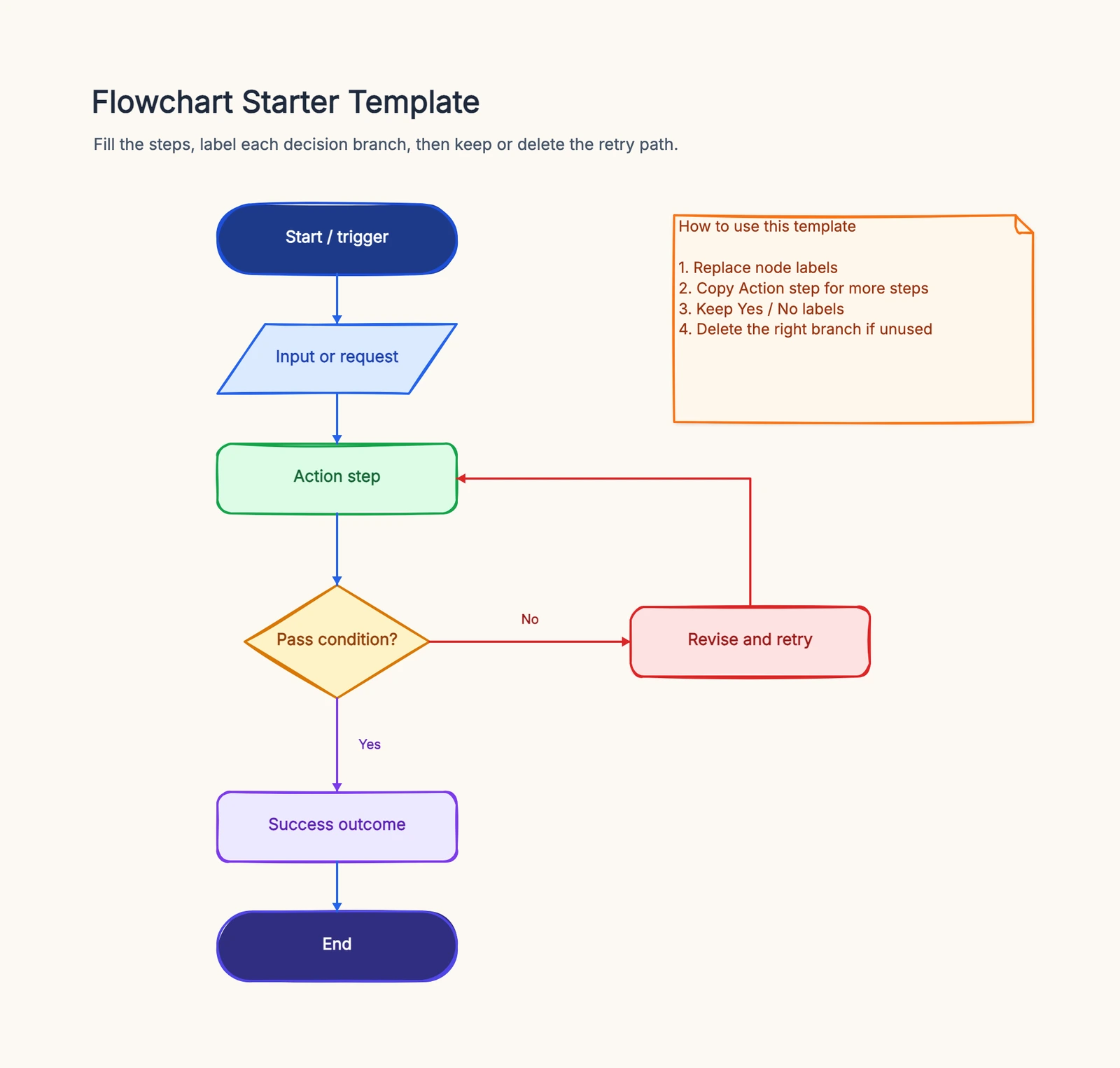
Flowchart Starter Template
Try this templateThe exercise reveals whether your priority is technical notation, workshop collaboration, fast sketching, AI assistance, or ownership of local files.
4. CodePic
Free tier: Unlimited
Style: Hand-drawn
Best for: Free sketching with AI integration
CodePic is a free, hand-drawn alternative with MCP AI integration. It's an infinite whiteboard, so the day-to-day experience is loose and canvas-first — sticky notes, freehand, connectors — similar in spirit to Excalidraw but with more structure available when you need it.
The structure comes as a broad shape library and a template library covering flowcharts, sequence diagrams, system architecture, ERDs, org charts, mind maps, and more. These live on the same canvas as your sketches rather than in a separate diagramming mode.
AI is what sets it apart for many teams. CodePic supports MCP, so you can describe a diagram in plain language to Claude or Cursor and get editable shapes placed on the canvas. Collaboration today is read-only link sharing — fine for sharing results, not for simultaneous editing. If real-time co-editing is essential, Miro is a better fit.
Best for: Developers and technical teams who want a free, hand-drawn canvas with AI-assisted diagram generation.
5. Excalidraw
Free tier: Unlimited (open source)
Style: Hand-drawn
Best for: Zero-friction sketching
Excalidraw is the "open a URL and draw" option. No signup, no install, no paid tier for the hosted app. The hand-drawn aesthetic makes everything look sketched, which keeps early-stage ideas feeling provisional rather than final.
For individuals and small teams, it's hard to beat for speed. A flowchart for a quick discussion, a sequence sketch for a code review, a rough mind map — all take minutes. Excalidraw also has a free Mermaid-to-diagram converter for bringing text-based diagrams in.
The limits are deliberate. The shape library is minimal, there are few templates, and team features (like encrypted collaboration) sit behind a paid plan. It's a sketchpad, not a full diagramming suite. If your work needs formal diagram types, you'll outgrow it.
Best for: Quick sketching and early ideation where speed matters more than structure.
6. tldraw
Free tier: Unlimited on tldraw.com (open source)
Style: Hand-drawn
Best for: Reliable real-time whiteboarding
tldraw is Excalidraw's closest competitor, with a hand-drawn aesthetic and a free hosted version. What it adds is polish and reliable real-time multiplayer from a shared link, no account required. The editor feels tighter under load and handles larger canvases gracefully.
Developers also value tldraw's SDK. It's one of the most respected whiteboard codebases available, and teams have built custom tools on top of it. If you're planning an embedded whiteboard in your own product, the source-available SDK is worth studying (with a paid license for commercial production use).
Like Excalidraw, tldraw is a canvas rather than a diagram engine. No deep shape library, no templates for formal diagram types, no AI integration. For freeform whiteboarding it's excellent; for structured technical diagrams you'd reach for draw.io or Lucidchart instead.
Best for: Teams that want open-source, real-time whiteboarding without account friction.
Quick Comparison
| Tool | Style | Free Tier | Real-time Collab | Templates | Best For |
|---|---|---|---|---|---|
| Creately | Clean | 3 docs | ✓ | Many | All-in-one diagramming |
| Lucidchart | Clean, professional | 3 docs | ✓ | Strong technical | Data-linked diagrams |
| draw.io | Clean, formal | Unlimited | Via file sharing | Shape library, few guided | Deep technical diagrams |
| Miro | Clean | 3 boards | ✓ | Very large | Team workshops |
| CodePic | Hand-drawn | Unlimited | Read-only link | Flowchart, ERD, system, more | AI-assisted sketching |
| Excalidraw | Hand-drawn | Unlimited | Shared link | Minimal | Zero-friction sketching |
| tldraw | Hand-drawn | Unlimited | Shared link | Minimal | Real-time whiteboarding |
How to Choose
Start with the diagram types you produce most. UML, ERDs, and network diagrams point to Lucidchart for paid or draw.io for free. Workshops, journeys, and team planning point to Miro. Freeform brainstorming and early ideation point to Excalidraw or tldraw. AI-assisted diagramming on a free canvas points to CodePic.
Pricing is the second filter. If you want zero recurring cost, draw.io, Excalidraw, tldraw, and CodePic all qualify, with different trade-offs in formality and collaboration. If a paid platform is fine and you want the best collaboration ecosystem, Miro and Lucidchart are the leading candidates.
Then run a small test: build one real diagram you actually need in the two or three finalists. The tool that feels natural after one session — and produces something you'd ship — is the one to keep.
For a fuller treatment of the free whiteboard side of this list, see our Best Free Online Whiteboard Tools in 2026. And if you're torn between the two formal diagram tools, our draw.io vs Lucidchart comparison walks through the differences.
Related Reading
- Excalidraw vs tldraw: Which Hand-Drawn Whiteboard Is Better? — The head-to-head for the hand-drawn options above.
- Excalidraw Alternatives: Hand-Drawn Whiteboard Tools Compared — A closer look at the sketching category.
- Miro vs FigJam: Which Whiteboard Tool Fits Your Team? — For when the collaboration platforms are your final choice.
- Best Free Online Whiteboard Tools in 2026 — A broader roundup of free canvases and whiteboards.
- draw.io vs Lucidchart: Pricing, Features & Which to Pick — The direct comparison between the two formal diagram tools.


