An AI video script generator is useful for drafting alternatives, but a shootable script needs more than fluent narration. Give it a brief with verified facts, a defined audience, a feasible visual plan and a clear action. Then revise the draft against what the production can actually show.
This walkthrough develops a fictional community repair-afternoon announcement. You can download its brief, a two-column script and an explicit revision log. The weak draft and revised lines are authored examples, not fabricated responses from a commercial model. The planned duration is a production target; no unperformed read-aloud or generated-video test is claimed.
Write the brief before asking for a script
The audience is a local resident with one small fabric item needing assessment. The available location is one room. We can stage a close-up of a loose seam, but we have no verified repair outcome, no attendance figures and no confirmed event date in this example. The desired action is to read the event page before travelling.
Those limits belong in the input. Otherwise a model may fill the gaps with “free repairs,” “fix anything” or a made-up time. Such details make the copy sound complete while creating information the production cannot support. Use explicit placeholders for unresolved facts and keep them out of the final published script until confirmed.
VEED's script generator is one documented drafting route. Whatever tool you choose, inspect its actual inputs and copy the result into a reviewable script. A generator should not become the only place where approved claims, versions and production decisions are stored.
| Brief field | This example | Why the writer needs it |
|---|---|---|
| Audience | Residents with a small fabric item | Avoids an undefined general audience |
| Purpose | Explain assessment and direct to event details | Limits the promise |
| Evidence | Staged seam sample and approved process | Determines feasible pictures |
| Limits | No guaranteed repair, price or turnaround | Prevents invented claims |
| Action | Read the event page before travelling | Gives the ending a specific job |
Ask for a structured draft rather than a finished film
A useful prompt is: “Write an approximately forty-five-second announcement from this brief. Return spoken words, visible action and unresolved dependencies in separate columns. Preserve the assessment requirement. Do not invent a date, address, price, repair outcome or customer quote. Flag missing facts.”
That instruction makes uncertainty visible. It also separates the script task from footage generation. Asking for a “viral cinematic video” before establishing the facts tends to produce adjectives and impossible shots rather than a useful production document.
Request a small number of alternatives with distinct reasoning, such as a problem-led opening and an action-led opening. Do not ask for fifty near-identical hooks before the shared body is accurate. A clear body makes variations easier to compare because the underlying offer and evidence stay the same.
Keep the initial draft. Revision is easier to review when someone can see what was removed and why. If the generator proposes an unsupported fact, record the issue as a factual correction rather than quietly polishing it into something equally vague.
Replace unsupported promises with observable actions
Our deliberately weak line is: “Fix anything in minutes for free.” It invents scope, speed, price and success. None of those facts exists in the brief. Replacing it with “Transform every item effortlessly” would retain the same problem under softer wording.
The revision is: “At our repair afternoon, the coordinator first checks what help is possible.” It describes the approved process and gives the picture a clear action: show an assessment moment. The limitation is no longer hidden in a disclaimer after an exaggerated promise.
Another weak line is: “Join hundreds of happy neighbours.” There is no attendance or satisfaction evidence. The revised line is: “Bring one small fabric item.” That is a supported instruction, not an invented social-proof claim.
A useful review method marks each sentence as fact, instruction, illustration or unresolved claim. Ask what supports it and what the audience could reasonably infer. An image of a completely restored bag can imply a guaranteed result even when the voice never explicitly promises one. Review the picture and words together.
Turn your brief into a shootable script
Open the video script template, add your audience, approved facts and next action, then fill in narration, pictures and dependencies. Start with the opening and ending. Check that every line has a feasible visual, and keep unconfirmed dates or outcomes in review notes.
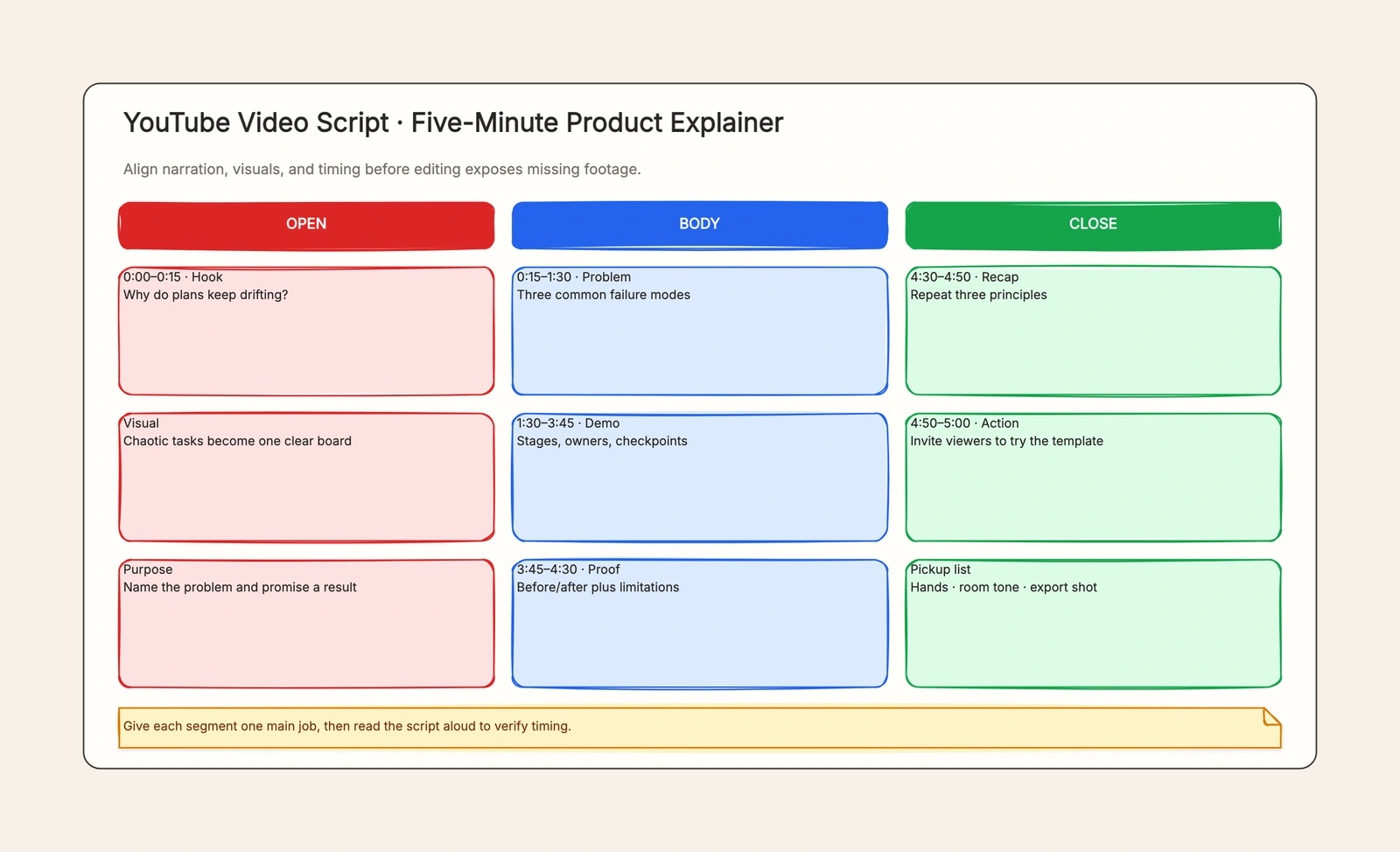
Build a two-column script that can be produced
The opening says: “A loose seam does not have to mean the end of a favourite bag.” Its picture is a staged close-up of an authored fabric sample. It introduces a relatable problem without claiming a particular customer's item was successfully repaired.
The middle says: “At our repair afternoon, the coordinator first checks what help is possible. Bring one small fabric item. We cannot promise every item can be repaired.” The visual shows an assessment tray and a single sample item, not a miraculous before-and-after transformation.
The ending says: “Read the event page for the confirmed time, location and what to bring before you travel.” Add the actual verified URL in editing. The script does not invent an address to fill the frame, and the destination must contain the information the voice promises.
| Section | Picture responsibility | Production dependency |
|---|---|---|
| Opening | Show a loose seam clearly | Staged sample available |
| Assessment | Show the item entering review | Permission for any real operator |
| Limit | Keep one item in the assessment context | Event scope approved |
| Action | Display the verified event destination | Time, location and URL confirmed |
The downloadable CSV adds exact narration beside those pictures. It is a script, not an automatic editor import format. Copy it into your own workflow and add shot identifiers, asset references and actual timing after production begins.
Time the spoken version instead of trusting word count
A target duration helps constrain the draft, but it is not a measurement. Read the final spoken text in the intended tone or render the approved voice. Include pauses for the audience to inspect the seam, understand the limitation and read the destination.
If the result is too short, do not pad it with generic enthusiasm. Use the available time to make the assessment process clearer or hold the actionable end card longer. If it is too long, remove repeated setup before removing a condition that affects attendance or expectations.
Keep spoken words separate from directions. A parenthetical instruction such as “show the tray” should not accidentally enter a voice-generation field. Similarly, visible text can be shorter than the spoken sentence as long as it does not contradict it. Label the columns clearly before handing the script to another person.
Record measured duration and the voice revision after the timing pass. This article has not performed that pass for a complete forty-five-second announcement, so the planned length remains a target. Treat precise timing claims with the same evidence standard as factual claims.
Make the visual plan feasible for your inputs
A scene requiring a crowded room, recognizable volunteers and a completed repair is not feasible if you have only a fabric sample and an empty room. Rewrite the scene or collect the missing authorized assets. Do not assume a video model can fill every production gap without changing what the video implies.
Use generated footage for clearly illustrative moments when appropriate. Use verified recordings when the picture is evidence of a real event, person or result. A fictional repair scene cannot prove what a particular community session delivered. Keep the origin of each visual in an asset ledger.
The AI product-video workflow covers accurate object representation. The AI B-roll workflow helps decide whether an insert should be stock, generated or filmed. Those are production decisions downstream of the script, not substitutes for a correct brief.
Use the video script template to connect narration and picture during review. Its value is making dependencies visible. CodePic does not generate the final voice or video; it helps collaborators see what must be supplied and approved.
Localize the task rather than translating slogans
A Chinese version should sound like an actual local announcement, not preserve English sentence length. It can say “先由协调员判断能提供什么帮助” to express the assessment stage. Keep the limit on guaranteed repair and the instruction to check details before travelling.
Dates, location terms and event expectations need local review. If one version says “fabric item” and another says “any household item,” the two language versions are offering different events. Compare the practical action each audience would take, not only whether the sentences seem similar.
Maintain a shared fact sheet and language-specific scripts. When the event time is confirmed, update both scripts and their end cards together. The AI video translation guide explains how to preserve terminology and dependencies across those layers.
Do not fabricate a translated testimonial to make the localized copy feel natural. If no customer statement exists, use the approved process and an original illustrative example. Natural language should make the facts easier to understand, not manufacture evidence.
Review the handoff with three concrete questions
Can the editor identify what is visible during every spoken sentence? If not, the script still contains unplanned production work. Add a feasible picture or simplify the line before generating media.
Can the fact owner point to support for every operational claim? If not, mark the line unresolved. A polished draft should not pressure the reviewer into accepting an invented date or outcome merely because the rest of the script is ready.
Can the viewer complete the stated next step? Open the actual destination, verify its information and inspect the final displayed link. A strong call to action fails if the page is missing or gives different instructions. Check this in the exported file, where cropping or tiny type can hide the address.
Download the brief, script and revision record
- Original repair-event brief
- Shootable narration and picture CSV
- Weak-line corrections and timing boundary
Replace the fictional facts before production. Keep the approved source, dated script revision, actual timing result, media references and final export together. When someone requests a later change, revise the underlying dependency rather than editing a random copy of the voice text.
An AI video script generator is most useful when it exposes alternatives quickly and leaves you with a document that can be checked. A finished script tells the writer what is true, the editor what to show and the viewer what to do. That is the standard to meet before turning words into footage.