An AI video translator is useful when you need the same video understood in another language, but the output is not approved just because the voice sounds fluent. Review four separate layers: the source transcript, the translated meaning, the spoken delivery and the subtitles. A mistake in the first layer can survive every later step.
This walkthrough turns a fictional pottery-room announcement into a Chinese-language handoff. You can download the original English speech fixture, bilingual text, glossary and subtitle files below. The speech was made with a system text-to-speech voice; the translation and subtitles were authored and checked for this example. They are not a claimed test of a commercial translation model, and no Mandarin dub is supplied.
Decide whether you need subtitles, dubbing or a localized edit
A viewer watching silently needs translated subtitles. Someone following a demonstration while looking at their hands may need a translated voice. A presenter facing the camera might also benefit from lip synchronization, but that is a separate visual requirement. Do not buy or generate all three automatically.
HeyGen's video translator describes an upload or video-link workflow with translation features. That establishes a possible production route, not a guarantee that its output will use your organization's terminology. Check the available source language, target language, input restrictions and downloadable outputs in the actual account before allocating a full project.
A localized edit can be more effective than a literal dub when the original contains long introductions, region-specific instructions or dense text on screen. Keep a change log: an omitted example is an editorial decision, while an omitted condition can change the instruction. Decide who can authorize those changes before generating anything.
| Needed outcome | Minimum deliverable | Separate review |
|---|---|---|
| Understand without sound | Translated subtitle track | Reading speed and meaning |
| Listen while doing another task | Translated audio | Pronunciation and instruction order |
| Watch a speaking presenter | Dub plus suitable face treatment | Mouth timing and identity |
| Use a different regional procedure | Localized script and edit | Local process owner approval |
Build a source transcript before translating
Our announcement says: “Welcome to the pottery room. Leave your piece on the drying rack. Book a kiln slot after the instructor approves it. Keep the aisle clear.” There are only four sentences, yet two expressions can easily go wrong without context.
“Piece” means a pottery work, not a machine component. “Kiln slot” means a reserved firing interval, not a physical opening in a kiln. The word “after” makes the instructor's approval a prerequisite. Preserve that dependency even if the target language rearranges the sentence.
Create a source transcript that matches what is actually audible. If an earlier approved script differs from the recording, either correct the recording or document the discrepancy; do not silently translate a script that the audience never hears. Check names, numbers, dates, negation and references such as “this tray,” especially when the camera is showing something else.
For a longer project, assign each sentence an identifier and a source interval. That lets an editor replace one line without guessing which subtitle, voice segment and shot need updating. Keep the original media untouched and make corrections in a versioned working copy. A reviewer should be able to trace a target sentence back to its source.
Translate meaning with a small approved glossary
The Chinese version is: “欢迎来到陶艺教室。请把作品放在晾坯架上。得到老师确认后,再预约窑烧时段。请保持通道畅通。” The phrasing is natural for a room announcement and preserves the approval sequence. It does not add a firing temperature, a booking website or a safety promise that the source never supplied.
| Source expression | Approved Chinese | Rejected interpretation | Why it matters |
|---|---|---|---|
| drying rack | 晾坯架 | 烘干机 | A rack is not powered drying equipment |
| kiln slot | 窑烧时段 | 窑的槽口 | The task is scheduling |
| piece | 作品 | 零件 | The context is pottery |
| after approval | 得到确认后 | 自动确认 | Human approval remains required |
Give a translation tool the glossary, audience and intended action along with the transcript. A useful instruction is: “Translate this room announcement for Mandarin-speaking pottery learners. Preserve the requirement for instructor approval. Use the supplied glossary. Flag ambiguity instead of inventing operational details.” Keep the generated draft separate from the approved version.
A back-translation can help expose missing conditions, but it is not sufficient approval on its own. A second model can repeat the first model's assumptions. Ask a target-language reviewer to describe the action they would take after hearing the line. If they would book first and ask later, the instruction has failed regardless of how polished the prose sounds.
Turn the translation into your review workflow
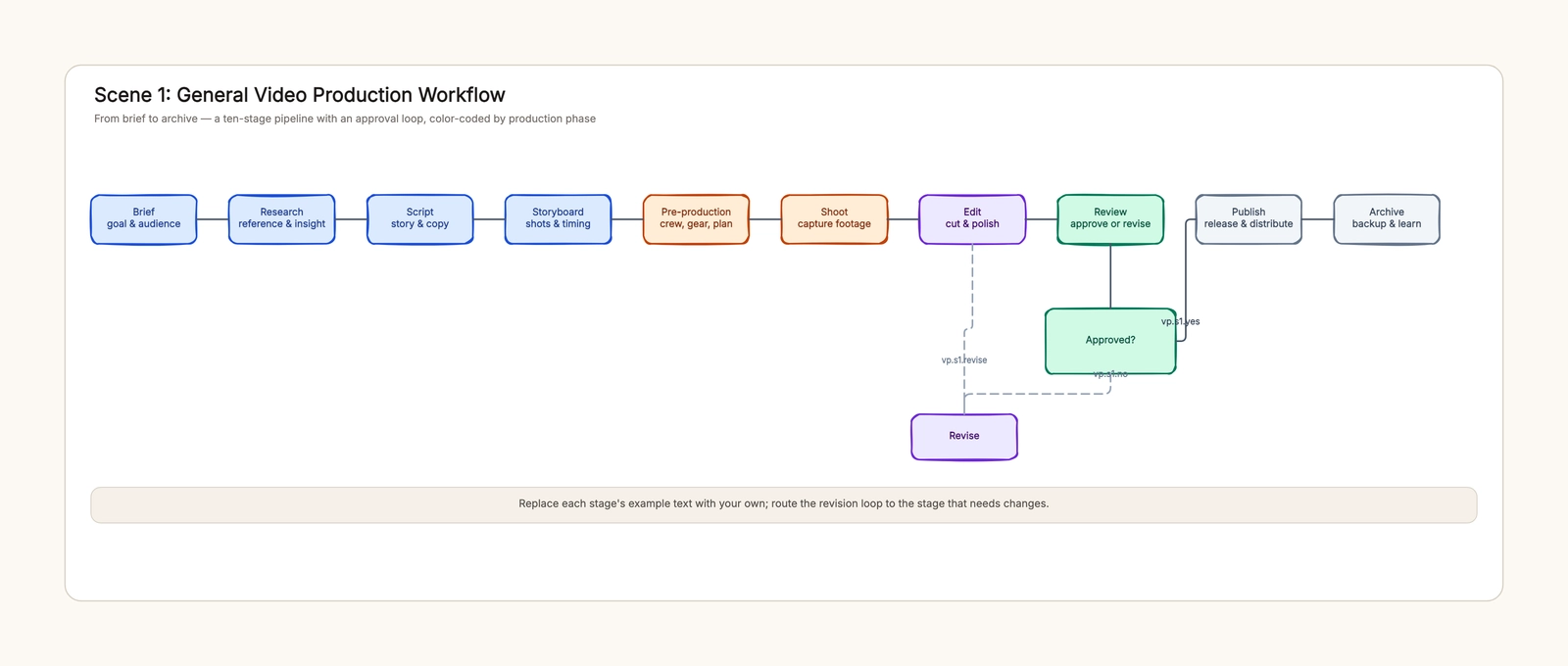
Open the video production workflow template and replace the example with your source, translation, voice and subtitle stages. Add an owner and acceptance condition to each. Mark one term that needs review, then connect it to the audio and caption assets that must change together.
Prepare the dub without forcing the original wording
Approve the target text before paying to render a new voice. Read it in the intended delivery style and note where a listener needs a pause. A translated sentence may be longer than its source; squeezing it into the old interval can make a practical instruction difficult to follow.
There are three reasonable responses to that problem. Shorten redundant phrasing while preserving meaning, lengthen the picture where the edit allows it, or split the sentence at a meaningful boundary. Do not remove “after the instructor approves it” just to fit a short mouth movement. That would solve timing by breaking the task.
Use a stock voice with appropriate usage permissions or follow the provider's authorized voice workflow. A multilingual dub does not automatically require cloning the original speaker. Record which voice, locale and pronunciation choices were approved so a later update does not sound like a different presenter halfway through the video.
Listen to the actual exported audio, not only a text preview. Check the beginning and end of sentences, awkward emphasis, names and words with multiple pronunciations. If the dub is mixed over the original, make sure the source voice does not obscure the target instruction. Retain a clean target-language track for future edits.
Treat translated subtitles as their own timed document
The downloadable Chinese SRT follows the source sentence windows. It is a subtitle translation for the supplied English audio, not a synchronization file for an unmade Mandarin dub. Once you create a new spoken version, re-time the subtitles against that audio instead of assuming equal sentence lengths.
Break text where the thought breaks. The third Chinese cue uses two lines around the approval condition and the booking action. A break in the middle of a term makes the reader reconstruct the meaning while also following the picture. Avoid putting a long instruction into a brief cue simply because the source has one subtitle block.
Keep one master text record and derive the subtitle tracks from it. If a reviewer changes “drying shelf” to “drying rack” in the narration, search the subtitles, on-screen labels, description and downloadable transcript for the old phrase. Otherwise viewers receive two names for the same object.
A burned-in subtitle is part of the image; a sidecar SRT is a separate file. They have different replacement costs. Deliver both only when the destination needs both, and make their language names unambiguous. Test the sidecar with the intended player and inspect the burned-in version at the actual viewing size.
Review picture, sound and instruction together
Play the whole sequence without stopping, then review the high-risk lines slowly. During “drying rack,” the picture should show the rack or a clearly illustrative view rather than a different machine. During the approval condition, the edit should not imply that booking is automatically completed.
If a speaking face is present, first distinguish a constant audio offset from local mouth-generation problems. Moving an entire track can fix the former but not the latter. The AI lip sync review covers that narrower diagnosis; translation approval remains a separate responsibility.
A practical review sheet needs a source sentence, approved target sentence, interval, issue, owner and resolution. “Sounds wrong” is difficult to act on. “The target sentence tells viewers to book before approval” gives the translator a precise correction. Resolve the meaning issue before spending another attempt on facial animation.
Watch with subtitles on and off. The audio should communicate its intended instruction without depending on a subtitle correction, and the subtitle track should not contradict the voice. Also check that any translated title or end card uses the approved vocabulary. Localization is unfinished if the body is translated but the only actionable link still points to an unavailable regional page.
Download the original translation handoff
- English speech fixture
- Bilingual source and approved translation
- Glossary CSV
- English source-timing SRT
- Chinese source-timing SRT
These files are intentionally small enough to inspect sentence by sentence. The pauses in the audio provide review space; they are not an example of optimized final pacing. Import the tracks into your chosen editor and verify the correspondence before replacing the source with your own material. Remove the fictional workshop instructions rather than mixing them into a real operational announcement.
For a larger assignment, use a video production workflow to assign translation, voice, subtitle and final-approval owners. CodePic can organize that handoff; it does not translate or dub a video. If your main task is correcting transcription and exporting subtitle files, use the separate AI subtitle workflow.
Release a package that can be corrected later
Name the files by project, language and revision, and include the approved transcript, glossary, clean audio, subtitle tracks and final media. Record the source revision and the tool settings that produced the adopted dub. That is more useful than a folder full of unnamed generated clips.
Before publication, have the process owner approve the instruction and a target-language reviewer approve the wording. A single person may fill both roles, but the checks still answer different questions. Publish only the approved combination of audio, picture and text, then keep the rejected draft out of the delivery folder.
When an instruction changes, start with the source sentence and update its dependent assets together. Replacing only the spoken line can leave an outdated subtitle or visual cue in circulation. A trustworthy AI video translator workflow makes correction easy because every language version has a clear source and an accountable final reviewer.