Content Mapping Template
Plan audience questions, content, next actions, and measurement across SaaS, ecommerce, and local-service journeys.
Use this templateWhat you get
- Three complete buyer-journey scenarios
- Connected journey stations with editable questions, pages, CTA, and measures
- A post-purchase care stage for the ecommerce example
What this template is for
This content mapping template helps you connect audience questions with useful pages, next actions, and observable progress. It contains three complete teaching scenarios rather than an empty funnel. The SaaS scene follows an agency project lead from a handoff problem to a sample review task and a plan decision. The ecommerce scene adds post-purchase care to discovery, comparison, and product selection. The local photography scene connects preparation advice, relevant work examples, and booking details to a qualified inquiry. Each stage includes a question, a content destination, a next step, and a measure with an owner. Replace the audience and business goal before changing individual cards, because those choices determine which content belongs in the plan. Then inspect existing pages and distinguish a missing answer from a missing link. A gap does not always require another article: it can call for clearer product details, a better demonstration, a support document, or a more appropriate call to action. Keep claims tied to actual product capabilities and service terms. The journey can loop or skip stages; the numbered journey stations organize a discussion and do not claim that every visitor follows one path. This whiteboard is a planning artifact, not a marketing-automation system or an analytics dashboard. Store measurements in your reporting tools, bring the evidence back to a review, and revise the map when questions or offerings change.
When to use this template
- Plan a SaaS evaluation path from a problem to a real task.
- Include care support after an ecommerce purchase.
- Connect local-service advice to relevant work and booking details.
- Audit whether existing content has a useful next action.
How to use it
- 1Choose one audience and one meaningful outcome.
- 2Replace stage questions with evidence from customers or research.
- 3Assign existing content before requesting new pages.
- 4Write the next action and its actual destination.
- 5Define a measure and owner for each task; revisit the map with evidence.
Quick example
Populated example
Related resources
How it compares to similar tools
Content map vs calendar
A map explains why content exists; a calendar schedules its delivery.
Content map vs keyword map
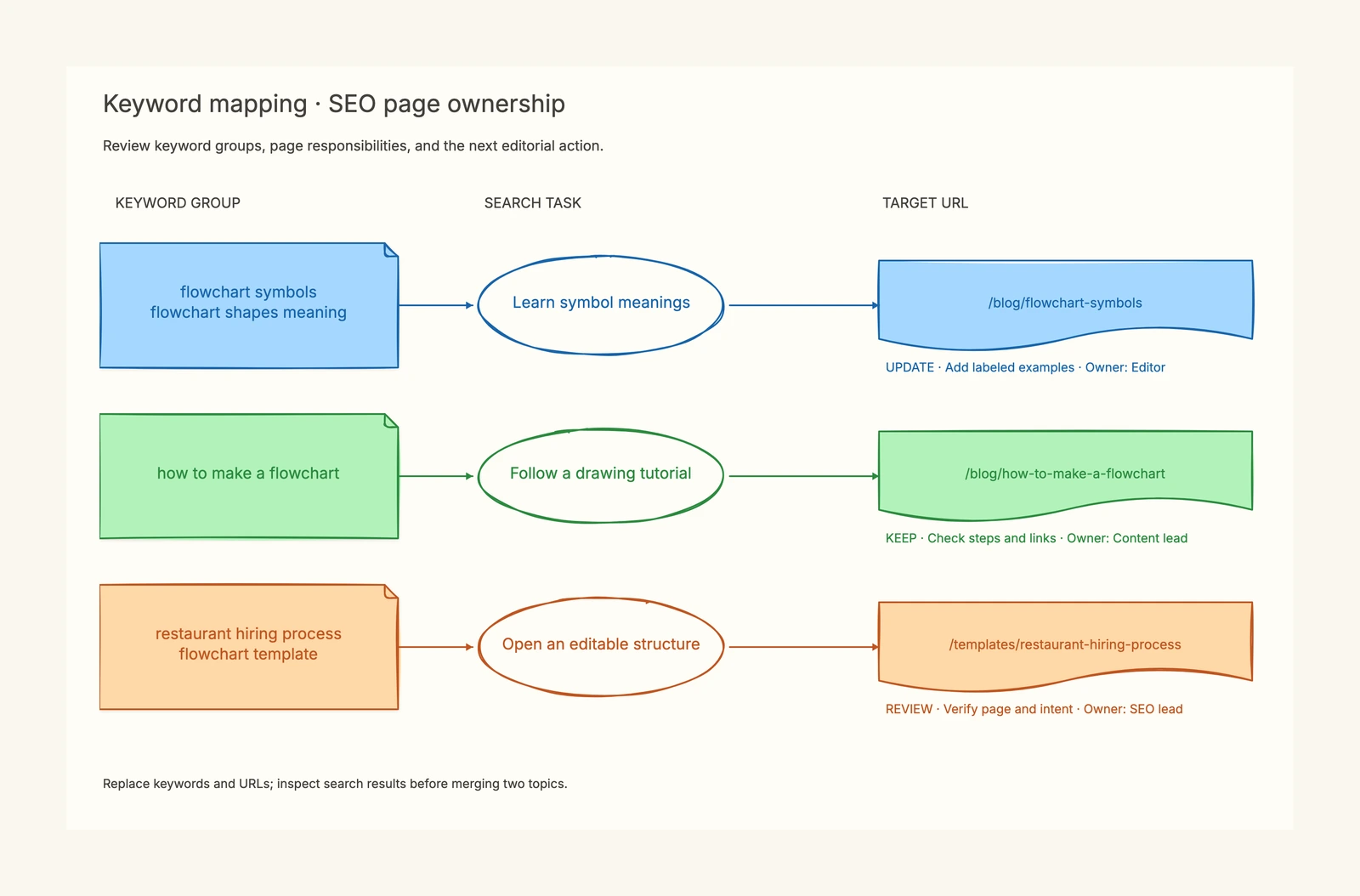
Journey questions and next actions differ from assigning searches to URLs.
Planning vs automation
This board records decisions; it does not send campaigns or track live events.
Common mistakes to avoid
Identical CTA at every stage
Choose an action that follows the question just answered.
A new page for every cell
Check whether an existing page can answer related needs before expanding.
Claims without an owner
Ask product, merchandising, or service owners to verify applicable details.
Frequently asked questions
Are these customer growth results?+
No. The scenes are teaching examples, with no measured conversion gains claimed.
Can visitors skip stages?+
Yes. Numbered stages organize content planning; actual journeys can loop or skip.
Does this template measure analytics?+
No. Define events here, measure them in your analytics system, and review evidence later.
Start editing online
Open the template in CodePic, replace the sample content, and make it your own in a few minutes.
See examples: /templates/content-mapping/examples