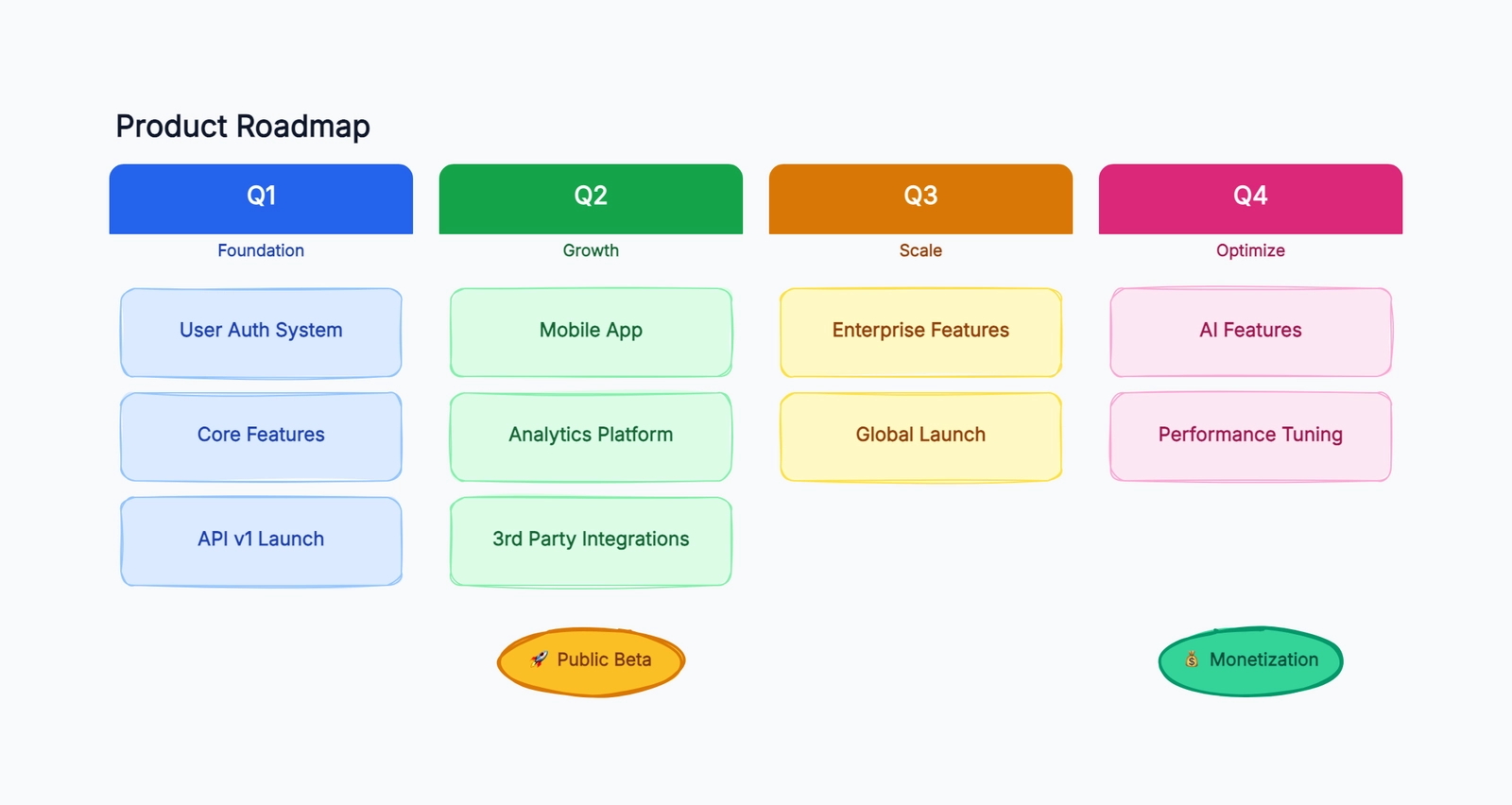
A product roadmap is a strategic communication tool that shows where a product is headed, what matters most, and roughly when important work is expected to happen. It connects product direction to real decisions: which customer problems deserve attention, which initiatives come first, and which trade-offs the team is making.
The important part is that a roadmap is not a fixed promise list. It should not pretend that every feature, date, and dependency is guaranteed. Good roadmaps communicate intent and priority while leaving room for learning, customer feedback, technical discovery, and market changes.
In practice, a product roadmap is most useful when it answers three questions clearly: What are we trying to achieve? What are we focusing on next? What are we deliberately not doing right now?
Why Roadmaps Work
Roadmaps work because product teams rarely fail from lack of ideas. They fail from too many ideas competing for attention.
A roadmap gives the team a shared frame for making choices. Instead of debating individual feature requests in isolation, people can ask whether the work supports the current goals and themes. That shift matters. It moves the conversation from "Can we build this?" to "Is this the right thing to build now?"
For product managers, the roadmap is a way to explain priorities without turning every planning conversation into a backlog review. For engineering and design, it creates enough visibility to plan capacity, explore technical risks, and avoid surprise requests. For sales, support, leadership, and customers, it gives a readable view of direction without exposing every internal task.
The best roadmaps also make trade-offs visible. If improving onboarding is the top theme this quarter, then a large reporting feature may need to wait. That does not mean reporting is unimportant. It means the team has chosen a clearer priority for the current planning horizon.
What a Product Roadmap Shows
A roadmap can be simple, but it needs enough structure to be useful. Most effective product roadmaps include the following parts.
Goals or themes. These explain why the work matters. A theme might be "reduce activation friction," "improve enterprise readiness," or "make collaboration faster." Themes are more durable than individual features and help people understand the strategic intent.
Initiatives or features. These are the larger chunks of work that support the goals. An initiative might contain several features, experiments, or technical projects. For example, "self-serve onboarding" could include signup improvements, sample data, welcome emails, and in-app guidance.
Time horizons. Roadmaps usually show time at a higher level than execution plans. That might be Now / Next / Later, quarters, months, releases, or broad phases. The further out the roadmap goes, the less precise it should be.
Status. Stakeholders need to know whether something is planned, in discovery, in progress, at risk, launched, or intentionally paused. Status makes the roadmap feel alive instead of like a slide that was true once.
Owners and dependencies. A roadmap should make responsibility and constraints visible. If an initiative depends on a platform migration, a data pipeline, a partner API, or another team, the roadmap should show that dependency early.
Types of Product Roadmaps
There is no single correct roadmap format. The right type depends on the audience, the product stage, and how much certainty the team actually has.
Now-Next-Later Roadmap
A Now-Next-Later roadmap groups work by confidence rather than date.
- Now means the team is actively working on it or committed to starting soon.
- Next means it is likely coming after the current focus, but details may still change.
- Later means it matters, but timing and scope are still uncertain.
This format is especially useful for early-stage products, fast-changing markets, and teams that do not want to imply false precision. It is easy to understand and keeps attention on priority rather than calendar promises.
Timeline Roadmap
A timeline roadmap places initiatives across months, quarters, or half-years. It is useful when stakeholders need to understand sequencing and broad timing.
Timeline roadmaps work well for mature products, cross-functional launches, and organizations where budgeting, marketing, or customer commitments require more visibility. The risk is that people may interpret every bar as a firm date, so the roadmap needs clear labels and regular updates.
Theme-Based Roadmap
A theme-based roadmap organizes work around strategic themes instead of dates or feature categories. For example, a B2B product might have themes like "admin control," "data accuracy," and "workflow automation."
This format is strong when the team wants to keep strategy visible. It prevents the roadmap from becoming a long feature inventory and helps stakeholders see how different pieces of work connect to bigger outcomes.
Release Roadmap
A release roadmap groups work by version, milestone, or launch window. It is common for products with packaged releases, mobile apps, developer tools, hardware, or enterprise software.
Release roadmaps are useful when the question is "What will be included in the next release?" They are less useful for early discovery or long-term strategy because they can push teams toward premature scope commitments.
Real-World Product Roadmap Examples
SaaS Product Roadmap
For a SaaS analytics product, the roadmap might look like this:
| Horizon | Theme | Initiative | Status | Owner |
|---|---|---|---|---|
| Now | Activation | Guided onboarding checklist | In progress | Growth PM |
| Now | Reliability | Query performance improvements | At risk | Platform team |
| Next | Collaboration | Shared dashboards | Discovery | Product + Design |
| Later | Enterprise | Audit logs and SSO expansion | Planned | Enterprise PM |
The value of this roadmap is not the exact dates. It shows the business logic: improve activation first, keep performance under control, then expand collaboration and enterprise readiness.
Mobile App Roadmap
For a consumer mobile app, the roadmap may be organized around releases:
| Release | Focus | Example work |
|---|---|---|
| 3.2 | Retention | Push notification preferences, saved views |
| 3.3 | Sharing | Invite flow, share cards, contact suggestions |
| 3.4 | Monetization | Trial reminders, plan comparison, upgrade screen |
Mobile roadmaps often need to account for app store review, platform-specific work, and staged rollouts. A clean release view helps marketing, support, and QA prepare without requiring them to read every ticket.
Internal Platform Roadmap
For an internal developer platform, the roadmap might focus less on features and more on capabilities:
| Timeframe | Capability | Why it matters |
|---|---|---|
| Q2 | Standard service templates | Reduce setup time for new services |
| Q2 | Centralized observability | Make incidents easier to diagnose |
| Q3 | Deployment policy automation | Reduce release risk across teams |
| Q4 | Cost visibility dashboards | Help teams manage infrastructure spend |
Internal roadmaps need clear owners and dependencies because the customers are other teams. If the platform team is blocked by security review or infrastructure changes, that should be visible early.
How to Create a Product Roadmap
Start with goals. Before listing features, write down what the product needs to accomplish. Are you trying to increase activation, reduce churn, expand into a new customer segment, improve reliability, or unblock a sales motion? A roadmap without goals becomes a decorated backlog.
Collect inputs, but do not treat them equally. Inputs can come from customers, sales calls, support tickets, analytics, competitors, leadership, and engineering. Collect them in one place, then look for patterns. A loud request from one account matters, but it should not automatically outrank a repeated problem affecting many users.
Group work into themes. Themes turn scattered requests into a coherent plan. "Add CSV export," "improve report filters," and "save custom views" may all belong under a broader theme like "make reporting more useful for managers."
Prioritize by impact, confidence, and effort. Prioritization does not need to be a complex scoring exercise, but the logic should be explicit. Which work supports the most important goal? Where is the evidence strongest? What has hidden technical cost? What must happen before other work becomes possible?
Choose the right time granularity. Use Now / Next / Later when uncertainty is high. Use quarters when the organization needs planning visibility. Use releases when packaging matters. Avoid daily or weekly detail unless the roadmap is being confused with a delivery plan.
Share the roadmap and update it regularly. A roadmap is useful only if people trust it. Share it with the teams who depend on it, explain what changed, and keep the status current. A monthly review is often enough for strategic roadmaps; fast-moving products may need a shorter cycle.
Common Product Roadmap Mistakes
Treating the roadmap as a commitment contract. The fastest way to make a roadmap harmful is to present uncertain work as guaranteed. Dates and scope should match the team's level of confidence. If something is still in discovery, say so.
Adding too many features. A roadmap packed with dozens of items does not create alignment. It creates noise. If everything is on the roadmap, the roadmap is no longer explaining priority.
Leaving out the strategic goal. Stakeholders can disagree productively when they understand the goal. Without goals, debates collapse into feature opinions: one person wants integrations, another wants reporting, another wants admin controls. The roadmap should show the reason behind the work.
Not updating the roadmap. An outdated roadmap is worse than no roadmap because people keep making decisions from stale information. When priorities change, the roadmap should change visibly, with a short explanation.
Product Roadmap vs. Other Planning Tools
Product roadmaps often get confused with other planning documents. They overlap, but they are not interchangeable.
| Tool | Best for | Main question it answers |
|---|---|---|
| Product roadmap | Strategic direction and priority over time | Where is the product going? |
| Gantt chart | Detailed project schedule and dependencies | When will each task happen? |
| Kanban board | Managing work in progress | What is moving through the workflow now? |
| Product backlog | Capturing and ordering possible work | What could we build? |
| Strategy document | Explaining market, positioning, and goals | Why are we choosing this direction? |
Product Roadmap vs. Gantt Chart
A Gantt chart is about execution detail: tasks, durations, dependencies, and deadlines. A roadmap is about strategic direction and priority. If a roadmap contains every task and dependency, it has probably turned into a project plan.
Product Roadmap vs. Kanban Board
A Kanban board shows the current flow of work. It is great for seeing what is ready, in progress, blocked, or done. A roadmap sits above that level and explains why the team is doing that work in the first place.
Product Roadmap vs. Product Backlog
A backlog is the inventory of possible work. It can be long, messy, and detailed. A roadmap is a curated view of the most important direction and initiatives. Not everything in the backlog belongs on the roadmap.
Product Roadmap vs. Strategy Document
A strategy document explains the market, customer, positioning, and business logic behind the product direction. A roadmap translates that strategy into a sequence of priorities. Strategy says why. The roadmap says what next.
Frequently Asked Questions
Who owns the product roadmap? The product manager usually owns the roadmap, but ownership should not mean writing it alone. Engineering, design, data, sales, support, customer success, and leadership all provide important inputs. The PM's job is to turn those inputs into a coherent set of priorities.
How far ahead should a product roadmap go? Most teams can plan the near term with more detail and the future with less detail. For example: this quarter in detail, next quarter at the initiative level, and later work as broad themes. If the roadmap looks equally precise twelve months out, it is probably pretending to know too much.
Should a roadmap include exact dates? Use exact dates only when the team has high confidence or an external commitment, such as a launch event, contract obligation, or compliance deadline. For uncertain work, use broader time horizons like quarters, releases, or Now / Next / Later.
How often should a roadmap be updated? A strategic roadmap should be reviewed regularly, often monthly or quarterly. The update cycle should match how quickly the product environment changes. What matters most is that changes are visible and explained.
What should not be on a product roadmap? Tiny tasks, speculative ideas with no priority, every bug fix, and unvalidated feature requests usually do not belong on the roadmap. They may belong in the backlog, but the roadmap should stay focused on direction and meaningful initiatives.
What is the simplest product roadmap format? Now / Next / Later is usually the simplest useful format. It communicates priority without pretending every future item has a reliable date.
If you want a quick starting point, use the free product roadmap template and fill it with goals, themes, initiatives, owners, and status before adding detailed dates. That order keeps the roadmap strategic instead of turning it into a task calendar.
Related Reading
- The Best Free Product Roadmap Templates & Tools in 2026 — a hands-on comparison of roadmap tools
- What Is an OKR? — product roadmaps and OKRs often work together; OKRs define the outcomes, and roadmaps show the path to get there