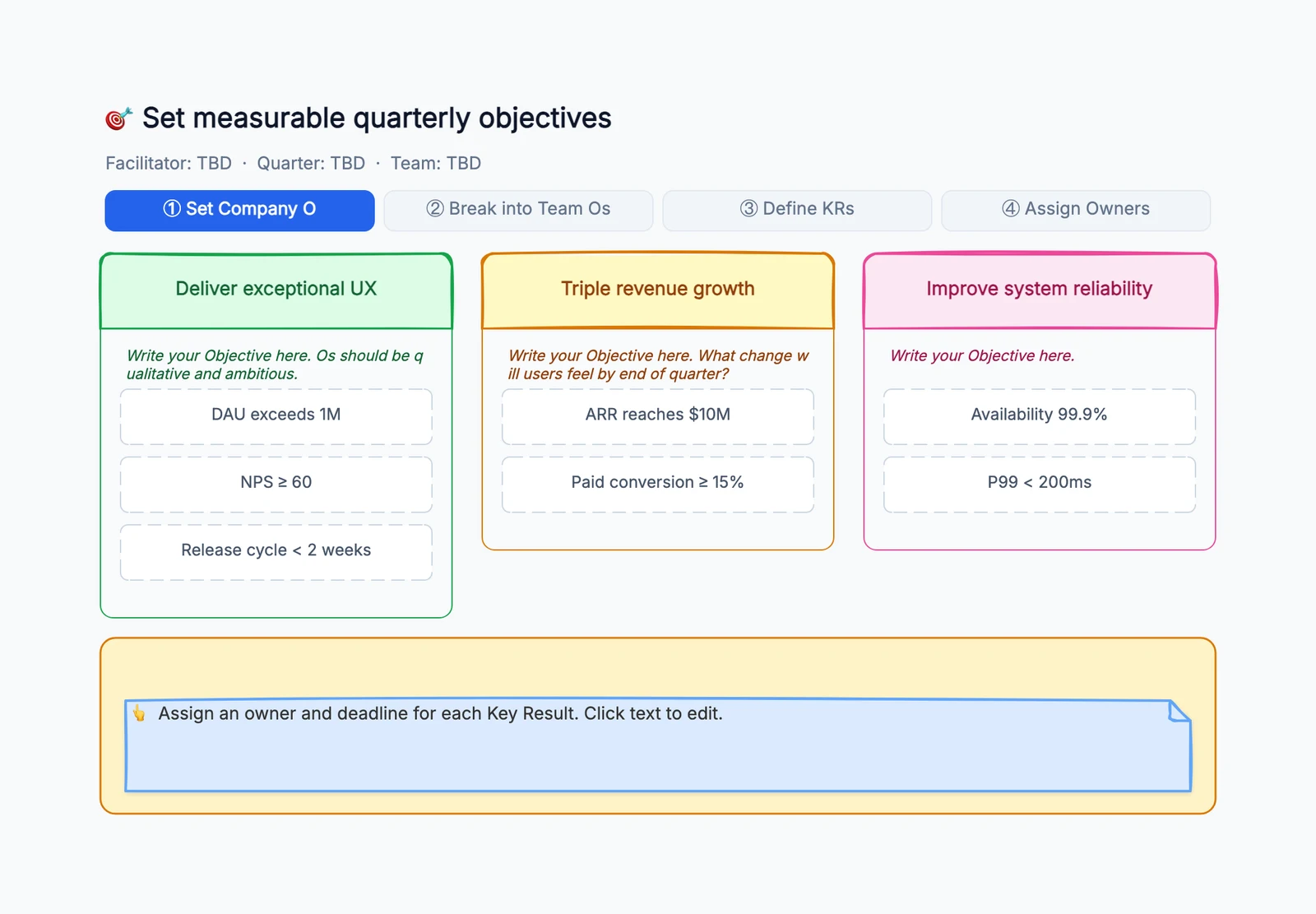
An OKR is a goal-setting format made of two parts: Objective and Key Results.
The Objective describes what you want to achieve. The Key Results describe how you will know whether you achieved it. Put simply: the Objective gives the direction, and the Key Results make that direction measurable.
For example:
Objective: Make onboarding feel effortless for new users.
Key Results:
- Increase activation rate from 42% to 60%
- Reduce average time to first successful project from 18 minutes to 8 minutes
- Cut onboarding-related support tickets by 30%
That is the basic shape of an OKR. It is not a task list, and it is not just a KPI dashboard with a new name. A good OKR connects a meaningful outcome to a small number of measurable signals.
Why OKRs Work
OKRs work because they separate two questions that teams often mix together:
What are we trying to achieve?
How will we know if we got there?
Without that separation, planning gets muddy. A team might say, "Improve onboarding," but everyone interprets it differently. For one person, it means redesigning screens. For another, it means adding tooltips. For support, it means fewer confused tickets. Those are all possible paths, but they are not the goal.
The Objective gives everyone a shared direction. The Key Results define the evidence.
That distinction matters because teams can change tactics without changing the goal. If a redesigned welcome screen does not improve activation, the team can try better templates, clearer empty states, or an email nudge. The OKR stays focused on the outcome rather than locking the team into one proposed solution.
Good OKRs also make tradeoffs easier. When everything feels important, the team needs a way to decide what gets attention this quarter. OKRs force that conversation early: if a project does not move a Key Result, it may still be useful, but it is probably not the priority.
Objective vs. Key Result
The easiest way to understand OKRs is to treat the two parts differently.
Objective
An Objective is qualitative. It should be clear, memorable, and motivating enough that people can repeat it without opening a spreadsheet.
Good Objectives sound like:
- Make our product easier for first-time users
- Become the default choice for small design teams
- Build a healthier, more predictable engineering process
Weak Objectives sound like:
- Improve metrics
- Work on growth
- Complete Q2 projects
The weak versions are either too vague or too task-oriented. An Objective should describe the change you want to create, not merely the activity you plan to perform.
Key Result
A Key Result is quantitative and verifiable. At the end of the cycle, you should be able to say whether it happened.
Good Key Results sound like:
- Increase weekly active teams from 1,200 to 1,800
- Reduce median API response time from 600ms to 250ms
- Raise trial-to-paid conversion from 8% to 12%
Weak Key Results sound like:
- Launch the new onboarding flow
- Write more blog posts
- Improve performance
The problem is that these weak examples are tasks or intentions. They may be useful work, but they do not prove that the Objective was achieved.
Good OKR Examples
The best way to learn OKRs is to look at examples that feel close to real work.
Product Team OKR
Objective: Make first-time users reach value faster.
Key Results:
- Increase new-user activation rate from 42% to 60%
- Reduce time to first completed diagram from 18 minutes to 8 minutes
- Improve onboarding satisfaction score from 3.6 to 4.4 out of 5
This OKR avoids saying exactly what the team will build. That is intentional. The team might improve templates, simplify setup, add sample content, or remove confusing steps. The Key Results keep the work pointed at the user outcome.
Marketing Team OKR
Objective: Grow qualified organic demand for our planning templates.
Key Results:
- Increase organic sessions to template pages from 20,000 to 35,000 per month
- Publish 12 search-focused articles with clear template intent
- Increase template signup conversion from organic traffic from 3.2% to 5%
The second Key Result is close to an output, so it needs context. If the team only measured article count, the OKR would become a publishing checklist. Paired with traffic and conversion results, it becomes part of a broader outcome.
Personal Growth OKR
Objective: Become more confident leading product discussions.
Key Results:
- Lead at least 6 roadmap or planning discussions this quarter
- Receive feedback from 3 peers or managers after facilitation sessions
- Reduce average meeting follow-up clarification questions by 50%
Personal OKRs do not have to feel corporate. They work best when they describe a real capability you want to build and include evidence that your behavior changed.
Engineering Team OKR
Objective: Make releases calmer and more reliable.
Key Results:
- Reduce production incidents from 8 per quarter to 3 or fewer
- Cut median rollback time from 40 minutes to 15 minutes
- Increase automated release-check coverage from 55% to 85%
This is stronger than "Improve engineering quality" because it names the kind of quality that matters: fewer incidents, faster recovery, and better release checks.
How to Write OKRs
1. Choose the Cycle
Most teams write OKRs quarterly. A quarter is long enough to make meaningful progress but short enough that the goals still feel connected to day-to-day work.
Annual OKRs can work for company-level direction, but they are usually too broad for team execution. Monthly OKRs often create too much overhead unless the team is moving through a very specific short-term push.
2. Pick a Small Number of Objectives
One to three Objectives is usually enough for a team. More than that, and the list stops being a priority system.
If a team has seven Objectives, it probably has seven workstreams, not seven priorities. OKRs are most useful when they force a hard choice about where focus belongs.
3. Write Measurable Key Results
Each Objective should usually have two to four Key Results. They should be specific enough that there is no debate at the end of the cycle.
Prefer:
- Increase self-serve signup conversion from 4% to 7%
- Reduce average support response time from 9 hours to 4 hours
- Raise NPS from 31 to 45
Avoid:
- Improve conversion
- Respond faster
- Make users happier
The second group may describe the same intent, but it does not create a clear finish line.
4. Align Across Teams
OKRs do not need to cascade mechanically from company to department to team. In practice, forced cascading often creates awkward goals that exist only to fit a chart.
Alignment means teams can see how their work contributes to a larger direction and where dependencies exist. A product OKR about activation may connect to marketing's work on better acquisition quality and engineering's work on performance. The connection should be useful, not ceremonial.
5. Review Regularly
An OKR written at the start of the quarter and ignored until the end is mostly decoration.
Review progress weekly or biweekly. The point is not to punish red numbers; it is to notice early when a tactic is not working. If a Key Result has not moved after several weeks of effort, the team needs a conversation, not a surprise at the end.
Common OKR Mistakes
Writing Key Results as tasks. "Launch dashboard redesign" is a task. "Increase dashboard weekly active usage from 35% to 50%" is a Key Result. The task may help, but the result is what tells you whether it mattered.
Choosing too many Objectives. OKRs are supposed to create focus. If every project gets its own Objective, nothing has actually been prioritized.
Renaming KPIs as OKRs. KPIs are ongoing health metrics. OKRs are time-bound goals for meaningful change. "Maintain uptime above 99.9%" is usually a KPI. "Reduce customer-visible downtime from 120 minutes to 30 minutes this quarter" can be an OKR.
Skipping the review habit. OKRs need check-ins. A team should ask what changed, what did not, and whether the current work still matches the intended outcome.
Making every KR perfectly controllable. A Key Result should be influenced by the team, but not every good outcome is fully controllable. If you only choose metrics you can directly manipulate, the OKR often becomes a task list.
OKR vs. KPI vs. Roadmap vs. Kanban vs. Gantt
These tools often appear in the same planning conversations, but they answer different questions.
| Tool | Main Question | Best For |
|---|---|---|
| OKR | What outcome are we trying to achieve, and how will we measure it? | Strategic focus and quarterly alignment |
| KPI | Is an important business metric healthy? | Ongoing monitoring |
| Roadmap | What direction are we taking over time? | Communicating priorities and themes |
| Kanban | What work is in progress right now? | Managing flow and operational work |
| Gantt chart | What tasks happen when, and what depends on what? | Project schedules with dependencies |
An OKR might say the team wants to increase activation. A roadmap might show the major onboarding improvements planned across the quarter. A Kanban board tracks the actual work moving through design, engineering, and review. A Gantt chart may help if the work has fixed dependencies and dates. KPIs show whether the broader product health remains stable.
They are not replacements for one another. They are different lenses.
Frequently Asked Questions
What does OKR stand for? OKR stands for Objectives and Key Results. The Objective describes the goal. The Key Results define measurable evidence that the goal was achieved.
How many OKRs should a team have? Most teams should have one to three Objectives per cycle, with two to four Key Results under each Objective. If the list is longer, it usually stops being useful for focus.
Are OKRs the same as KPIs? No. KPIs track ongoing health, while OKRs define time-bound improvement goals. A KPI might be monitored every month for years. An OKR should describe a change you want to create in a specific cycle.
Should OKRs be tied to compensation? Usually no. If OKRs determine pay, teams become conservative and choose safe targets. OKRs work better as alignment and learning tools than as performance contracts.
What score counts as success? Different companies score OKRs differently. A practical approach is to treat 70% progress on an ambitious OKR as strong, 100% as excellent, and 30% or less as a signal that either the goal, execution, or assumptions need review.
Can individuals use OKRs? Yes. Individual OKRs can be useful for career growth, learning goals, and focused personal projects. Keep them lightweight. If maintaining the OKR takes more effort than doing the work, the system is too heavy.
If you want to visualize your OKRs, try the OKR planning template. And since OKRs and product roadmaps often work together — OKRs define outcomes while roadmaps show the path — you may also find What Is a Product Roadmap? useful.
Related Reading
- OKR Planning Template — Turn objectives and key results into a visual planning board.
- Goal Setting Template — Use this when you need a lighter personal or team goal framework.
- What Is a Product Roadmap? — Connect OKRs to the work themes that move them.
- Free Product Roadmap Template — Plan the initiatives that support your outcomes.