An episode outline describes the major actions and changes in an episode before you write the full scene-by-scene script. For a short drama, record the opening situation, immediate goal, obstacle, consequential choice, result and next question. The outline should explain why one episode leads to the next.
This guide creates a complete three-episode fictional short drama, The Last Delivery. It includes filled episode cards, a causal-link check and a scene brief for episode one. The structure is an original teaching example, not a universal commissioning format or a proven formula for watch time.
Choose the series promise before dividing episodes
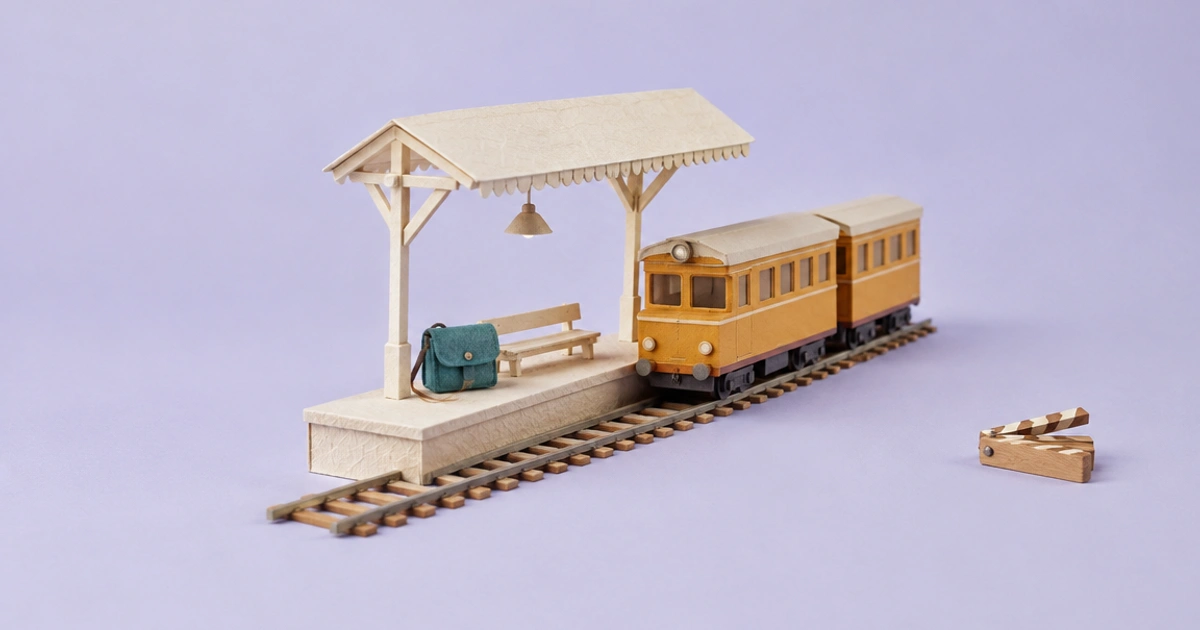
Our series follows Lin, an adult station courier, who returns a parcel and misses a train. A key inside the parcel matches the clasp on Lin's teal bag. That discovery leads to a forgotten station locker and a message about an unfinished delivery.
The promise is a small mystery driven by a practical choice: What happens when returning someone else's parcel brings Lin back to a promise of their own? We use one station, a passenger and a station attendant. Those boundaries make the example easier to plan; they do not establish a required cast or budget.
Decide whether the idea needs multiple episodes. If all three entries merely delay opening the same parcel, the story may work better as one short film. A series needs new decisions and consequences, not just several cuts through an unchanged question.
Script to Screen's episode-outline exercise asks writers to consider the story and character arc of each episode. The courier story and the planning fields below are our own way of making that task concrete.
Distinguish a premise, outline, script and storyboard
The premise states the central situation. A series outline explains the overall progression. An episode outline identifies what happens and changes within one installment. A script supplies playable actions and dialogue. A storyboard plans how those actions will be shown.
| Document | Useful question | Example |
|---|---|---|
| Premise | Why follow this story? | A returned parcel reveals a forgotten promise |
| Series outline | Where does the whole story go? | Kind act → search → meaningful delivery |
| Episode outline | What changes this time? | Lin sacrifices the train and recognizes a key |
| Scene script | What do people do and say? | Lin turns away from the door and returns the parcel |
| Storyboard | What must the viewer see? | Door, look, turn, handoff, departing train |
Keep the level of detail appropriate. An outline does not need every camera angle. A sentence saying “Lin feels guilty” may identify an emotional intention, but the later script still needs an action that lets the audience understand it.
For the transition from script to pictures, use the script-to-storyboard walkthrough. Do not ask the outline to solve every downstream production decision before the story's causal structure is clear.
Fill the three-episode map
This example plans three short episodes, each with a provisional one-minute target. That target is a creative constraint to test, not a claim that all platforms or all stories require this length.
| Episode | Immediate goal | Obstacle | Consequential choice | Result | Earned next question |
|---|---|---|---|---|---|
| 1: The Parcel | Catch the departing train | A passenger has lost a parcel | Lin returns it instead of boarding | Train leaves; key matches Lin's bag clasp | Why does the passenger have that key? |
| 2: The Locker | Discover what the key opens | Passenger will explain only if Lin checks a closed locker | Lin asks the attendant for help instead of forcing it | Attendant identifies an old delivery pouch with Lin's family mark | Who left the unfinished delivery? |
| 3: The Address | Complete the unfinished delivery | Letter gives a place Lin has avoided visiting | Lin reads the message and chooses to deliver it | Parcel reaches its intended recipient; Lin understands the bag's history | Main promise resolved; a new job may begin |
The episode-three ending resolves the main promise rather than withholding the same answer again. A new job can suggest continuation, but the audience should receive the outcome of the question they followed.
The second episode introduces an attendant for a specific function: making access and information plausible. Do not create a new character only to recite backstory. Give that person a visible action and a reason to participate.
Write the complete episode cards
Episode one: The Parcel
Open with a departure tone and a choice the audience can understand immediately. Lin finds a parcel while heading toward the train. A nearby passenger searches an empty red bag. Lin looks at the train door, then walks away from it and returns the parcel.
The train leaves during the handoff. The passenger opens the parcel to reveal a brass key. Lin notices its triangular notch matches the bag clasp. End with the passenger closing a hand around it, making the recognition feel deliberate rather than accidental.
Change: Lin begins with a travel problem and ends with a personal mystery. Story evidence: the missed train shows the cost; the visible shape match explains Lin's reaction. Held question: the key's connection to Lin, not whether the parcel was returned.
Episode two: The Locker
Begin by acknowledging episode one's ending. Lin asks about the key. The passenger points toward a locker and says the answer is inside. Lin tries the handle, sees it is locked, and chooses to ask the attendant rather than force entry.
The attendant checks the key and retrieves an old delivery pouch through the station's appropriate access process. We do not make the outline an instruction for opening someone else's locker. The pouch carries the same family mark as Lin's bag. Inside is an undelivered letter addressed to a workshop Lin recognizes.
Change: the abstract mystery becomes a specific delivery. Story evidence: the pouch and address justify the next destination. Held question: who left it and why the delivery matters to Lin. A full script can decide how much the passenger knows, but that decision must remain consistent.
Episode three: The Address
Open with Lin outside the workshop, now holding the pouch. The address is not a random new setting: it is the consequence of the letter in episode two. Lin hesitates because the workshop belonged to an estranged family friend.
Lin reads the enclosed note, which asks for the return of a repaired bag clasp and an apology. The friend recognizes the family mark, accepts the delivery and explains why Lin's bag carries the matching design. End with Lin choosing to complete a new delivery rather than chase the train that started the story.
Change: Lin moves from avoiding an old connection to acting on it. Payoff: the key, pouch and bag mark connect to the same history. Boundary: the series resolves this relationship; it does not need a surprise villain or another unexplained key.
Check causality between installments
Use “because” and “therefore” to test links. Because Lin returns the parcel, Lin sees the key. Because the key matches the bag, Lin asks about its purpose. Because the locker yields a letter, Lin goes to the workshop. Each move follows information or a choice already present.
A weak version might say: Lin finds a key, then a villain appears, then a new city is introduced. The word “then” provides order but not enough motivation. Add the missing cause or remove the unrelated event. Do not assume a cliffhanger makes arbitrary plotting coherent.
| Link to inspect | Question | Example repair |
|---|---|---|
| Episode 1 → 2 | Why does Lin stay with the passenger? | Show the key-and-clasp match before the cut |
| Locker → letter | Why can the attendant help? | Establish the station role and appropriate access |
| Episode 2 → 3 | Why this workshop? | Make the address visible and recognized |
| Ending → promise | Does the mystery produce an outcome? | Resolve the bag design and unfinished delivery together |
Write unresolved author decisions separately. Whether the passenger is an old colleague or a messenger affects their dialogue across the series. Mark it for decision before scripting rather than allowing each episode to invent a different answer.
Turn episode one into a scene brief
The episode outline becomes actionable when the next writer knows the required input and outcome. Here is a compact handoff:
Episode: 1, The Parcel
Location: station platform; train and bench already visible
Characters: Lin and passenger, both adults
Opening state: Lin wants to board; parcel unattended
Required actions: discovery, owner clue, choice, handoff, missed train
Required object reveal: brass key; triangular notch matches bag clasp
Closing state: Lin has a personal question; passenger conceals the key
Dialogue budget: only what clarifies action or changes the relationship
Unresolved: exact wording; final shot duration
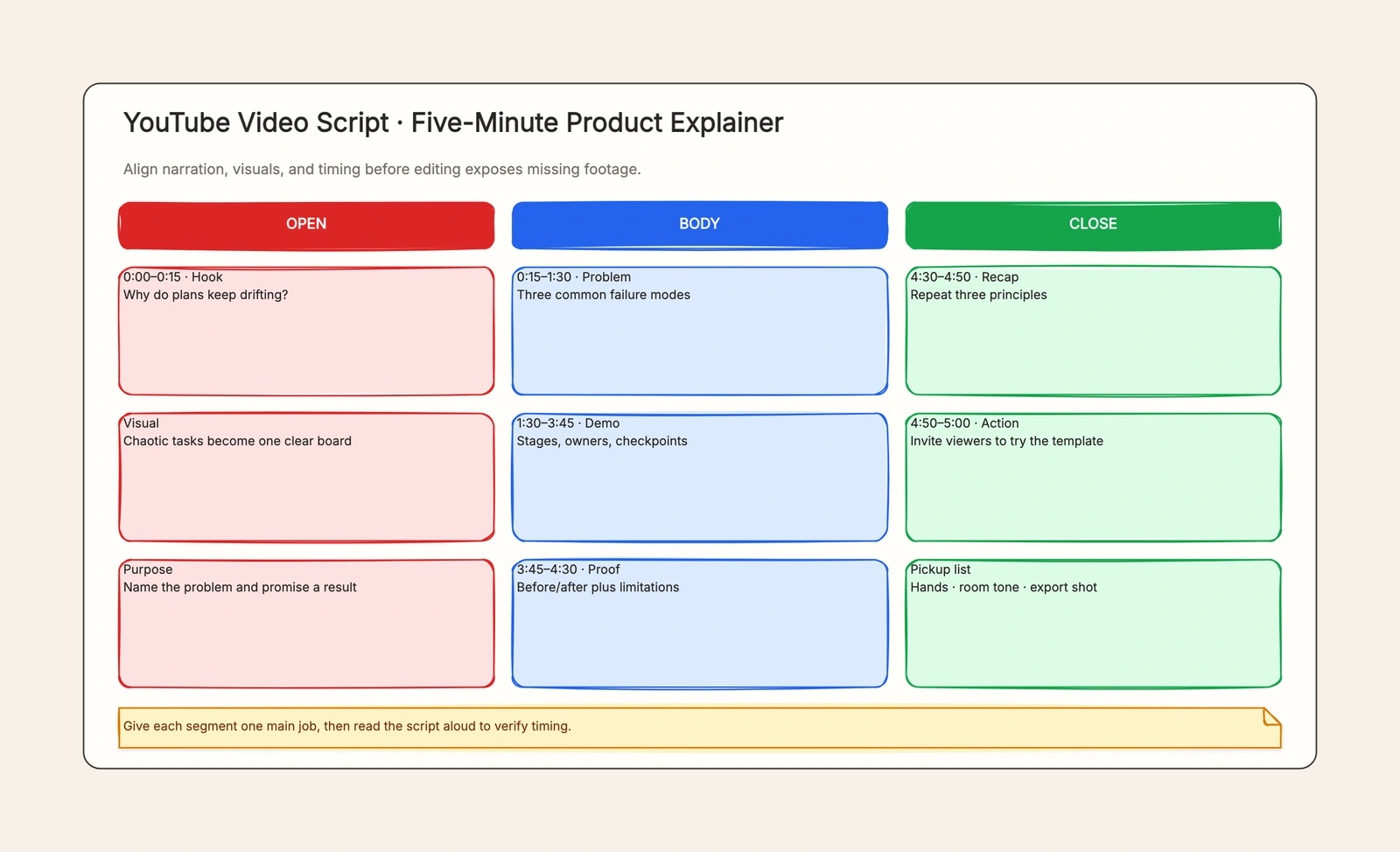
The brief leaves room for writing while protecting the episode's function. The video script template can organize picture, speech and timing; rename and replace the example content. The AI storyboard guide handles the later shot-level plan.
Repair three common outline failures
Repeated setup: every episode reintroduces Lin, the station and the bag before anything changes. Repair it by opening with the current unresolved action and including only the context needed to understand it. A returning viewer should not wait through the entire premise again.
Cliffhanger without consequence: episode one ends on the key, but episode two ignores it and starts an unrelated subplot. Repair it by making the next goal arise from the previous ending, or make the first ending different. An ending is a promise about what deserves attention.
Too much explanation: episode three resolves everything through a long speech while Lin does nothing. Repair it by making the resolution depend on Lin delivering the object or making another visible choice. Dialogue can explain context, but should not replace the central action.
These repairs are editorial suggestions. They are not evidence that a particular structure guarantees retention, revenue or platform distribution. An outline makes the plan inspectable; actual audience response needs its own evidence.
Review the whole map before polishing dialogue
Read only the goals, choices and results down the three cards. You should see a progression rather than three paraphrases. Next, read only the recurring objects: parcel, key, pouch, clasp and letter. Check that ownership and meaning remain coherent.
Keep a small continuity note beside the map. If the key is brass in episode one, do not silently make it a digital access card later. Intentional revisions can improve the story, but they must update all affected cards and character or prop references.
For production, connect the reviewed outline to an AI comic drama workflow. CodePic can hold the cards and references on a manual planning canvas. This guide does not provide a dedicated automatic series generator, downloadable screenplay package or finished video.