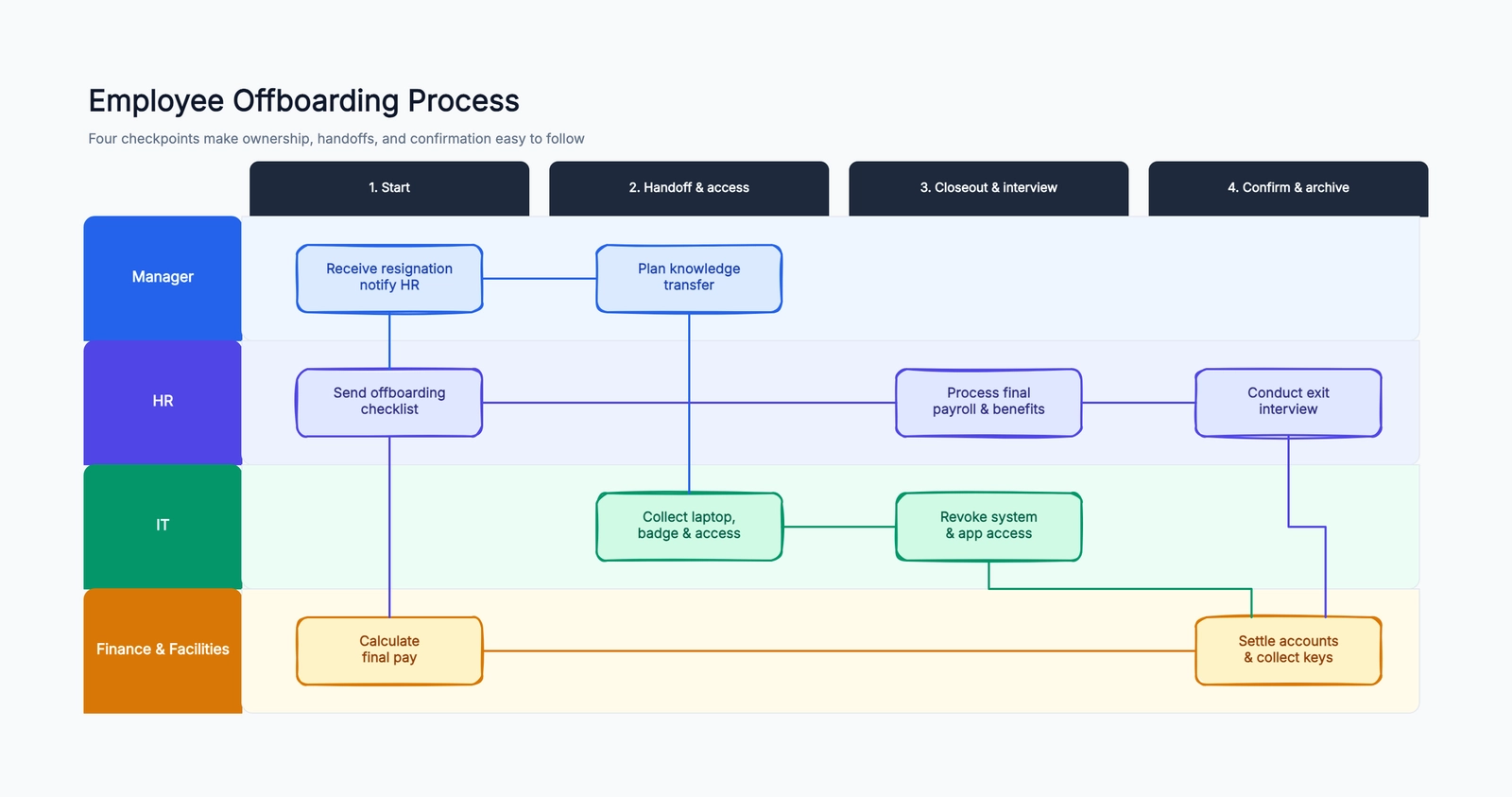
An employee offboarding checklist is the difference between a clean departure and a former employee who still has access to your systems three months later. Most companies have a rough idea of what leaving should look like — return the laptop, one last meeting, final pay — but without a written process, the steps fall between departments and get skipped.
This guide lays out a complete offboarding checklist, organized by owner and phase, and shows how to turn it into a swimlane diagram that every department can follow.
Why a checklist beats a loose email thread
Offboarding spans four functions at once. The manager needs to capture knowledge. HR needs to run the exit interview and close out benefits. IT needs to revoke access and collect hardware. Finance needs to settle pay. When these run through a chain of forwarded emails, the moment one person forgets to copy the next, a step disappears.
A written checklist fixes this because it assigns each task to an owner before the employee's last day. Nothing depends on someone remembering to forward the thread. The checklist is the shared source of truth, and each department works from it instead of from whatever they happened to hear.
The cost of skipping a step is not abstract. A missed account revocation is a security risk. A missed final-pay calculation can create a compliance problem. A missed device return is lost hardware and potentially lost data. The checklist exists to make those failures visible before they happen.
What belongs in every offboarding checklist
Every offboarding checklist needs the same skeleton, whatever the company size. The specifics change; the categories do not.
First, the knowledge handoff. What does this person know that no one else does? Which files, passwords, clients, or processes walk out the door with them? This has to be captured before access is removed, not after.
Second, the device and access return. Every laptop, badge, key, and login must come back or be revoked, and there should be a record of each.
Third, the people and money steps. The exit interview, the benefits closeout, and the final paycheck all need a clear owner and a deadline.
Fourth, the final confirmation. Someone has to check that every line item is done and formally close the employee's record. Without this closing gate, the checklist is a list of good intentions rather than a process.
Keep the checklist alive after the first use. Every offboarding surfaces a step that was missed — an app that was not revoked, a device that was not returned — and the checklist should absorb that lesson for the next departure instead of starting from zero each time.
The four owners of offboarding
Offboarding is not one department's job. It is four jobs that have to happen in parallel and then converge.
The Manager owns the knowledge handoff. They know what the departing person was working on, who depends on it, and what has to be documented or reassigned. The manager also receives the resignation in the first place and starts the process.
HR owns the checklist itself, the benefits and payroll closeout, and the exit interview. HR is the coordinator who makes sure the other lanes actually move.
IT owns device return and account revocation. This is the highest-risk lane: a revoked login can be restored, but a login that was never revoked can sit dormant for months.
Finance & Facilities owns the money and the physical space — final pay, expense reimbursement, and collecting keys and access cards.
On an employee offboarding template, these four roles become four swimlanes, and the arrows show where one lane hands work to the next.
The offboarding process, phase by phase
The process is easier to run as four checkpoints: start, handoff and access, closeout and interview, then confirmation and archive. Seeing the work grouped this way keeps the board readable without losing the detailed tasks.
Notification starts when the manager receives the resignation and tells HR. HR then sends the offboarding checklist to everyone involved.
Knowledge handoff is the manager's phase. They schedule the handover, collect the documentation, and reassign the open work before the person leaves.
Device return is where IT collects the laptop, badge, and any physical access. This should be scheduled early enough that nothing depends on chasing the person on their last day.
Account revocation follows device return. IT revokes every system and application access, including the ones the person set up outside the main directory.
Comp & benefits is where HR finalizes payroll and benefits and Finance calculates the final pay, including any accrued time off.
Exit interview is HR's chance to hear why the person is leaving and catch any unresolved issues while the information is still fresh.
Final confirmation ties it together. Finance settles accounts and collects keys, and someone signs off that every earlier phase is complete.
The step-by-step offboarding checklist
Here is the checklist in its flat, checkable form. Derive it from the process, then attach an owner and a due date to each line.
Before the last day: confirm the departure date and notify HR; send the offboarding checklist; schedule the knowledge-handoff meetings; list every system and device the employee has access to.
Knowledge handoff: transfer documents and files to a shared location; reassign the open tasks and client contacts; capture the passwords and account ownership that only this person had.
IT steps: collect the laptop, phone, and peripherals; collect the badge, keys, and access cards; revoke email, chat, and directory access; revoke every third-party app and any API keys or admin accounts.
HR and Finance steps: finalize the payroll and any accrued time off; close out benefits and send continuation notices where required; schedule and run the exit interview; process the expense reimbursement.
Final confirmation: confirm every account is revoked; confirm every device is returned; confirm the final pay and benefits are processed; archive the record and close the employee file.
IT and account revocation: the high-risk steps
If one phase deserves extra care, it is account revocation. A former employee with a working login is a security incident waiting to happen, and it is one of the most commonly missed steps because IT is often the last to hear about a departure.
Run a full account inventory rather than revoking the obvious ones. The employee's directory account, email, chat, and VPN are the starting point. Then look for the shadow IT: the project-management tools, the shared document drives, the code repositories, the third-party SaaS logins, and any admin or API credentials they held.
Timing matters. Revoke access after the knowledge handoff is complete but on a known schedule, so the manager is not surprised when a shared document suddenly becomes read-only. And keep a record of what was revoked and when, so an audit later does not rely on memory.
Final pay and the exit interview
The exit interview and final pay are the two steps employees remember most, and they are the two most likely to become awkward if they slip.
Run the exit interview before the person's last day, not after, while they can still speak freely and remember the specifics. The value is not in a heroic exit survey; it is in the specific, factual answers about what worked and what blocked them, which you can act on for the people who stay.
Final pay, accrued time off, deductions, and benefits notices can have deadlines. Confirm the requirements that apply to your employment arrangement and location with HR, payroll, or qualified local counsel, then coordinate with Finance so the payment and notices go out on time. Do not let the benefits closeout wait on the exit interview.
Common mistakes that break an offboarding process
The first mistake is treating offboarding as a single HR task. It is not. When one person tries to own all four lanes, the IT and Finance steps are the first to fall through.
The second mistake is revoking access before the knowledge handoff is done. It feels safe, but it cuts off the person who still holds the context, and the handoff never finishes.
The third mistake is running offboarding from memory. Without a written checklist or a swimlane diagram, the process changes with every departure, and each one teaches the same lessons from scratch.
The fourth mistake is skipping the final confirmation. A checklist is only as good as its last gate. Someone has to verify that every account is down, every device is back, and every payment is made before the record closes.
Free employee offboarding template
Open the employee offboarding template to get four swimlanes and four editable checkpoints already laid out. Rename the lanes to your departments, replace the example tasks with your real checklist, and attach an owner to each node.
If you are building the opposite flow, the hiring process flowchart covers the onboarding side. For a blank cross-functional layout that is not tied to HR, start from the swimlane diagram template.
A clean offboarding does not make the departure painless, but it makes it complete — and that is what protects the company, the team, and the person who is leaving.