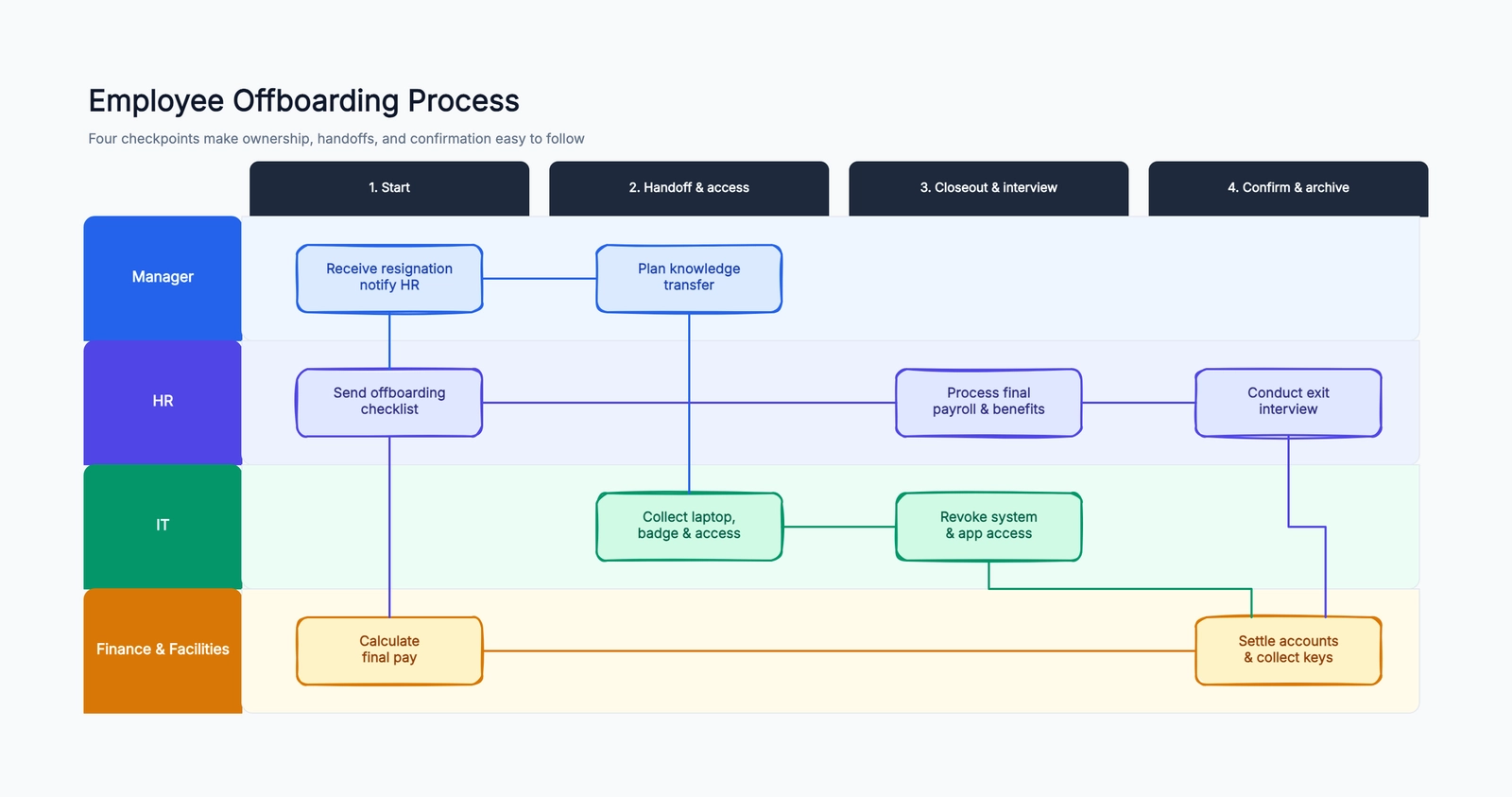
An employee offboarding process is different from an offboarding checklist. A checklist lists tasks; the process shows when those tasks start, who owns each handoff, and what must be complete before the person’s departure is confirmed. That distinction prevents the most common failures: access left active, knowledge captured too late, devices unaccounted for, or payroll and benefits handled from conflicting information.
Use the employee offboarding template as a shared swimlane for the manager, HR, IT, and finance. Adapt it to your approved policies, local employment rules, and security procedures.
Phase 1: Record notice and plan the route
Start with a single authorized notice record: departure type, last working day, manager, employment details, urgent risks, and the person coordinating the process. Do not launch different email threads for each department. HR or the designated coordinator should create the shared plan, assign owners, and establish the evidence each team must provide.
Phase 2: Complete knowledge handoff before access changes
The manager owns the practical handoff: active work, client context, recurring responsibilities, decision history, shared locations, and the successor or interim owner. Treat knowledge as a deliverable, not a meeting. A handoff document, walkthrough recording where appropriate, or confirmed task reassignment gives the next owner something they can use.
Phase 3: Coordinate access, devices, and physical assets
IT and facilities should work from the same authorized event, not from memory. The process needs a record of accounts, devices, badges, keys, and any exception that changes the normal timing. It should also make clear who confirms the work is complete. Do not use this article as a security policy; align the dates and controls with the organization’s approved process.
Phase 4: Finalize employment administration
HR and finance need the same source information for final pay, expenses, benefits, equity, and required notices. Map the inputs and approvals rather than assuming “HR handles it.” A reliable process exposes where a manager must confirm an expense, where payroll needs a date, and where an employee must receive documentation.
Phase 5: Close the relationship respectfully
An exit conversation can surface operational lessons, but it should not be the only closing step. Confirm where the employee can ask follow-up questions, how property return is documented, and how the team communicates the transition to relevant coworkers and customers. Keep the communication factual, respectful, and appropriate to the situation.
Phase 6: Run final confirmation
The process ends only when the coordinator can see evidence from every required lane: knowledge handoff, access and asset action, administration, and communication. Review exceptions explicitly. A missing device, a delayed payroll item, or retained access should stay visible with an owner and next date rather than being hidden by a “complete” status.
Make the process work in practice
Pilot the swimlane on one departure and note where the handoff stalled. Then simplify the steps, clarify responsibility, and preserve only the evidence that the next role actually needs. A strong employee offboarding process is not bureaucratic; it frees people from chasing missing information at an already sensitive moment.