Use an AI UGC video generator for creator-style presentation, not for inventing a real customer's experience. A synthetic actor can introduce a product, explain an approved feature or present an illustrative scenario. It cannot supply evidence that someone bought, used or benefited from the item when that never happened.
This example plans a stationery-pouch demonstration with three opening hypotheses and one shared body. You can download the hooks, script structure and production ledger. The pouch is a fictional sample, the copy is authored for this walkthrough and no campaign result or generated actor performance is claimed.
Separate creator style from customer evidence
“UGC” often suggests material made by actual users, while an AI UGC tool may produce a paid or synthetic presenter in a casual creator format. Make the origin clear in the published context. A handheld-looking shot, conversational voice and imperfect setting do not turn an invented account into a real review.
UGCVideo.ai's official site describes script or product-link routes to avatar and advertising videos. That is a candidate workflow, not evidence that its promotional claims about trust or performance apply to your project. Evaluate what it can actually preserve and export in your account.
For our sample, the presenter says what the pouch is intended to show. The actor does not say “I bought this last month,” “it changed my routine” or “my pens never get lost now.” Those would imply personal history and results that the example does not have.
| Content type | Acceptable basis | What a synthetic actor cannot establish |
|---|---|---|
| Product explanation | Approved feature information | Personal ownership |
| Demonstration | Verified view of the actual product | Unfilmed fit or durability results |
| Illustrative scenario | Clearly fictional setup | A real customer's experience |
| Customer quotation | Authentic approved source | A newly invented testimonial |
For an actual campaign, check the platform and local requirements that apply to synthetic media and endorsements. This article does not provide a jurisdiction-specific legal determination. Its practical production rule is to keep the source of the person, statement and product evidence visible to reviewers and clear to the audience.
Build a small product evidence pack
Before writing hooks, collect approved product photos, dimensions, compartment details and any relevant usage limitations. Our fictional pouch has a zip opening and three visible compartments, but that description is a teaching assumption. A real product owner must verify the actual construction before using the corresponding line.
Use a plain source image showing the object clearly rather than a heavily styled scene that hides the opening. Include a detail view when the demonstration depends on a zip, divider or fastening. If the tool supports product references, confirm which input mode uses them and how they affect the result.
Keep exact measurements in a fact sheet. A generated image of three pencils fitting inside is not a measurement. If capacity matters, film or photograph the actual placement with the real item and retain the source. The presenter can narrate that evidence without pretending to have personally performed a test.
Record asset origin, revision and approval owner. A product-page link can provide input material, but scraped or summarized information still needs review. Do not let an automatic import silently change the product version, color or bundle contents in the video.
Keep the shared body accurate before varying the hook
Our shared body is: “Here is how this sample pouch separates three stationery items. Check the measurements and details on the product page.” It is deliberately modest. The demonstration must show the actual separation before this is suitable for a real product.
The body should contain one supported reason to look closer, a visible demonstration and a matching next step. Avoid stacking invented claims about savings, durability and convenience into a short clip. More claims require more evidence and leave less time to inspect the product.
Use one action sequence: show the empty compartments, place the items and hold the result. A synthetic presenter can introduce or react to the setup, but precise product interaction may be better filmed or composited from approved material. There is no requirement for the actor and product to be generated together.
Keep the destination aligned. If the video directs viewers to measurements, the landing page should display the measurements for the same product. A compelling hook cannot repair a mismatch between the pictured item and the page where someone lands.
Connect three hooks to one proof sequence
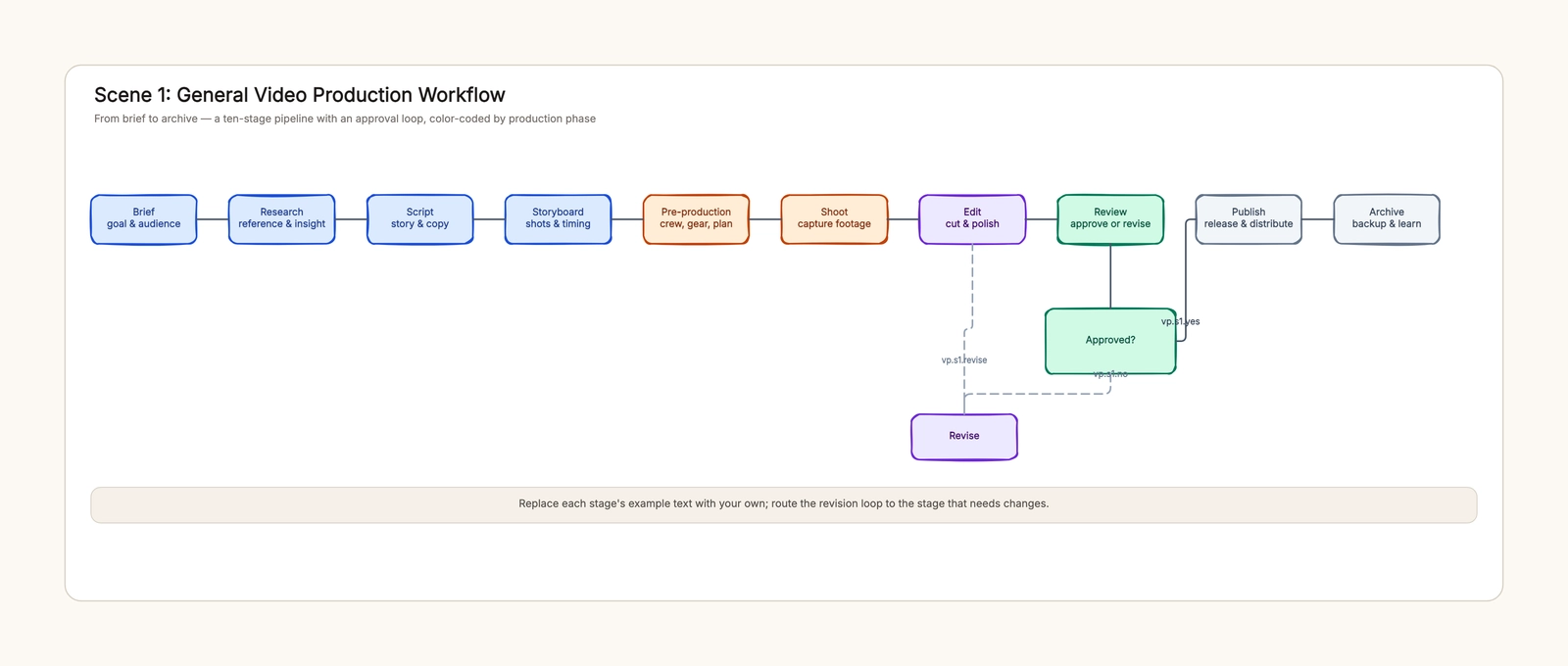
Open the video production workflow template and give the problem, action and detail openings separate branches leading to the same approved demo and destination. Attach the source and reviewer for the product visuals before comparing hooks, so the variants have a consistent body.
Write three hooks with distinct hypotheses
The problem-led opening is: “Pens disappearing at the bottom of your bag?” It addresses an inconvenience without claiming the presenter personally experienced it. Its hypothesis is that a recognizable problem will make the demonstration relevant.
The action-led opening is: “Watch where these three items go.” It starts with visible movement and asks the picture to do more of the work. Its hypothesis is that the demonstration itself can earn attention without a longer setup.
The detail-led opening is: “One opening, three visible compartments.” It puts a concrete feature first. Use that line only when the actual product has the stated construction; otherwise revise the number and description before publishing.
| Variant | What changes | What should stay shared |
|---|---|---|
| Problem | Audience inconvenience | Product, demonstration and destination |
| Action | Immediate placement | Product, body and offer |
| Detail | Construction feature | Proof sequence and final action |
These are creative hypotheses, not measured winners. A downloadable hook sheet is useful for organizing a later test, but it does not establish watch time, click-through or conversion improvements. Record actual deployment differences before attributing a result to the opening alone.
Direct the presenter without inventing intimacy
Describe delivery in observable terms: conversational pace, a pause before the demonstration and a neutral invitation to inspect details. Do not instruct the actor to fake a spontaneous discovery or imply a long-standing personal relationship with the product.
A script such as “I cannot believe I lived without this” creates an unsupported personal claim. “Here is the compartment layout” gives the actor a real presentational job. The second line may sound less dramatic, but it is easier to substantiate and match with the picture.
Choose a suitable licensed or authorized presenter and voice. Keep the identity consistent across hook variants if you want to compare openings. Changing the face, voice, background, pacing and product angle at the same time creates several competing explanations for any observed difference.
The AI avatar video guide covers reusable identity and voice settings. For this page, the additional concern is the relationship between the actor and the claim: a convincing face should not be used to manufacture evidence of a real purchase or outcome.
Review product interaction at the frame level
Inspect the opening, zip pull, compartments, item count and contact points. A pencil passing through fabric, a divider appearing halfway through the action or a pouch expanding to fit the contents invalidates the demonstration. Smooth motion does not make those changes accurate.
Compare the empty and filled states with the approved references. Check scale against the same stationery items. A cut that swaps to a different pouch can be hard to notice at normal speed while still changing the claim. Keep the source of each interval documented.
If the interaction cannot be generated accurately, replace it with a real insert or a restrained still treatment. The AI product-video workflow explains identity checks, while the AI B-roll guide helps separate illustrative coverage from factual evidence.
Watch the exported video with sound off. Does the picture imply a capacity or durability claim the narration never approved? Then listen without looking. Does the actor make an experience claim that the product sequence cannot support? Approval should cover both explicit words and reasonable visual inferences.
Plan the edit as a short evidence sequence
Keep the hook close to the first relevant visual. If the question is about finding pens, show the pouch organization promptly rather than delaying it behind a long presenter introduction. Hold the final arrangement long enough for viewers to inspect it.
Add exact captions in an editable layer and verify them at the intended viewing size. Do not rely on generated packaging text or background signs. Check that captions do not hide the compartment opening during the very moment meant to prove the feature.
The video production workflow template can assign responsibility for copy, product evidence, actor selection, edit and release. CodePic organizes those approvals; it does not generate the actor or verify the physical pouch. Keep the actual product owner involved where construction and capacity are concerned.
For the broader structure of a short advertising script, the AI video ads example covers audience, proof and destination. This article adds the narrower creator-style concerns: synthetic identity, experience claims and believable product interaction.
Measure a campaign only after it actually runs
Choose a primary outcome before deployment and preserve the raw observations. A view, a click and a purchase are different events with different denominators. Compare variants under a defined setup and record placement, audience, dates, spend and attribution settings.
Do not treat generated volume as campaign performance. Producing three hooks proves only that three creative inputs exist. A provider's testimonial or marketing percentage does not supply evidence for this fictional pouch or your particular audience.
When observations are sparse, report that limitation instead of naming a winner from a handful of actions. If the variants differ in more than the hook, describe the comparison accordingly. The production ledger should make those differences easy to recover later.
Download the hook and review package
Replace the fictional construction with approved facts and attach actual source material before production. Add your rendered attempts, adopted intervals and campaign observations only after they exist. Keep unverified claims out of the release folder.
An AI UGC video generator can help you present a product in an approachable format. The dependable workflow keeps the actor's origin honest, the demonstration accurate and the measured results separate from creative hypotheses. That is a stronger foundation for repeated production than a persuasive fictional review.