Curriculum Map Template
A year-long curriculum map template on an editable whiteboard — semesters or grades down the rows, subjects or units across the columns, each cell holding a unit name, hours, and learning goal. Ships with three scenes (a Grade 3 year, a junior-math subject map, and a four-year computer science program) you can rewrite for any grade, subject, or major. No signup required.
Use this templateWhat you get
- Grid layout — rows for semesters/grades, columns for subjects/units — the whole year's scope at a glance
- Every cell is a replaceable unit with hours and a goal, color-coded by subject or strand
- Three scenes: elementary grade, single subject, and a four-year university major
What this template is for
A curriculum map is the one-page answer to a question every teacher and program lead faces at the start of a term: what do we actually teach, and in what order? It lays the whole year or the whole program on a grid — semesters or grades down the rows, subjects or units across the columns — so each cell is a unit with its hours and its goal. That is the difference between a curriculum map and a lesson plan: a lesson plan zooms into one class period, while a curriculum map shows the whole scope at once. This template gives you three scenes to adapt. The elementary scene maps one grade across a year, with semesters as rows and four subjects — Chinese, math, English, and science — as columns. The middle-school scene flips the axis to a single subject, junior math, laid out by strand so you can watch a concept build across semesters. The university scene maps a four-year computer science program, with years as rows and course modules as columns, each cell carrying a course, its credits, and its goal. Every cell is a replaceable card, and subjects or strands are color-coded so the map reads at a glance. This template structures the scope and sequence; it does not prescribe standards or pedagogy. Build the map around your real program: the terms or years, the subjects or units, and the hours or credits each one carries.
When to use this template
- Map one elementary grade across a full year — semesters as rows, subjects as columns.
- Lay out a single subject across semesters — watch concepts build strand by strand.
- Chart a four-year university major — years as rows, course modules as columns.
- Share one board with a department to agree on scope and sequence before the term starts.
- Swap units, hours, and goals for a new textbook or curriculum revision.
- Give new teachers and students one page that shows where each unit fits.
How to use it
- 1Decide the axes first — semesters or grades down, subjects or units across.
- 2List the subjects or strands that run the full year and give each a color.
- 3Fill each cell with a unit name, its hours or credits, and one clear goal.
- 4Check each row reads in teaching order, so concepts build left to right and top to bottom.
- 5Mark the cells that are new or changing so the team sees what to revise.
- 6Share the board and update it as units move between terms.
Quick example
Grade 3 year map (first semester)
Related resources
How it compares to similar tools
Curriculum map vs. lesson plan
A lesson plan zooms into one class period — objectives, materials, and a sequence of activities. A curriculum map zooms out to the whole year or program, showing what is taught and in what order. Use the map for scope, the plan for the day.
Curriculum map vs. syllabus
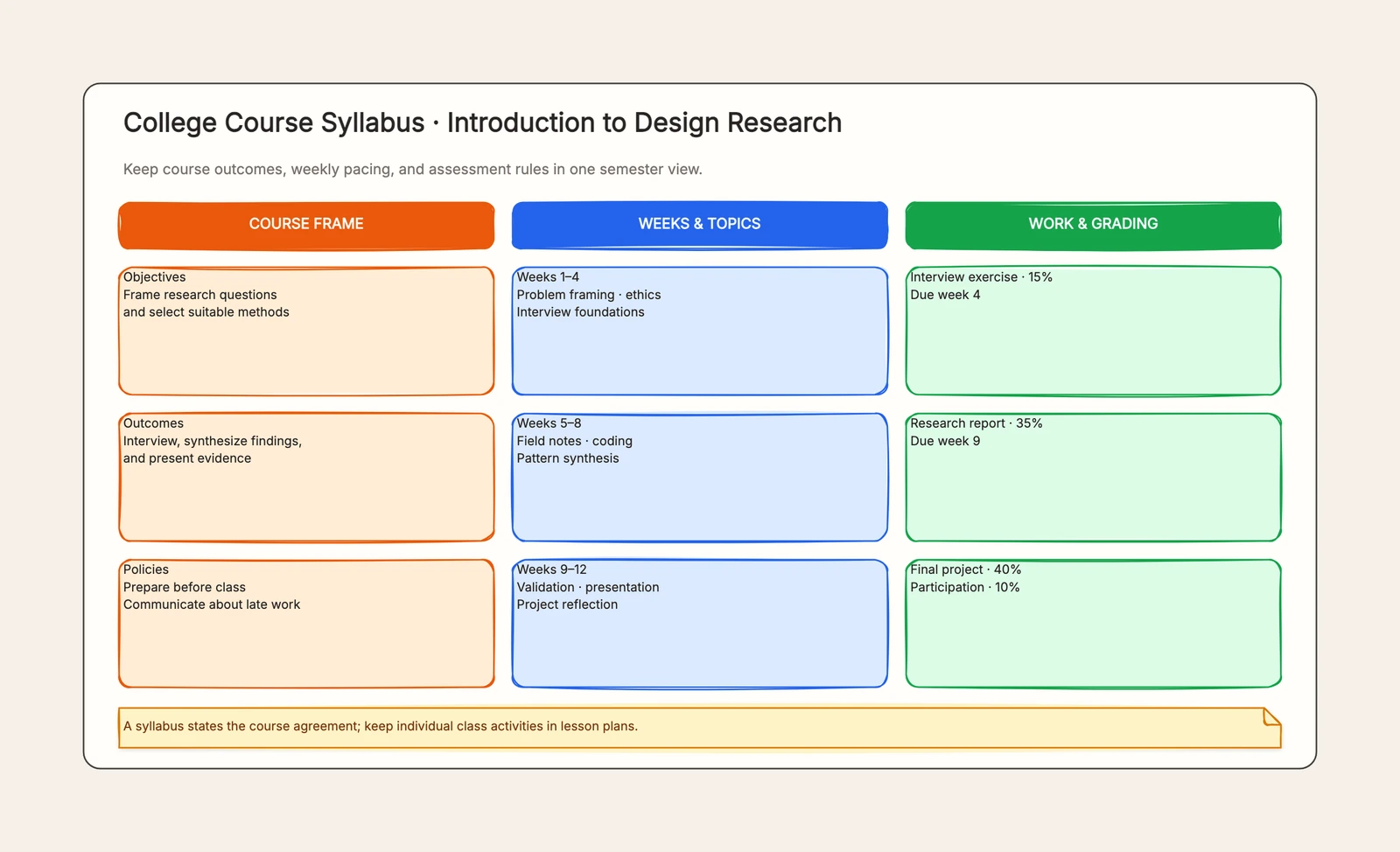
A syllabus is a document students read — policies, deadlines, and expectations. A curriculum map is a working grid the teacher and department edit, where the sequence and coverage are visible at a glance and easy to revise.
Subject map vs. grade map
A grade map lists every subject one grade covers in a year. A subject map follows one subject across semesters so you can see a concept build. This template includes both, plus a four-year program map.
Common mistakes to avoid
Mapping only the topics, not the sequence
A list of units is not a map. Order the cells so each row and column shows what builds on what — the sequence is the part that makes the map useful.
Leaving cells empty or as labels
A grid of subject names with blank boxes tells you nothing. Fill every cell with a unit, its hours, and a goal, even if it is a placeholder you will revise.
Writing lesson-level detail in every cell
A curriculum map is scope, not daily planning. Keep each cell to unit, hours, and goal, and leave the activity-by-activity detail to the lesson plan.
One color for everything
If every subject is the same color, the map becomes a wall of boxes. Color-code subjects or strands so the grid reads at a glance.
Building it alone and never sharing it
A map only aligns a team if the team sees it. Share the board with the department and update it together when units move between terms.
Frequently asked questions
What is a curriculum map?+
A curriculum map is a grid that shows a whole year or program at once — semesters or grades down the rows, subjects or units across the columns — where each cell is a unit with its hours and its learning goal.
What is the difference between a curriculum map and a lesson plan?+
A lesson plan covers one class period — objectives, materials, and activities. A curriculum map shows the whole scope and sequence, so you see what is taught and in what order across the year or program.
What should each cell in a curriculum map include?+
Each cell should hold a unit name, its hours or credits, and one clear goal. That is enough to see coverage and sequence without turning the map into daily planning.
What are the rows and columns in a curriculum map?+
The most common layout puts semesters or grades down the rows and subjects or units across the columns. For a single subject, put semesters down and strands or units across; for a major, put years down and course modules across.
Can a curriculum map cover a whole major or program?+
Yes. A four-year program map puts years down the rows and course modules across, with each cell holding a course, its credits, and its goal — useful for program brochures, advising, and course planning.
Does this template prescribe standards or pedagogy?+
No. It structures the scope and sequence — units, hours, and goals. Standards, pedagogy, and pacing decisions are yours to make with your department.
Start editing online
Open the template in CodePic, replace the sample content, and make it your own in a few minutes.
See examples: /templates/curriculum-map/examples