The SCAMPER technique generates alternatives by asking seven kinds of questions about an existing product, service or process. What could you substitute, combine, adapt, modify, put to other uses, eliminate, or reverse and rearrange? Start with something specific, then write what would actually change.
This walkthrough applies every prompt to the same fictional club welcome pack. You will get seven concrete alternatives, a selection method and a small test plan. The examples are proposals, not evidence that the resulting pack improves attendance or saves a measured amount of time.
When SCAMPER is useful
SCAMPER works well when there is already an object or routine to examine: a meeting agenda, a welcome pack, a study session or a familiar household product. “Invent something useful” is too open to give its prompts much traction.
The Asian Development Bank’s method note describes the seven prompt families as ways to provoke changes and alternatives. Treat them as lenses, not a guaranteed innovation process or a sequence that must be completed before anyone can judge an idea.
If you are still unsure what problem people have, investigate that first. Creative variations on the wrong object can be interesting without being useful. A beautifully redesigned welcome pack does not resolve an unclear meeting location if nobody knows where to collect it.
Define the starting object and the problem
Original hypothetical brief: A community sketching club gives new members a thick printed welcome folder at their first session. It contains meeting dates, a materials list, attendance rules, examples of activities and several blank practice pages.
The organizers have noticed repeated questions about what to bring and where to meet. They have not established whether the cause is the folder’s organization, late distribution, changing arrangements or something else. The initial design question is: How could the pack help a newcomer prepare for the first session?
For this exercise, assume a small printing budget, no requirement for a phone, and the ability to update information between sessions. Those are scenario constraints, not universal requirements for every club.
Write down what must survive any redesign: an accurate meeting location, current timing, essential materials and a way to ask questions. This prevents elimination from becoming “remove everything” and combination from becoming “add every possible feature.”
Seven SCAMPER prompts, seven distinct changes
1. Substitute: replace one component
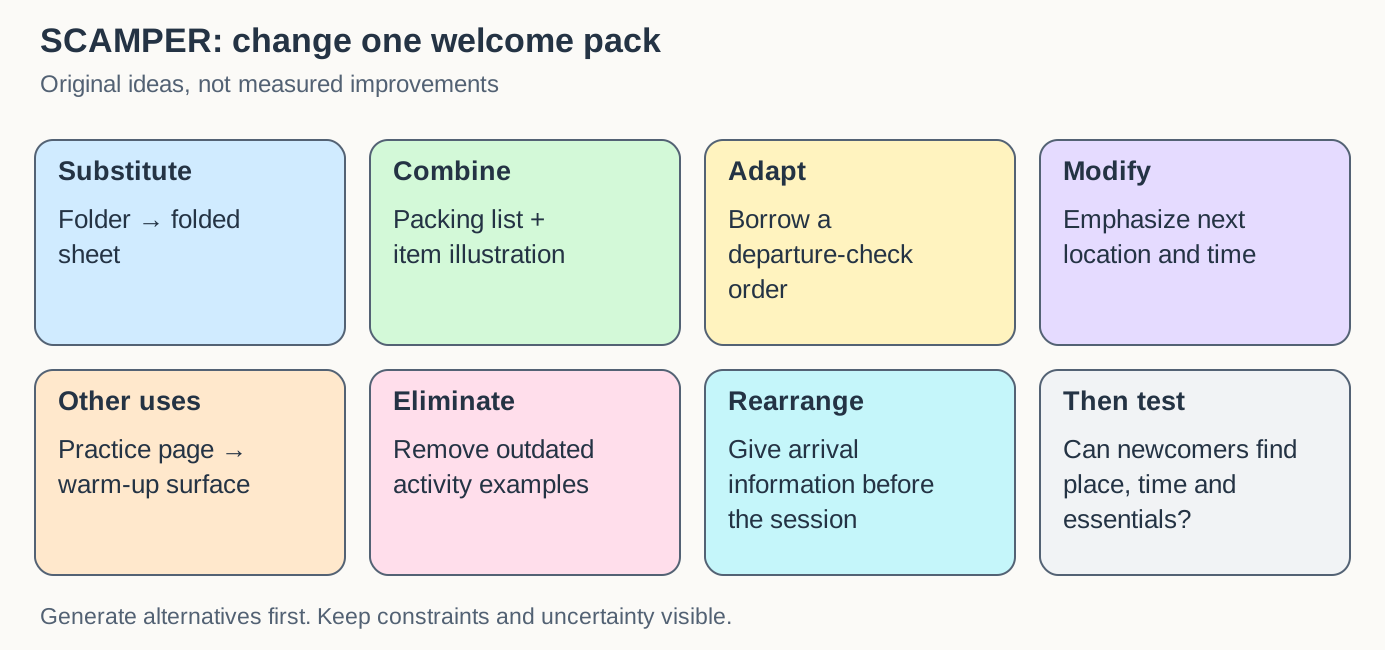
Ask: “What could take the place of this material or delivery method while preserving the job?” Replace the heavy folder with a single sturdy folded sheet containing essential first-visit information.
The change is concrete: a smaller physical item, not a vague instruction to simplify communication. Its possible weakness is reduced space. Keep optional material elsewhere only if a newcomer can still prepare without a phone or an extra account.
2. Combine: join two useful functions
Ask: “Which separate parts could work together?” Combine the materials checklist with a small first-session packing illustration so people can connect each item name to its use.
The combination should remove a real gap. Adding a decorative sketch beside every paragraph might increase clutter without helping a reader decide what to bring. Explain which two jobs the idea combines and why that relationship matters.
3. Adapt: borrow an approach from another setting
Ask: “What already helps people arrive prepared somewhere else?” Borrow the departure-check format used in a travel briefing: meeting point, arrival time, essentials and a contact if delayed.
Adaptation is not copying someone else’s finished content. Translate a useful pattern into the club’s task. A travel briefing’s passport reminder is irrelevant; the underlying priority order may be useful.
4. Modify: change scale or emphasis
Ask: “What should become more visible, smaller or easier to update?” Make the next meeting’s location and time the most prominent area, and reduce the space given to the club’s history.
This changes information hierarchy rather than the entire delivery system. A potential test is whether a newcomer can find the correct location without reading the whole page. Larger type alone is not enough if the information itself is out of date.
5. Put to other uses: reuse something available
Ask: “Can a current component serve an additional useful purpose?” Let the folder’s removable practice sheet become the first session’s warm-up drawing surface, with a small reserved space for the member’s own materials notes.
The new use must not destroy essential information. Do not ask someone to draw over the meeting details they still need. Check the relationship between the added use and the original purpose rather than celebrating reuse for its own sake.
6. Eliminate: remove a source of friction
Ask: “What could disappear without losing an essential job?” Remove outdated activity examples from the first-visit pack and keep only one current example that explains what will happen.
Eliminating several pages may make the pack easier to inspect, but it may also remove reassurance for anxious newcomers. Test what people miss. A smaller pack is not automatically a better pack.
7. Reverse or rearrange: change order or direction
Ask: “What happens if the sequence changes?” Give the essential arrival information before the first session rather than handing over the complete folder after the newcomer arrives.
For someone without digital access, provide the same essentials through a chosen practical route, such as a printed pickup copy or a conversation. Rearranging delivery exposes an important possibility: the problem may be timing, not the amount of information.
Keep idea generation separate from selection
Write each alternative as a change, a user benefit hypothesis and an uncertainty. For example: “Move arrival information before the session; newcomers may prepare earlier; we do not yet know which delivery route reaches them.” This is more useful than a note saying “better welcome experience.”
Do not reject every idea the moment it appears, but do not treat a full board as approval either. Finish the exploration, group duplicates and then compare options using criteria related to the original task.
A brainwriting session can let people explore prompts silently before discussing them. Later, an affinity diagram can group ideas about content, timing and access. Those are organizing aids, not evidence that the ideas work.
Select a small, inspectable test
For the fictional club, compare three candidates: the folded sheet, the combined packing illustration and earlier delivery. Use the following questions rather than an unexplained numerical total.
| Criterion | What to inspect |
|---|---|
| First-session usefulness | Does it help someone find the place and bring essentials? |
| Access | Can someone use it without a phone? |
| Maintenance | Who updates changes before distribution? |
| Cost | Can the club make a trial without a large commitment? |
| Learnability | What result would challenge the idea? |
Suppose the club chooses a one-page arrival sheet sent or provided in advance, combining substitution with rearrangement. That is allowed. SCAMPER categories do not require a final idea to belong to only one box.
For a practice test, ask a few volunteers unfamiliar with the pack to find the next location, arrival time and essential materials. Record what they answer, where they hesitate and what they cannot find. Use a clearly labeled draft with fictional or trial details so nobody follows an unapproved arrangement.
These observations can identify confusion in the draft. They do not by themselves establish an effect on attendance, long-term engagement or all newcomers. If the pack will be used operationally, verify real dates and responsibilities before issuing it.
Common mistakes and how to repair them
Changing the problem halfway through: A discussion about arrival preparation becomes a complete club branding project. Return to the original question and save unrelated ideas in a separate area.
Using abstract verbs instead of changes: “Optimize the folder” does not tell anyone what to build. Name the component, the new version and the job it is expected to do.
Treating categories as an exam: A team spends ten minutes deciding whether a change is adapt or modify. Record both labels if helpful and continue. The distinction matters only when it generates a new line of thought.
Counting ideas as results: Seven filled boxes do not show seven improvements. Track what is proposed, selected, tested and learned as separate states. That keeps an appealing presentation from becoming a false success report.
Organize the exercise on a whiteboard
Place the design question and constraints above seven labeled areas. Put one specific change on each note, then add a short uncertainty. Keep the original pack or a description visible so participants are varying the same starting object.
The brainstorm template can provide a general idea space. It is not a dedicated SCAMPER generator, and the exercise does not require automatic categorization. If the main question concerns adoption obstacles after an idea is selected, use force field analysis to examine those obstacles separately.
End the session with a chosen experiment, an owner, the material to prepare and a date to review what happened. A useful SCAMPER exercise produces alternatives you can inspect and questions you can test, rather than a promise that creativity alone has already solved the problem.
Preserve the alternatives you did not select
Keep a short note beside each rejected or deferred idea explaining why it was not chosen for this test. An inaccessible delivery route and an untested assumption are different reasons. If circumstances change, that distinction helps the group revisit an option without repeating the entire exercise. It also prevents later readers from assuming the selected idea was the only proposal or had already outperformed the alternatives.