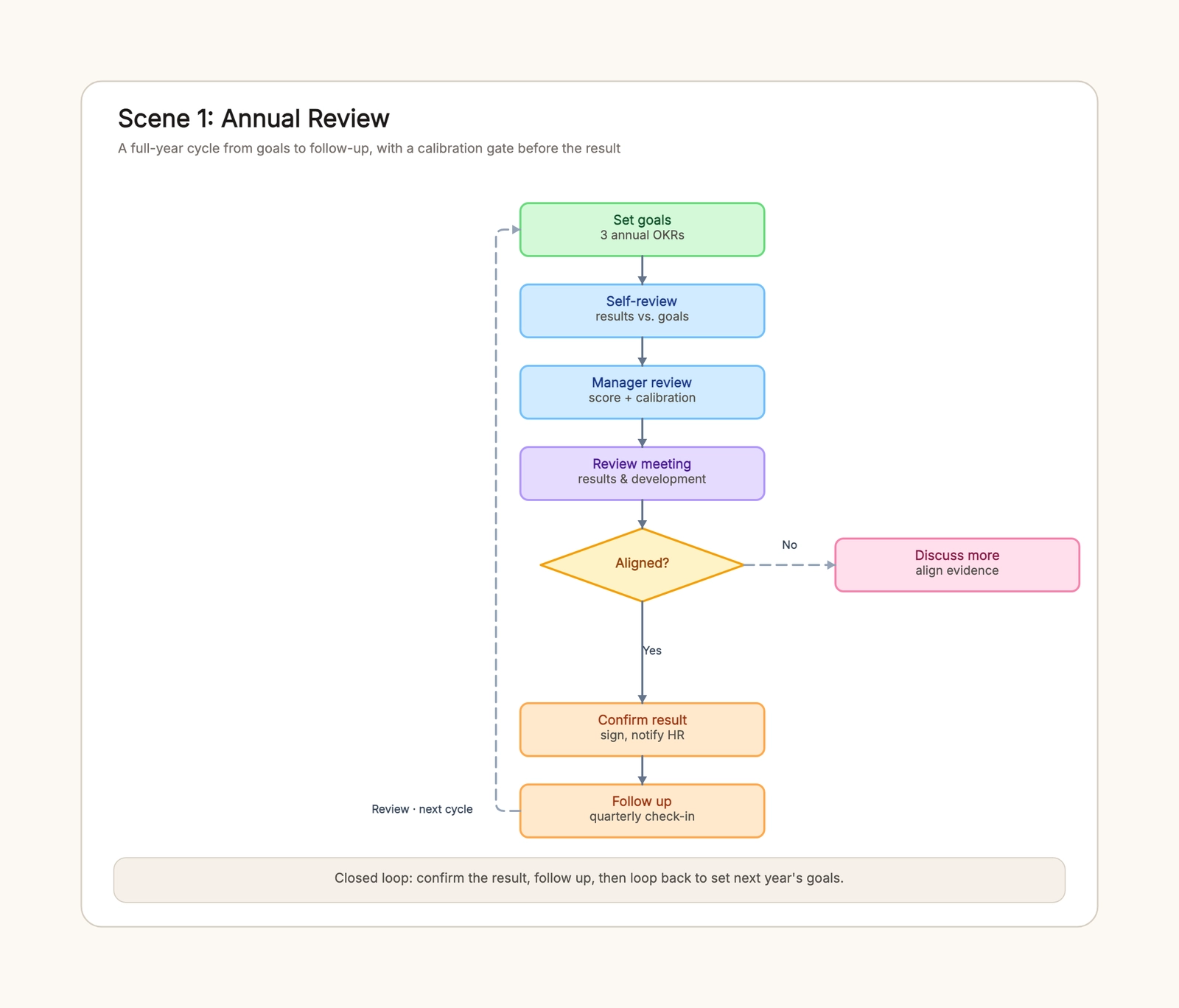
A performance review process is the difference between a review that ends at a rating and one that actually changes how someone works. Most teams already have the pieces — goals, a self-assessment, a manager's notes, a conversation. What's usually missing is the sequence that ties them together, and one step that almost everyone skips: calibration.
This guide walks through the six steps, then shows the three cadences the same process takes — annual, quarterly, and probationary. You can adapt the performance review process template and edit the stages and decision points directly in the browser.
What a performance review process should achieve
A review is not a form to complete. It is a decision and a reset. A workable process should produce four outcomes:
- the person knows how they are doing against agreed goals, not against a manager's memory;
- the rating is fair and consistent across the team, not one manager's instinct;
- the conversation ends with a concrete next step, not a vague "keep it up";
- the follow-up actually happens, so the review feeds the next cycle instead of being filed away.
Avoid treating every review as the same weight. An annual review carries comp and promotion decisions and needs the full path. A quarterly review is lighter — it exists to catch drift early. A probationary review is a structured pass-or-extend decision for a new hire. The same six-step backbone works for all three; only the depth and the decision at the end change.
The six steps of a performance review process
1. Set goals and agree on them
The review starts before the review period, not at its end. Write goals that are specific and measurable, and agree on them in writing. A goal that is clear on day one is the only fair benchmark on the last day. If the goal was never agreed, the review becomes an argument about what was expected.
2. Self-assessment
Ask the person to assess their own work first, before the manager writes anything. A self-assessment surfaces what the person thinks they did, which is often different from what the manager saw. The gap between the two is the real material for the conversation.
3. Manager evaluation
The manager writes an independent assessment against the same goals. This is where evidence matters — specific outcomes, not adjectives. "Shipped the migration on time" is useful; "did a good job" is not.
4. Calibrate across the team
This is the step most teams skip, and it is the one that keeps ratings honest. Two managers will rate the same level of work differently — one generous, one strict. Calibration puts every rating side by side and corrects that drift before anyone hears a number. Without it, the "fair" rating is really just one manager's instinct.
5. Hold the review conversation
The conversation is where the rating becomes a plan. State the assessment, listen to the self-assessment, and agree on the next step — a development goal, a changed responsibility, or a support plan. The conversation ends with one clear action and one owner, not a vague "keep it up."
6. Follow up
A review that ends at the meeting is a review that disappears. Schedule the follow-up, record the agreed next step, and check in on it. The follow-up is what makes this cycle feed the next one instead of starting from zero.
Annual review example
An annual review follows the full path because comp and promotion hang on it. Goals are set in January. The self-assessment and manager evaluation happen in December, then the team calibrates before any numbers are shared.
The calibration gate is the part that matters most here. If one manager rates everyone "exceeds" and another rates everyone "meets," the calibration step catches it before the numbers reach people. The review conversation then covers the full year, the rating, and the comp decision, and ends with the next year's goals.
The annual mistake that costs the most is letting ratings drift by manager. A calibration gate fixes it in one pass.
Quarterly review example
A quarterly review is lighter — it exists to catch drift while there is still time to correct. Goals are reviewed against the last three months, not the full year. The self-assessment is short, the manager evaluation is a progress note, and calibration is quick because fewer decisions hang on it.
The quarterly conversation is about re-prioritizing: what to keep, what to drop, and what changed. The next step is a small adjustment, not a big reset. This is the cadence where a team actually stays on track, because problems surface in April instead of December.
Probationary review example
A probationary review is a structured pass-or-extend decision for a new hire. Checkpoints sit at 30, 60, and 90 days, each with a specific bar: fit at 30 days, independent work at 60, and a clear pass or extend at 90.
The decision point is explicit — "aligned?" — so the outcome is a named pass or extend, not a surprise on the last day of probation. If the answer is extend, the next step is a concrete plan with a new date, not an open-ended wait.
Common performance review mistakes
Reviewing from memory
A rating built from what the manager remembers is really a rating of the last month. Evidence and goals, written at the start and updated through the period, are the only fair basis.
Skipping calibration
Without calibration, ratings drift by manager, and the "fair" process is not fair. Calibration is the one step that corrects for how different people rate differently.
Ending at the rating
A number is not a plan. The review is not done until there is a concrete next step with an owner and a date.
No follow-up
A review that is filed away changes nothing. Schedule the follow-up before the meeting ends, or the cycle starts from zero next time.
Using one depth for every review
An annual review and a quarterly check-in are not the same. Run the full path where decisions hang on it, and a lighter version where the point is to catch drift early.
Build an evidence packet before writing the rating
For each goal or competency, collect the agreed expectation, two or three dated examples, the result or impact, and any relevant context. Separate direct observation from second-hand feedback, and separate outcomes from factors outside the employee's control. A useful note says, “Delivered the migration two days before the revised deadline after the vendor delay; documented the rollback and no incidents occurred.” “Great ownership” is a conclusion without evidence.
Give the employee the same categories in advance so the self-review answers the same questions. Ask for accomplishments, obstacles, support received, support missing, and priorities for the next period. New evidence can change a manager's draft; the self-review should not be treated as a writing contest or as proof that quiet employees contributed less.
Calibrate without turning people into a quota
Calibration should test whether managers applied the same standards, not force a predetermined distribution. Review comparable evidence, identify ratings that use different thresholds, and record why a rating changes. Do not compare employees whose roles, levels, opportunities, or review periods are materially different as if their numbers were interchangeable.
The facilitator should watch for recency bias, halo and horns effects, proximity bias, and unsupported personality language. Replace “not strategic” with the expected behavior and the evidence showing whether it occurred. If the group cannot explain a rating from documented expectations and examples, return it for more evidence instead of settling it by seniority or volume.
Turn the conversation into a follow-up plan
End with a small set of actions that have an owner and review date. An employee action might be to lead the next customer review; a manager action might be to provide access to a stakeholder or training budget. Record disagreements accurately rather than forcing artificial agreement, and explain the local process for correction or appeal.
Check progress before the next formal review. A quarterly or annual process fails when goals disappear for months and reappear only at rating time. A short monthly check on priorities, evidence, obstacles, and support keeps the final conversation from becoming a surprise.
Restrict access to review material, follow retention and privacy rules, and avoid copying sensitive personal or medical information into a general evidence file. The process should collect job-relevant evidence, not create an informal personnel archive.
Keep the process useful over time
Review the process itself once a year. If the same calibration disagreements keep appearing, fix the rating criteria. If follow-ups never happen, add an owner and a date to the follow-up step. The process should get lighter and more consistent every cycle, not heavier.
Start with the performance review process template, replace the example stages with your own, and keep the calibration gate. If you are also mapping how people move into and through a team, the recruiting pipeline template covers the front of the journey, and the 30-60-90 day plan template covers a new hire's first plan.