A NotebookLM mind map gives you a branching view of the sources in a notebook. Use it to explore topics, then check important branches against the original material. If you want to reorganize the structure as editable whiteboard nodes, rebuild the relevant branches deliberately rather than assuming a downloaded image contains editable topics.
Google's current help uses the name Gemini Notebook. This article keeps the familiar NotebookLM search term while covering the same source-review task. The example is an original reading-club pack with an authored outline; it is not a screenshot or output generated in a Google account.
Find Mind Maps in the current interface
The official Mind Maps help describes opening a notebook with sources and selecting the Mind Map chip in chat. It also describes expanding branches, selecting a node for follow-up questions, and downloading through the map view. The current guide says the mobile app does not support this feature, so use the supported interface rather than expecting identical controls everywhere.
For the naming change, Google's administration help says NotebookLM is being renamed Gemini Notebook. Do not confuse that standalone research product with a similarly named notebooks feature inside Gemini Apps. Check which product your tutorial and your account actually refer to.
Before creating anything, decide whether the goal is exploration, study, sharing or structural editing. The same source set can support different maps, and the right level of detail depends on the question you want the branches to answer.
Prepare a small source pack you can audit
Our fictional reading club is planning a discussion about neighborhood repair. The pack contains a short event outline, a facilitator note and a list of open questions. Each paragraph has an identifier so that a branch can point back to a precise statement.
| Source | What it establishes | What it does not establish |
|---|---|---|
| R1 event outline | Three discussion topics: repair habits, access and sharing | No ranking of which topic matters most |
| R2 facilitator note | Pair discussion followed by a group conversation | No measured learning outcome |
| R3 question list | Cost, confidence and available space remain open questions | No survey finding about local residents |
The materials are fictional and intentionally short. They let you inspect the complete source set rather than trust a large unexplained summary. Download the reading pack and editable outline to repeat the exercise with your own branch choices.
Keep a question above the pack: “What should participants discuss, and which questions remain unresolved?” That question gives the map a job. A map that tries to summarize every possible aspect of repair may add branches unrelated to the supplied material.
Generate for exploration, then review the branches
In your own supported account, add the selected sources, create the map using the documented control, and inspect the result before sharing it. This article does not claim that the supplied pack was run through the product. The review method applies to the actual output you receive.
For each main branch, ask whether it names a source topic, an inferred grouping or a claim that needs evidence. Those are different categories. A branch called “access” can be an organizing label; a branch called “residents cannot afford repairs” makes a factual claim that R1–R3 do not establish.
Expand a branch before deciding it is correct. A sensible parent can contain an unsupported child. Then check the reverse direction: does an important qualification disappear from the map because it is less visually prominent than the headline topic?
A useful review row contains node label, supporting paragraph, issue and action. Possible actions include keep, rename, move, split, merge or request evidence. The purpose is to make the structure more faithful and useful, not to preserve every generated label.
Rebuild one branch as an editable plan
An authored outline for the exercise is repair discussion → habits / access / sharing / unresolved questions. Under habits, place “what people already do” as a discussion prompt, not an established finding. Under unresolved questions, keep cost, confidence and space as questions.
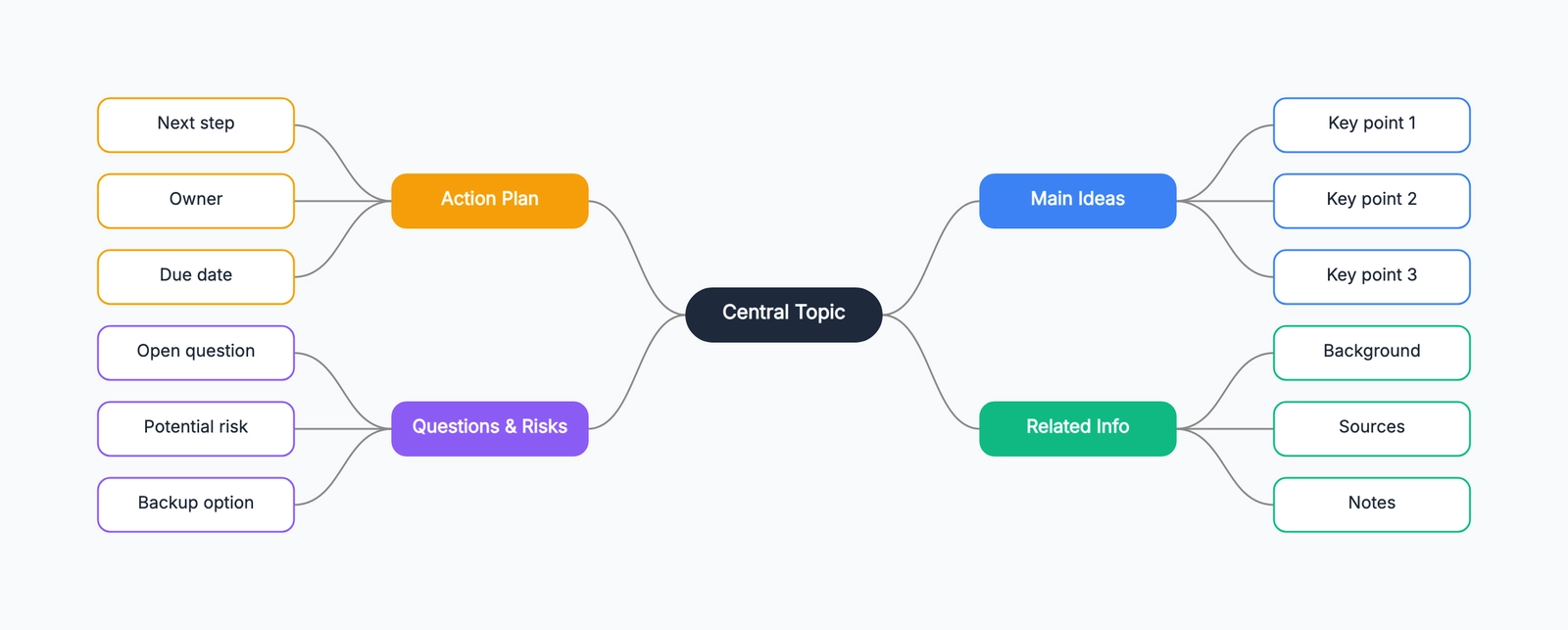
Open the mind map template and replace the sample branches with those four groups. Add source IDs to the nodes you need to verify, move questions into their own branch, and delete any branch that your source pack cannot support. You are manually rebuilding an editable structure, not importing a downloaded picture as nodes.
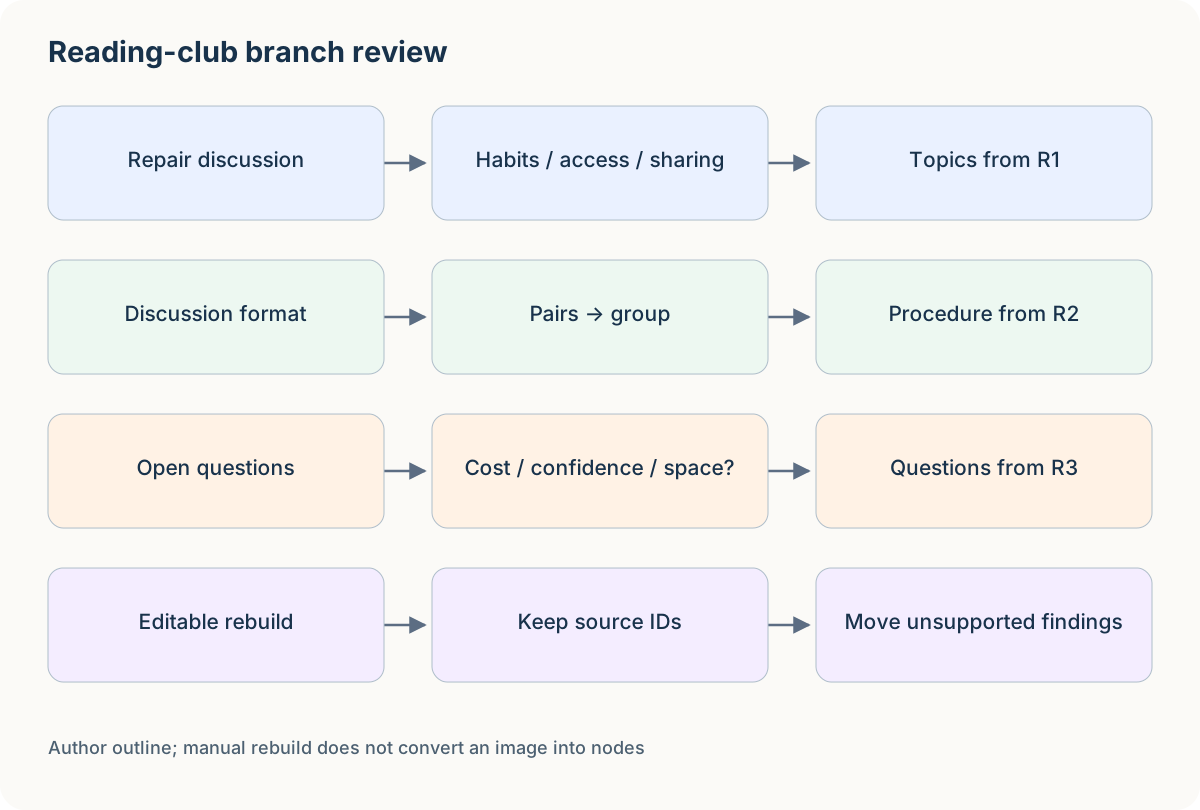
Author-created example: inspect the relationships before adapting the template.
For a larger source set with conflicting versions, use the context engineering selection log first. The quality of the map depends partly on which source version you chose to include.
Decide what an export is for
A downloaded map can be useful as a reference or a sharing artifact. Before planning further editing, inspect the actual file type and test what the destination application can do with it. Do not infer a structured topic format merely because the image looks like a mind map.
If the downloaded artifact is a raster image, placing it on a whiteboard preserves its appearance as an image. It does not turn each word into a separately editable node. A manual rebuild is appropriate when you need to reorder branches, change relationships or maintain a planning map over time.
Our download includes an authored Markdown outline that you can copy while rebuilding. It is not a proprietary Notebook export, a tested .mm file or an automatic conversion. Keep that distinction visible if you share the exercise with a team.
Third-party extraction tools may promise other formats. Evaluate them as separate products: inspect permissions, accepted inputs, the actual output and whether the resulting relationships survive editing. This article does not rank extractors or claim to have tested their conversion accuracy.
Preserve meaning when moving nodes
Suppose an initial map places “cost” beneath “barriers” and “barriers” beneath “local findings.” That hierarchy implies the club already established a local cost barrier. The fixture only lists cost as an unanswered question. Move the node to unresolved questions and rename it “What costs matter to participants?”
The change affects meaning, not just appearance. Parent-child placement can turn a topic into a conclusion. Connecting a source ID helps reviewers see whether the relationship is supported or merely a proposed organizing choice.
Avoid mixing questions and answers at the same visual level without labels. A reader may interpret all siblings as equally established facts. Use explicit question wording or a distinct group for hypotheses, then explain the convention in a small legend.
When combining branches, preserve the source references. “Access and sharing” might be a helpful discussion grouping, but the merged node should not erase the fact that its children came from different passages with different limits.
Check the map with a partner
Ask someone to use the map to locate one topic, one unresolved question and one supporting passage. If they cannot tell those apart, the structure needs work even if the layout is attractive. This is a usability exercise you can perform, not a measured result claimed for the supplied example.
Then ask the reverse question: can they reconstruct the original source meaning from the branch? If “pair discussion before group conversation” becomes “pair discussion is more effective,” the map has added a conclusion. Restore the process description or supply evidence before keeping the stronger claim.
Record edits in a small log. Name the original label, the revised label, the reason and the source reference. That log is especially useful when the map becomes a planning document and later readers assume every branch was generated directly from evidence.
For a static visual summary with a stronger layout and fact-checking focus, see the NotebookLM infographic guide. A navigable branch map and a single visual summary solve related but different reading tasks.
Common NotebookLM mind map mistakes
Treating a generated branch as a verified finding. Check the underlying passage. The source may discuss a question rather than answer it, or describe one event rather than a general pattern.
Confusing a screenshot with an editable outline. Verify the file and the destination workflow. If you need separate nodes, use a supported structured format or rebuild them manually; do not advertise an untested conversion.
Keeping every branch for completeness. A discussion map should support the discussion. Archive irrelevant detail in the source register rather than making the main canvas unreadable.
Ignoring naming and interface changes. Current help may use Gemini Notebook while older tutorials say NotebookLM. Identify the product and supported device before deciding a feature has disappeared.
Choose how much of the map to rebuild
You do not need to reconstruct every branch to gain an editable working map. Start with the part that supports the next discussion and keep a reference to the fuller source outline. A smaller reviewed branch can be more useful than a complete-looking reconstruction whose relationships nobody checked.
For the reading club, the first editable version needs the discussion themes, the pair-to-group format and the three open questions. It does not need decorative branches about the history of repair. Add a branch later only when a new source or a participant question gives it a clear role. Record that addition so later readers can distinguish source-derived structure from discussion contributions.
Turn the map into a working discussion aid
Replace R1–R3 with approved material, retain the source identifiers and rebuild only the branches needed for your discussion. Ask participants to add questions without relabeling them as findings. If you later delegate a report based on the discussion, the Cowork report brief shows how to hand off the evidence and acceptance checks.
Keep one owner for the current map and a record of which source set it reflects. When the discussion produces a new decision, add its meeting reference rather than silently converting an earlier question into an answer. That small maintenance step keeps a useful study aid from becoming an unreliable record of what the group agreed.