To use Claude Cowork well, describe a finished outcome, provide the relevant files, and define what should happen when information is missing. For a report, that means specifying the reader, the decision, the source material and the acceptance checks before asking for polished prose.
This guide builds a fictional community-workshop report from a small source pack. You get the brief, a worked evidence table and a handoff checklist. The report excerpts are authored examples of the intended output, not a claim that a particular account ran Cowork successfully.
Find the current Cowork entry point
The official getting-started guide describes Cowork for multi-step knowledge work. Availability and the interface vary by plan and rollout. Some accounts show separate Chat and Cowork options; others have the combined experience. Check the guide and your own account instead of relying on an old screenshot or assuming that a missing toggle means the feature is unavailable.
The workflow below does not require a particular connector. It begins with a deliberately small pack of fictional text files. Use approved material when adapting it to your work. A report that can be completed from three supplied files is easier to inspect than an open-ended request to search every connected workspace.
Choose a task with a clear ending. “Prepare a decision brief about whether to repeat the workshop” is concrete. “Manage our community program” combines ongoing responsibilities, communication and authority that a single report task cannot safely or usefully define.
Prepare a source pack with visible gaps
Our fictional library ran a weekend repair workshop. The coordinator must decide whether to repeat the format next month. The source pack includes attendance notes, volunteer feedback and the next-month room constraint. Each file has an identifier so a reviewer can trace a statement without guessing which conversation it came from.
| Source | Confirmed information | Limits |
|---|---|---|
| S1 attendance note | 18 visitors; 12 brought an item | No satisfaction survey |
| S2 volunteer note | Two volunteers; intake was crowded | No measured queue duration |
| S3 room note | Smaller room available next month | No confirmed staffing commitment |
The numbers are fictional exercise inputs, not a reported event. Their purpose is to create an honest decision problem. The task has enough information to propose a smaller repeat session, but not enough to claim that visitors were satisfied or that waiting time will improve.
Download the source pack and report brief. Keep those identifiers when editing the example. If you rename every file halfway through review, the evidence trail becomes harder to follow even when the prose remains unchanged.
Write an outcome-based task brief
Give Cowork the audience and decision first. The coordinator needs a one-page report that supports a scheduling discussion, not an announcement ready to send to the public. The output should separate confirmed observations, interpretations, missing information and a conditional recommendation.
An original prompt you can adapt:
Prepare a decision brief for the workshop coordinator using only S1–S3. Explain whether repeating the format next month is supportable. Cite source IDs beside factual statements. Do not infer satisfaction, repair success, queue duration or volunteer availability. Include the questions that must be answered before scheduling. Return a draft for review; do not contact anyone or publish it.
Add an output shape: a short decision paragraph, an evidence table, two feasible options and a list of unresolved questions. Specifying sections makes review more predictable without dictating every sentence. If the source pack cannot support the recommendation, a useful result says so.
Avoid demanding certainty and brevity at the same time. “Recommend one option with no caveats” removes information the coordinator needs. A concise report can still distinguish a supported observation from an assumption that would change the decision.
Review the plan before the polished report
A reasonable task plan would read the three sources, extract claims, check for conflicts, draft alternatives and assemble a brief. Before execution in your own account, inspect whether the proposed steps fit the task. A plan that adds outreach, rearranges unrelated files or searches private folders has expanded beyond this exercise.
Map the work in three lanes: coordinator, Cowork task, reviewer. Put source selection and final scheduling in the coordinator lane, extraction and drafting in the task lane, and evidence checking in the reviewer lane. Draw a return arrow for missing input rather than a loop that says “keep working.”
Open the swimlane template, replace the generic roles with those three lanes, and add the exact handoff questions. You should leave with a map that says who supplies the room capacity and who approves the final recommendation.
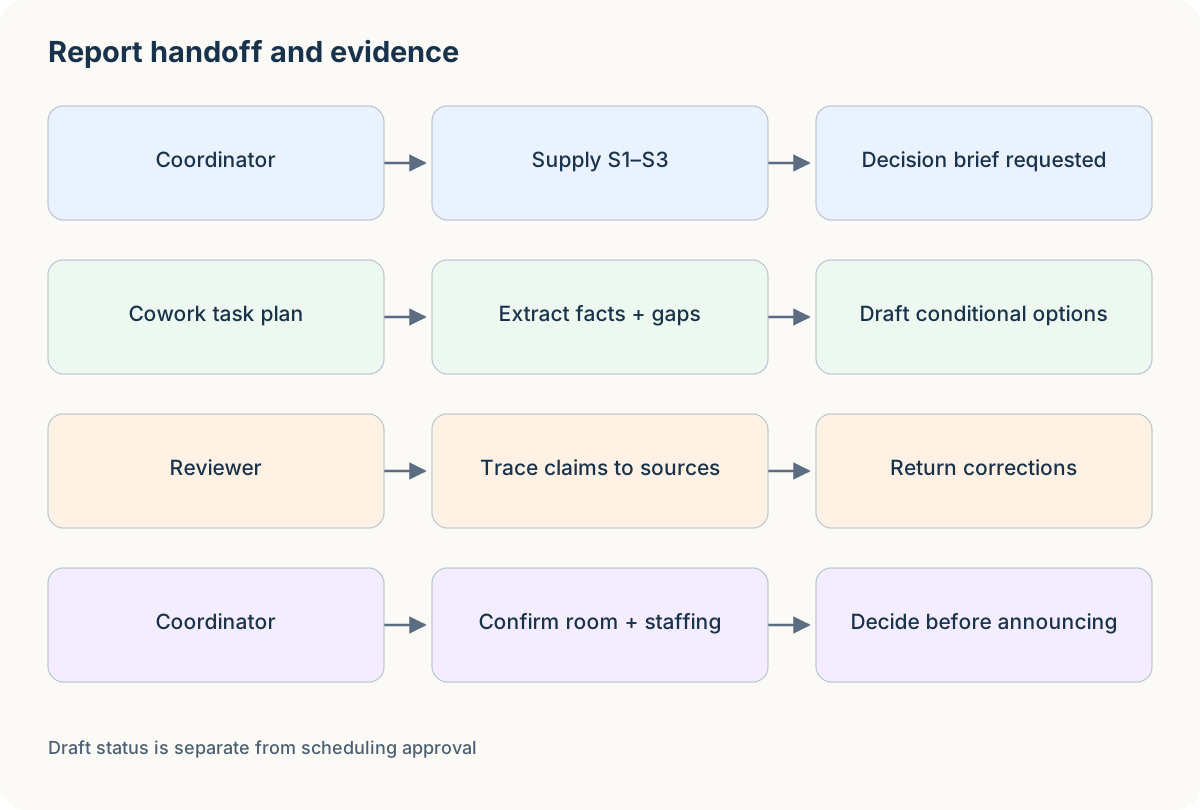
Author-created example: inspect the relationships before adapting the template.
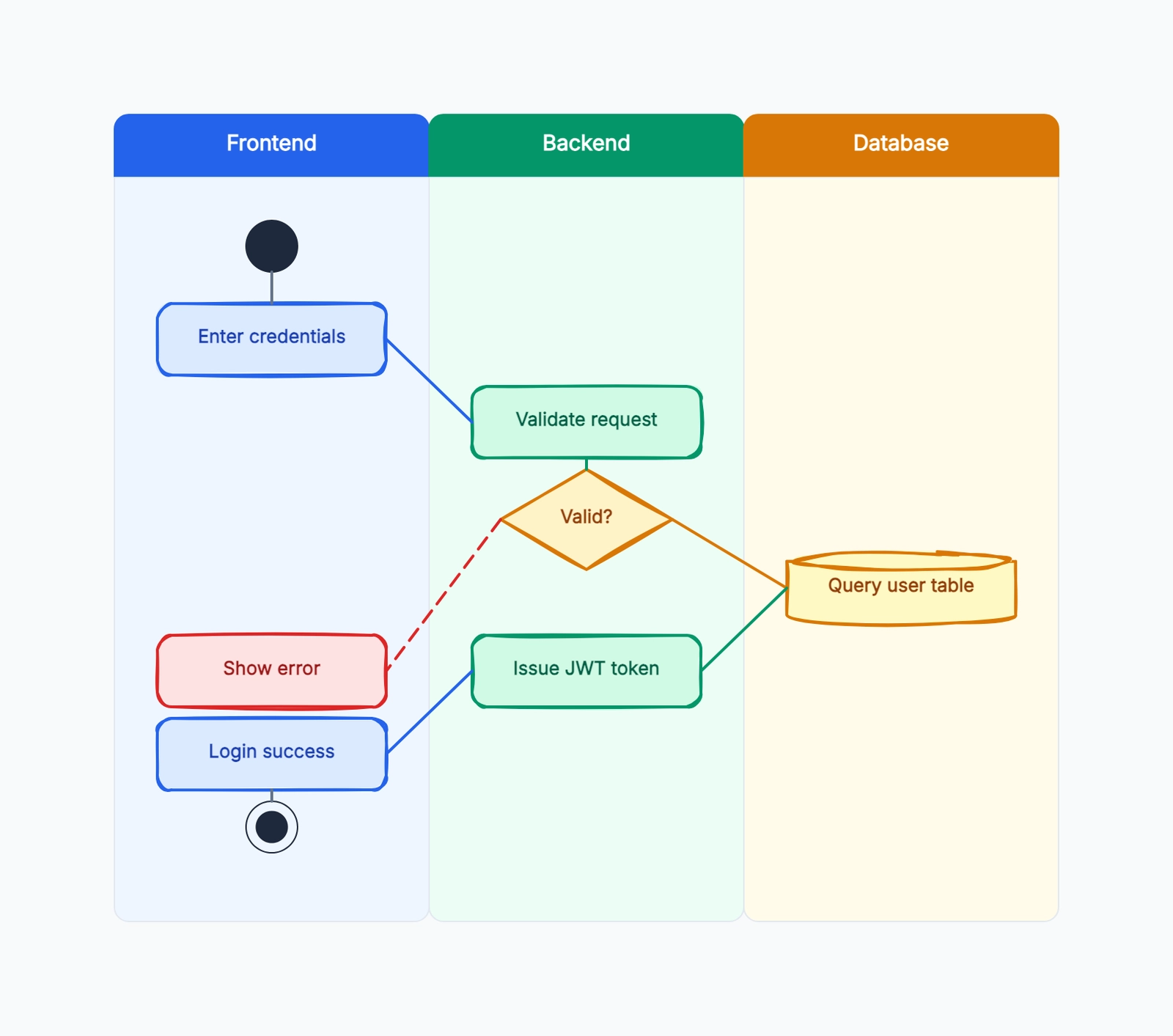
For more detail on reusable instructions, read the Claude Skills example. A repeated report-review procedure belongs in a skill; the particular workshop facts still belong in the task's source material.
Check a worked report against the sources
Here is an authored recommendation for the exercise:
Consider a smaller repeat session only after confirming room capacity and volunteer availability. S1 records 18 visitors and 12 items brought for assessment; it does not establish repair outcomes. S2 identifies crowded intake. S3 changes the available room. These observations support reviewing the intake format before confirming another date.
Every sentence has a job. The first is conditional. The second preserves the meaning of the attendance figures. The third combines two operational constraints without converting them into a measured causal claim. The final sentence recommends a planning action rather than promising an improved outcome.
A weak draft might say, “The successful workshop achieved high satisfaction, so repeat it with a shorter queue.” Those claims are intentionally written mistakes. Neither satisfaction nor queue duration was measured, and an item brought for assessment is not an item successfully repaired.
Use the following review table to repair the draft:
| Draft claim | Evidence check | Revision |
|---|---|---|
| High satisfaction | No survey in S1–S3 | Remove or request survey evidence |
| 12 successful repairs | S1 counts items brought | Say 12 items brought for assessment |
| Shorter queue next time | No duration baseline | Propose testing intake changes |
| Volunteers confirmed | S2 describes past staffing | Ask for next-month availability |
Hand back a usable artifact
A handoff should tell the coordinator what can be used now and what still requires a decision. Name the draft, preserve the source list, identify its review status and attach the open questions. “Report complete” is too broad if the recommendation depends on room capacity that nobody has confirmed.
For this exercise, the handoff note can say: “Draft ready for evidence review. Room capacity and volunteer availability remain unresolved. The report is suitable for a scheduling discussion, not a public event announcement.” That note prevents a polished draft from accidentally becoming an approved commitment.
Ask the reviewer to check at least one claim from each source. Reviewing only the opening paragraph can miss an unsupported number buried in a table. Then inspect the reverse direction: does each important source constraint appear somewhere in the report? A draft can be accurate sentence by sentence and still omit the one detail that changes the decision.
When the source pack changes, update the report version. Keep a brief revision log: what changed, which conclusion it affected, and who accepted the revision. Do not silently replace a room constraint while leaving the old recommendation labeled approved.
Cowork versus Claude Code for this task
The useful distinction is the working environment and the artifact you need. This exercise concerns a report, a source pack and an editorial handoff. A coding task would instead need a repository, commands, changes and technical checks. Some work crosses that boundary, such as preparing a report from structured data using a script.
Choose based on the work and the review you can perform. Having a coding-capable tool does not make every report a software project. Having a document-oriented interface does not remove the need to inspect calculations or generated files. The acceptance criteria should survive either choice.
If your real task needs a connector, document what it can read and which actions it can perform. A connection is not a replacement for an instruction saying whether the task may send a message, update a record or merely prepare a suggestion.
Common mistakes when delegating work
Giving the entire archive instead of the relevant pack. Extra files can introduce old versions and unrelated claims. Start with selected sources and add more only when the task identifies a specific gap. The context engineering walkthrough shows a version-selection example.
Accepting a fluent summary as an evidence check. Read the cited passage and confirm that its meaning matches the sentence. A citation beside a claim does not establish that the claim is supported.
Mixing a draft with an external action. Preparing an event recommendation and announcing the event are separate steps. Keep the communication destination and approval boundary explicit.
Asking for revision without identifying the error. “Make it better” may change good passages while retaining the unsupported claim. Point to the exact sentence, its source and the required correction.
A handoff checklist for the receiving coordinator
Before using the draft, the coordinator should answer three concrete questions: can each factual sentence be traced, does the recommendation preserve the room and staffing conditions, and is the next decision assigned to someone who can make it? Keep the draft in review until those conditions are met.
If the coordinator asks for a public invitation, open a new task brief. It needs a confirmed date, approved location, participation instructions and a working destination for questions or registration. Reusing the report as an announcement without those inputs changes both the audience and the consequences of the text.
The same distinction applies to file organization. Ask whether the final task should create a separate reviewed folder or merely return a draft. Moving or renaming original materials can break references used by another person, so include that operation explicitly when it is actually needed.
Use the brief on your next task
Replace the workshop with one decision you actually need to make. Keep the source identifiers, define an acceptable incomplete result and draw who owns the next action. For a more detailed state machine, use the agentic workflow example. The aim is to delegate a bounded piece of work whose result you can inspect and use.