The ladder of inference is a way to inspect the mental steps between what you observe and what you do. You select some information, give it meaning, make assumptions, reach a conclusion and act. The risky jump is treating an interpretation such as “they do not care” as if you directly observed it.
This example starts with an unanswered message. You will map the reasoning, identify a missing agreement, and write a clearer follow-up. The people, messages and responses are fictional teaching material; the exercise does not diagnose anyone’s personality or establish why a real colleague stays silent.
The model is a check on reasoning, not mind-reading
The Systems Thinker describes how people can select and interpret different data, then reinforce those interpretations through their actions. HBS Online also emphasizes working backward from conclusions and examining what information may be missing.
Different teaching diagrams use different rung counts. Some separate meanings, assumptions, beliefs and action; others group several of those operations. The six areas below are a practical planning adaptation, not a claim that there is one universally required six-step diagram.
| Area | What to record | Type of statement |
|---|---|---|
| Available observations | What could be checked in the situation | Data, with source and limits |
| Selected observations | What you paid attention to | A subset of the available data |
| Added meaning | How you interpreted that subset | An interpretation |
| Assumptions | What you accepted without checking | A proposition needing verification |
| Conclusion | What you decided was happening | A judgment based on the prior steps |
| Action | What you did or planned to do | Behavior that may change later evidence |
The aim is not to remove all judgment. It is to make an important judgment clear enough that you and others can inspect the route to it.
Example: A colleague has not replied
Fictional observations: On Tuesday at 9:00, Noor sends Sam a draft workshop outline and asks, “Could you take a look?” At noon, there is no reply in that message thread. Noor has not specified a reply time. The outline contains two open questions, but neither is labeled as a decision needed that day.
Noor’s first interpretation: “Sam has ignored the outline because this workshop is not important to them.”
Planned action: Rewrite the whole outline alone and tell the project group that Sam is not interested in contributing.
The silence is observable within a particular channel and period. The motive is not. Noor also knows what the message says, whether a deadline was agreed, and what decisions the outline needs. Focusing only on the missing reply discards information relevant to a different explanation.
Map the first climb up the ladder
| Area | Noor’s initial account |
|---|---|
| Observation | No reply in the thread between 9:00 and noon |
| Selection | Attention centers on the silence |
| Meaning | Silence means rejection of the request |
| Assumption | Sam saw the request and understood it as urgent |
| Conclusion | Sam does not care about the workshop |
| Action | Exclude Sam and rewrite the outline alone |
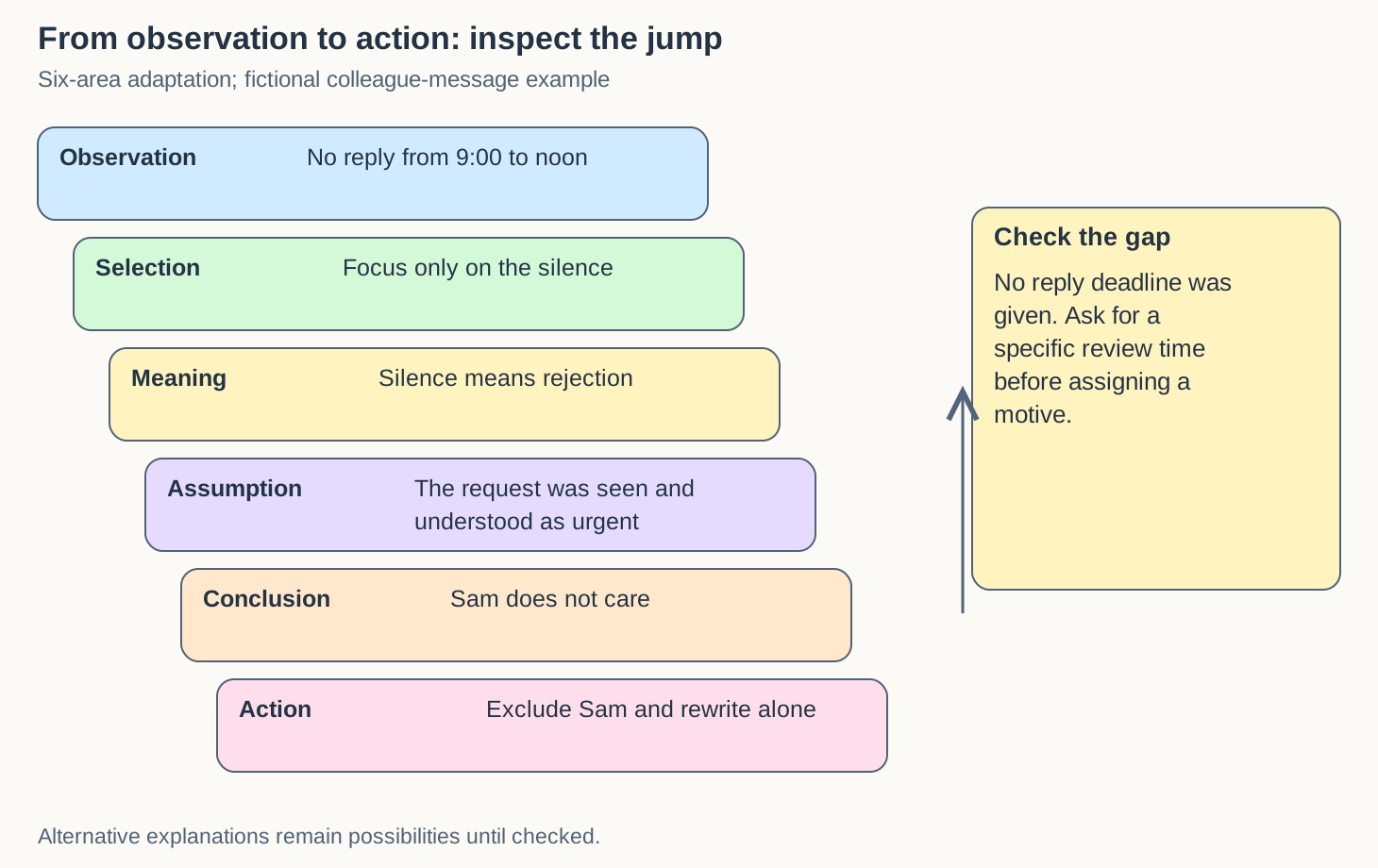
Several alternative accounts remain possible: Sam may not have read it, may be waiting for a clearer question, may expect to review it later, or may disagree with part of it. Listing alternatives does not prove any of them. It identifies why the current evidence cannot establish one motive confidently.
Do not replace a negative certainty with a comforting certainty. “Sam is definitely just busy” is also untested. A useful next step collects relevant information instead of choosing the nicest story.
Go back down the ladder in five checks
1. Name the conclusion before defending it
Write the judgment in a sentence: “I think Sam is not interested.” Mark it as a conclusion, not a fact. Naming it makes the difference visible without requiring Noor to pretend the concern does not exist.
Avoid replacing the sentence with an accusation disguised as a question: “Why does Sam never care?” That wording embeds the conclusion and adds “never,” a claim the three-hour observation cannot support.
2. Separate the observation from its meaning
Use a statement another person could inspect: “There is no reply in this thread by noon.” Add the time, channel and content of the request. These details are not pedantry; they define what is actually known.
If a detail cannot be checked, label its status. “The message was received” may be known in one system while “the recipient read and understood both questions” remains unknown. Delivery, reading and agreement are different events.
3. Identify the assumptions doing the work
Ask which assumptions must be true for the conclusion to follow. Here, Noor assumes the message was seen, its urgency was understood and a prompt reply was expected. None has been established in the brief.
Some assumptions may be reasonable enough for a low-consequence next step. Others matter because the planned action would affect a colleague’s participation. The level of checking should match the consequence, not a demand for certainty about everything.
4. Look for information you excluded
The original message contains no reply deadline and no clearly labeled decision. That omission may help explain a mismatch in expectations. It does not prove Noor caused all the difficulty; it gives Noor something specific to clarify.
Check for disconfirming evidence as deliberately as confirming evidence. A prior promise to review by 11:00 would change the account. A message asking for comments “when you have time” would change it differently. Record the actual agreement rather than remembering it in the form most favorable to your conclusion.
5. Ask a question that can change your account
A practical follow-up could be:
I sent the outline this morning, but I did not give a review time. I need to choose between the two opening activities by 15:00 today. Could you review that section by 14:30, or let me know if another arrangement is needed?
The message names the observation, owns the missing information and makes a bounded request. It does not require Sam to defend their character. If Sam cannot respond in time, Noor can choose a fallback without claiming to know Sam’s motive.
Revise the action after new information
In one possible fictional continuation, Sam replies: “I planned to read it this afternoon. I can check the opening activities at 14:00.” This response challenges the urgency assumption, not every concern Noor might have about the project.
The revised action is to confirm the specific review, keep Sam included, and decide what happens if the review cannot be completed. Noor can also label decision deadlines more clearly next time. The example does not prove that every unanswered message is harmless or that a better request always receives a reply.
If no reply arrives, preserve that as new data. Use the agreed fallback, record the unmet request and raise the operational issue through the appropriate channel if needed. The ladder asks for accountable reasoning, not indefinite patience or avoidance of difficult conversations.
Notice the feedback loop
Suppose Noor excludes Sam without checking. Sam then has fewer chances to contribute, and Noor notices the reduced contribution as further evidence of disinterest. The action helps create the next observation that reinforces the original interpretation.
That is why it matters to examine not only what you think but what your response makes possible. A clarification opens one kind of evidence; an accusation or exclusion may produce another. None gives perfect access to another person’s mind.
For wider recurring patterns, the iceberg model can help distinguish an event from repeated structures and assumptions. Use it when the issue spans more than one interaction; avoid turning one silent morning into a sweeping story about a whole culture.
Compare two ladders without making one person the defendant
Ask each participant to record their observations, interpretation, uncertainty and proposed action. Share one specific example before discussing broad labels such as reliability or commitment. People may be selecting different information rather than disagreeing about the same facts.
A useful question is: “What did you notice that led you to that conclusion?” Another is: “What information would change your view?” Answer those questions yourself as well. Demanding evidence only from the other person turns the exercise into an interrogation.
A concept map can keep the different accounts visible on a shared planning surface. Do not write a colleague’s motives as confirmed facts on the board. Let them correct the account attributed to them.
Common mistakes when using the model
Calling interpretations objective data: Words such as lazy, hostile or dismissive describe a judgment. Replace them with a specific statement or action and record your interpretation separately.
Collecting alternatives without checking any: A long list of possibilities can become another way to avoid the issue. Choose the smallest useful clarification and decide what information it would provide.
Assuming reflection guarantees correctness: The model can reveal a gap but does not certify the final conclusion. Keep the source and uncertainty attached to important claims.
Using the ladder only on others: Begin with your own selection and assumptions. If you want to test how evidence supports a written conclusion, the CER guide offers a complementary structure. If several possible actions remain, force field analysis can examine implementation obstacles after the evidence question is clearer.
Before acting, write one line for what you know, one for what you infer and one for what you will check. That small distinction often makes a conversation more precise without turning routine work into an elaborate analysis ritual.