A church organizational chart answers a question most congregations never write down: who is responsible for what, and who holds whom accountable. It matters more than it looks. When a visitor asks "who do I talk to about the food pantry?", when a new elder needs to understand oversight, or when a pastor leaves and nobody can explain the structure they are handing over — the chart is what saves the conversation.
This guide walks through five structures churches actually use, then draws a complete small church chart step by step, so you can build one for your own congregation in a single evening.
What a Church Organizational Chart Actually Shows
A church organizational chart looks like a corporate org chart but has to do more work. A business chart shows one thing: who reports to whom. A church chart shows three kinds of relationships at once, and mixing them up is the most common reason these charts fail.
Reporting is the day-to-day chain: the worship coordinator reports to the worship lead, the worship lead reports to the pastor. These are solid lines.
Oversight is accountability without daily management: elders or a board hold the pastor accountable but do not run the office. These are dashed lines.
Advisory and collaboration are the ties that do not fit either category: a volunteer coordinator who supports several ministries, or a communications team that helps the ministry director with an event. These are also dashed, or a separate light style, and they never sit in the reporting chain.
The chart earns its keep by keeping these three apart. When every relationship is drawn as a solid line, the pastor looks like the boss of the elders — which misrepresents how most churches actually govern.
Five Structures Churches Actually Use
There is no single right way to organize a church, but most congregations settle into one of five shapes. Pick the one closest to your situation and adjust the role names to match your bylaws.
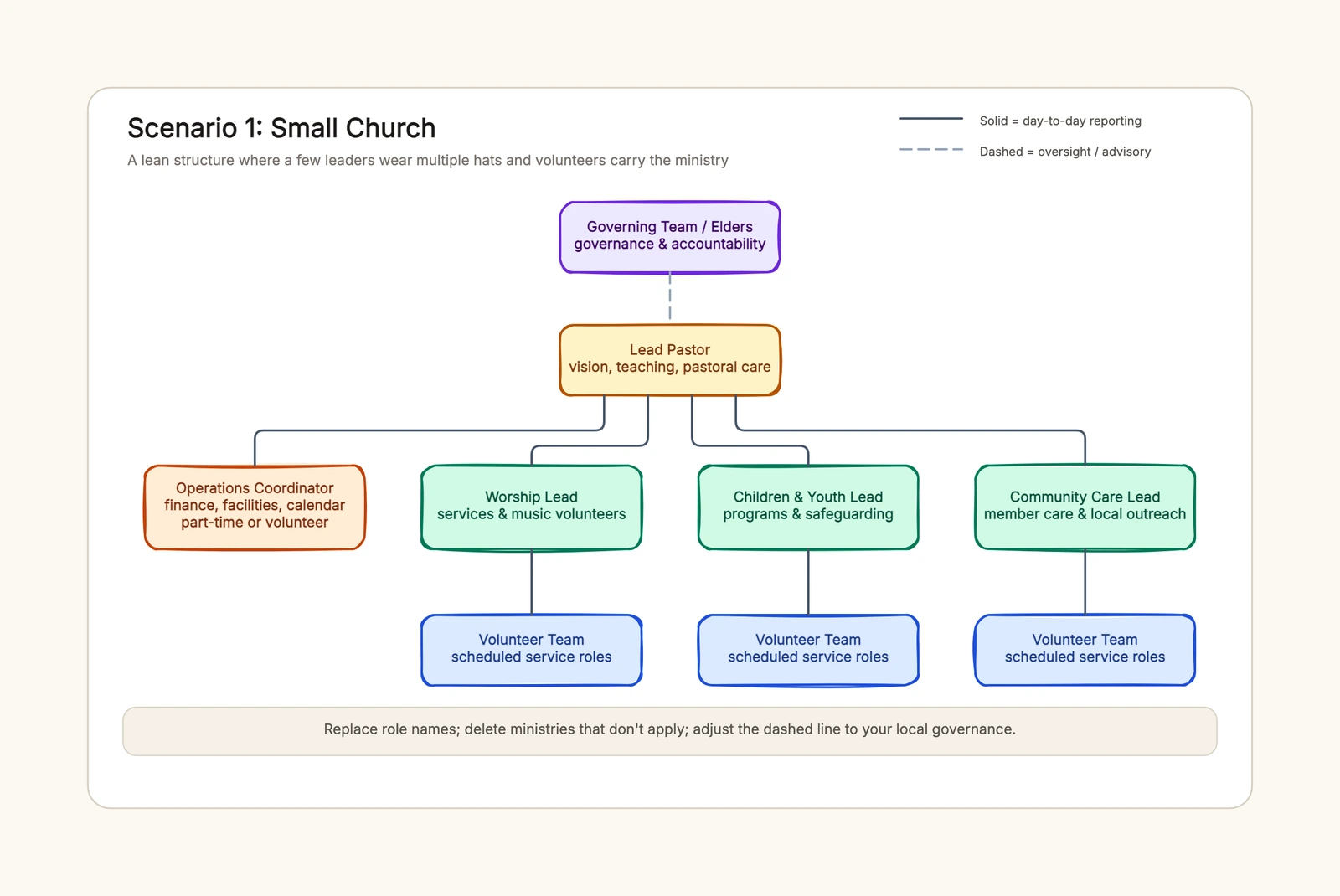
1. Small church. A governing team or elders, one lead pastor, and a handful of ministry leads who each carry a volunteer team. People wear multiple hats: the same person may coordinate worship and handle the calendar. Shallow is the point — three levels is usually enough.
2. Volunteer-led church. No full-time staff at all. The chart shows teams rather than titles — worship team, kids and families team, outreach team — because the work is carried by laypeople. Role names are honest about who actually does the work each week.
3. Growing church. Staff has grown past the founding stage, and the work splits into two tracks: a ministry director over worship, children, youth, and groups, and an operations director over finance, communications, and facilities. The senior pastor leads the staff instead of running both tracks.
4. Multi-ministry church. Several ministry branches — pastoral care, worship and production, children and youth, community outreach — each with their own team, plus an operations team and volunteer coordinators who support multiple branches. The main hierarchy stays within three levels so it stays readable.
5. Leadership transition. A temporary structure drawn during a handover: the incoming pastor, the unchanged ministry leads, and a note marking interim responsibilities. Documenting the structure before the transition means the change is a name on the chart, not a redesign.
How to Draw a Church Organizational Chart in 6 Steps
1. Confirm the governance model first. Read the bylaws and note where oversight sits — elders, a board, or a council. This decides the top box and whether the line to the pastor is dashed or solid.
2. List every role. Start with the lead pastor and work down to the volunteer teams, including part-time and shared roles. Write each as "role — responsibility" (for example, "Operations Coordinator — finance, facilities, calendar") so the chart is useful on its own.
3. Separate oversight from reporting. Elders or a board connect to the pastor with a dashed line. Staff connect to their supervisors with solid lines. If a person serves two roles, mark it explicitly instead of drawing them twice.
4. Group roles into tracks. Put pastoral and ministry work on one side, operations and administration on the other. In a small church these may be a single row of leads under the pastor; in a larger church they become two directors.
5. Add volunteers. In a small church, put a "Volunteer Team" card under each ministry lead. In a larger church, add volunteer coordinators as a layer connected with dashed lines to the branches they serve — never one box per volunteer.
6. Validate with the people in it, then set a review date. Walk the chart past the actual leaders before sharing it. Then schedule a review every time a role changes or a leader steps down, and at least once a year.
If you already have the roles and structure in your head, the church organizational chart template gives you three ready-made scenes — small, growing, and multi-ministry — that you can edit instead of starting from a blank canvas.
Example: Building a Small Church Chart
Let's draw the most common case: a small church with a part-time pastor and volunteer-led ministries.
Step one — roles. The governing body is a team of three elders who oversee the pastor. The pastor covers vision, teaching, and pastoral care. Below the pastor sit four leads: Operations (finance, facilities, calendar), Worship (services and music), Children & Youth (programs and safeguarding), and Community Care (member care and outreach). Each lead has a volunteer team.
Step two — grouping. Elders at the top. Pastor under them. The four leads in one row under the pastor. Volunteer team cards under each lead. That is three levels total.
Step three — lines. A dashed line from the elders to the pastor: they oversee, they do not manage day to day. Solid lines from the pastor to the four leads: they report to the pastor. Solid lines from each lead to their volunteer team. One detail worth marking: the Operations Coordinator role is part-time or volunteer in many small churches — write it on the card so the chart matches reality.
Step four — the check. Ask the elders: is the dashed line right, or does your tradition make the board the direct supervisor? Ask the leads: does anyone report to two people? Fix those before you share the chart.
The finished chart fits on one page and reads top to bottom: who governs, who leads, who carries each ministry. That is the whole point — a chart a visitor can understand in ten seconds.
Solid vs. Dashed: Getting the Line Language Right
The line style is not decoration; it is the semantics of the chart. Keep one rule: solid means day-to-day reporting, dashed means oversight, advisory, or support.
The two mistakes that break charts are drawing elders as the direct boss of the pastor (solid, when it should be dashed oversight) and drawing volunteers inside the reporting chain (they support a ministry, they do not sit under a manager). Add a small legend on the chart so nobody has to guess — one line example for solid, one for dashed.
Common Mistakes When Drawing a Church Chart
Ranking by title instead of function. Five boxes all labeled "Director" convey nothing. Every box needs a role and a responsibility, even if the card gets a little longer.
Leaving volunteers out. In a small church, volunteers carry most of the ministry. Omitting them makes the chart look empty and hides who actually does the work.
Drawing oversight as daily management. Elders hold the pastor accountable; they do not micromanage operations. A solid line straight down from elders to the pastor misrepresents the relationship.
Showing a dual role twice. When one person is both worship lead and administrator, drawing them in two places implies two people. Merge into one card with both responsibilities, or label the shared role explicitly.
Letting the chart go stale. Church leadership changes often. A stale chart misleads new members, visitors, and the leaders themselves. Commit to updating it at least annually and whenever a role changes.
Next Steps
Start from what your congregation actually does, not from a generic hierarchy: list the roles, separate oversight from reporting, group ministry and operations, and add the volunteers who carry the work. If you want a structure to edit rather than a blank page, the church organizational chart template is a shortcut — and for a plain reporting hierarchy without the oversight layer, the org chart template is a simpler starting point.
Related Guides
- Church Organizational Chart Template — three editable scenes for small, growing, and multi-ministry churches.
- Org Chart Template — a plain reporting hierarchy for any team.
- Stakeholder Mapping Example — plot influence and interest when the question is about people, not resources.