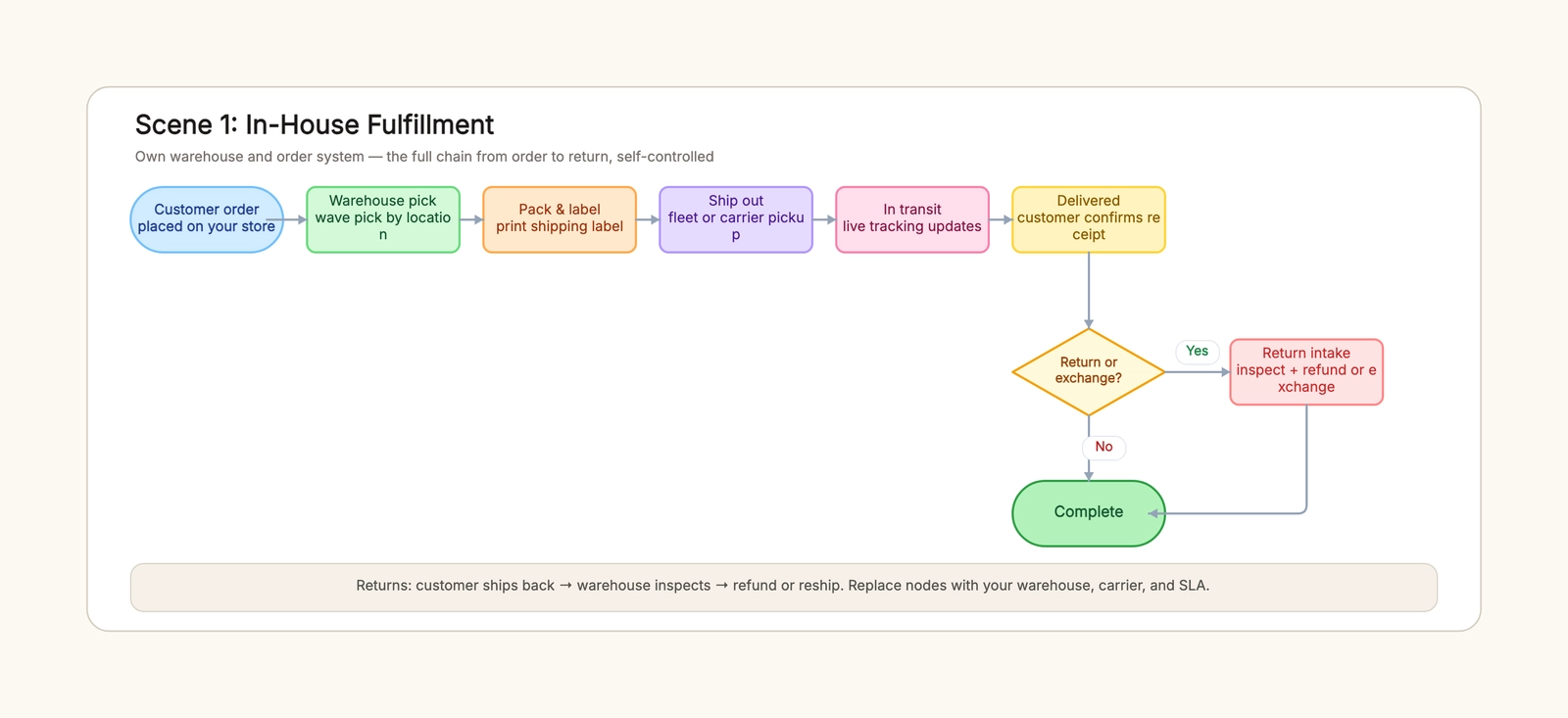
An e-commerce order fulfillment process is the chain a parcel runs from the moment a customer taps buy to the moment they sign for it — and, when the order goes wrong, the return that follows. Two orders placed a minute apart can take wildly different paths: one ships the same day, the other sits because the picking slip was mislabeled. A clear fulfillment flow fixes that by making every handoff explicit, so a parcel moves from order to pick to pack to ship to deliver to sign the same way every time.
This guide walks through the e-commerce order fulfillment process step by step, then shows the three shapes it takes for in-house, 3PL, and cross-border setups. You can adapt the e-commerce order fulfillment process template and edit every node directly in the browser.
What an e-commerce order fulfillment process covers
The e-commerce order fulfillment process is not the same thing as order processing. Order processing handles what happens before the goods move: payment, fraud checks, and stock availability. Fulfillment handles what happens after: the physical movement of the product from shelf to doorstep and back again. It is easy to blur the two because they share the same order, but they answer different questions — "can we take this order?" versus "how does this box actually reach the customer?"
A workable fulfillment process should answer five questions:
- what gets picked and where it is located in the warehouse;
- how the parcel is packed and labeled before it leaves;
- who hands the parcel to the carrier and when the tracking number goes live;
- how delivery and signed receipt are confirmed;
- what happens when the customer returns or exchanges the item.
Avoid treating every fulfillment setup as the same size. An in-house operation runs the whole chain through your own warehouse. A 3PL outsources storage and delivery but adds a system handoff. Cross-border adds customs clearance between the first mile and the last. Start from the same order-to-return backbone and branch only where the setup genuinely differs.
The order fulfillment process, step by step
The most useful fulfillment flow is organized around the physical movement of the parcel, not around departments. When each step names a place and an action, a new warehouse hire can follow it without asking. Here is the standard chain.
1. Customer order
The entry point. A customer submits their cart and checks out, and the order is created in your system. In an in-house setup this lands directly in your order system; in a 3PL setup it is pushed to the third party's system instead.
2. Warehouse pick
The warehouse locates the items and pulls them from the shelves. This is often a wave pick, where orders are grouped and a picker walks a route through the aisles by location. The step should name the location logic — "wave pick by location" — so the picker knows the route.
3. Pack and label
The items are packed, and the shipping label is generated and applied. This is where the parcel gets its tracking number, so the label and the order must match exactly. A mislabel here is the most expensive mistake in the whole chain.
4. Ship out
The parcel leaves the warehouse and is handed to the carrier — your own fleet or a courier pickup. This is a distinct step from "in transit" because someone owns the handoff moment and the tracking number goes live here.
5. In-transit delivery
The carrier moves the parcel, and the tracking status updates. For a multi-warehouse 3PL this step may route the order to the warehouse closest to the customer; for cross-border this is where the parcel sits in the international line.
6. Signed delivery
The customer receives and signs for the parcel, and the order is confirmed delivered. The signature or delivery confirmation is the trigger that closes the physical leg.
7. Return or exchange
The decision point. The diamond asks whether the customer returns or exchanges the item. "No" closes the order; "Yes" routes to return intake — inspection, then a refund or a reship. This branch is where cost and trust are decided, so it belongs in the same flow rather than a separate diagram.
Three fulfillment models
The same seven steps bend into three real setups. The difference is never the happy path — it is the handoffs and the extra steps between "ship" and "sign".
In-house fulfillment
You own the warehouse, the staff, and the order flow end to end. The flow runs cleanly through your own systems, and the only external touchpoint is the carrier pickup. This is the simplest model to diagram because there is no system boundary in the middle.
Third-party logistics (3PL)
A 3PL takes over warehousing and delivery. The flow gains a handoff at the very start — the order is pushed to the 3PL system — and a sync at the end, when stock, order, and delivery status flow back to you. The diagram should make that two-way sync explicit, because it is where 3PL integrations quietly break.
Cross-border fulfillment
Cross-border adds customs declaration and clearance between the first mile and the last. The order, pick, and pack happen in the domestic warehouse, but "ship" becomes first-mile shipment with customs, and "deliver" becomes clearance plus last-mile delivery in the destination country. The return path is the expensive part — it goes back to a domestic or overseas warehouse, slower and costlier than a domestic return.
In-house fulfillment example
An in-house flow is the cleanest to map. The customer order lands in your order system, the warehouse runs a wave pick by location, the parcel is packed and labeled with its tracking number, your fleet or a courier picks it up, the parcel moves in transit with live tracking, and the customer signs for it.
The return branch asks "return or exchange?" A "no" completes the order. A "yes" routes to return intake: the customer ships the item back, the warehouse inspects it, and you either refund or reship. Keeping the return branch in the same diagram — rather than a separate returns policy page — is what makes the flow complete.
3PL: what changes
The 3PL flow keeps the same physical steps but moves the warehouse and the carrier behind a system boundary. The order is pushed to the 3PL system, the 3PL runs its own WMS wave pick, packs and labels with its own outbound label, and hands the parcel to a courier for pickup.
The part that differs most is the sync. Orders, stock levels, and delivery status must flow both ways, so the diagram should show the push at the start and the status return at the end. The most common 3PL failure is not the picking — it is a status that never comes back, leaving the customer asking "where is my order?" while your own system still says "processing." For the inbound side that feeds a 3PL, the warehouse receiving process flowchart maps the receiving and inspection steps.
Cross-border: what changes again
Cross-border fulfillment inserts customs into the middle of the flow. The order and payment cross a border, the domestic warehouse picks and sorts while preparing customs documents, the parcel is packed with an international label, and "ship" becomes first-mile shipment with customs declaration. Then the parcel travels the international line, clears customs, and enters last-mile delivery in the destination country before the overseas sign-off.
The return path is the part people underestimate. A cross-border return usually goes back to a domestic or overseas warehouse, and the shipping and customs cost can exceed the value of the item. The flow should reflect that return path explicitly rather than assuming a domestic-style return.
The return and exchange branch
The return branch is where a fulfillment process earns or loses money. A well-mapped return is: customer ships back → warehouse or 3PL inspects → refund or reship. Each of those is a step with an owner, and the inspection decision decides whether the item returns to sellable stock or goes to the disposal pile.
The mistake to avoid is ending the flow at "delivered." A flow that stops at signed delivery hides the return path and leaves the most expensive part of the chain undocumented. Keep the return-or-exchange diamond in the same diagram, and the whole order-to-return chain stays visible in one place.
Common fulfillment mistakes
Stopping at delivery
A flow that ends at "delivered" hides the return path. Returns are where cost and trust are won or lost, so the return branch belongs in the same diagram.
No carrier handoff step
Between "ship" and "in transit" there is a handoff to the courier. Skipping it leaves the tracking number and the pickup time unowned in the diagram, and that is exactly where parcels go missing.
Confusing fulfillment with order processing
Payment, fraud, and stock checks belong in an order processing diagram — see the order processing flowchart for that side. Mixing them into a fulfillment flow makes the diagram unreadable for the warehouse staff who actually have to follow it.
One flow for every scenario
In-house, 3PL, and cross-border runs differ in their real steps. Forcing them into one diagram hides the handoffs and customs steps that actually matter. Use three scenes and keep the differences visible.
Vague node labels
"Handle order" tells nobody what to do. Use a verb tied to a place and a system — "wave pick by location" or "handoff to courier" — so each step is executable without a supervisor's explanation.
Keep the flow current
A fulfillment process is only useful while it matches reality. Review the flow whenever you change carriers, switch to a 3PL, or add a destination country, and update the nodes that changed. Keep the diagram next to the warehouse SOP and the returns policy, so the physical chain and the written policy stay in sync. A flow you review once is a flow that keeps every order moving the same way.
Start with the e-commerce order fulfillment process template, replace the nodes with your warehouse, carrier, and SLA, and keep the return branch in the same diagram. For the payment and stock side that comes before fulfillment, see the order processing flowchart; for the physical space your flow runs through, the warehouse layout template.