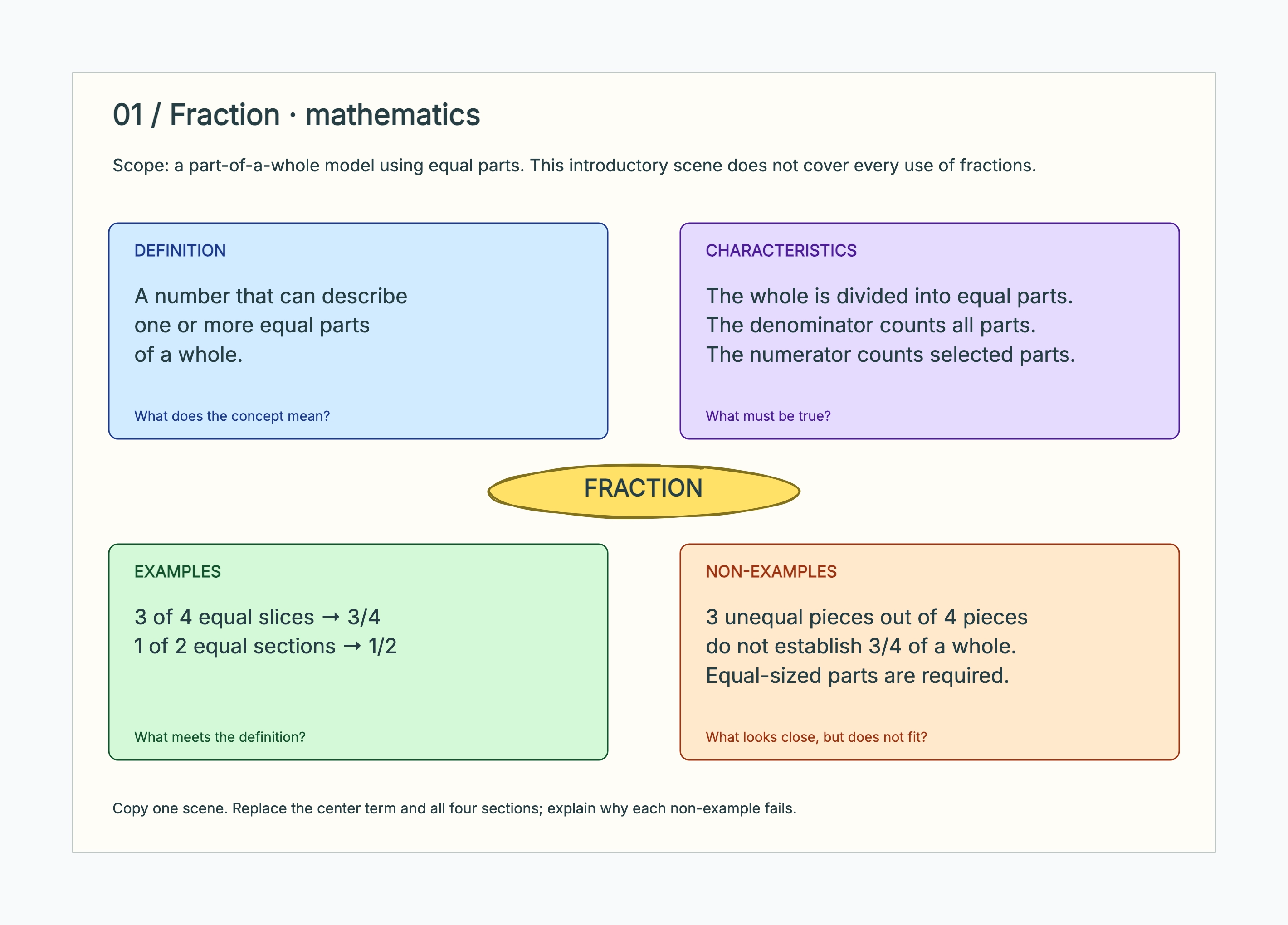
01 / Fraction · mathematics
Who uses it: Students reviewing equal parts in an introductory mathematics lesson
DEFINITION: A number that can describe one or more equal parts of a whole.
CHARACTERISTICS: The whole is divided into equal parts. The denominator counts all parts. The numerator counts selected parts.
EXAMPLES: 3 of 4 equal slices → 3/4 1 of 2 equal sections → 1/2
NON-EXAMPLES: 3 unequal pieces out of 4 pieces do not establish 3/4 of a whole. Equal-sized parts are required.
Why this works: The near miss changes only the equal-parts condition, making the source of the misconception explicit.
02 / Habitat · science
Who uses it: Science learners distinguishing a place from a diet or physical trait
DEFINITION: The place where an organism lives, with the conditions and resources it needs.
CHARACTERISTICS: Depends on the organism. Provides suitable conditions and access to needed resources.
EXAMPLES: A pond where a frog lives A decaying log where a woodlouse lives
NON-EXAMPLES: “Eats insects” describes diet. “Has moist skin” describes a trait. Neither names a place to live.
Why this works: The contrasting statements may describe the organism correctly but belong to different information categories.
03 / Resilient · vocabulary
Who uses it: A vocabulary group discussing responses to setbacks
DEFINITION: Able to recover or adapt after difficulty or a setback.
CHARACTERISTICS: A difficulty has occurred. The person adjusts or recovers. Support and rest can be part of it.
EXAMPLES: After a rejected draft, a writer uses feedback and tries a revision. A student asks for help and adjusts.
NON-EXAMPLES: Finishing an easy task with no setback does not demonstrate it. Hiding distress alone is not evidence.
Why this works: The cases require both a difficulty and a response. They do not equate resilience with concealing distress or refusing help.
04 / Acceptance criteria
Who uses it: A product manager and developer clarifying one story
Definition: observable conditions used to decide whether this story is accepted.
Characteristics: specific to the story; clear expected behavior; verifiable.
Example: Given an empty required email field, submitting shows an error and creates no account.
Non-example: “Make signup delightful” gives no observable acceptance condition.
Why this works: This is a simplified product example, not a promise that one criterion fully specifies secure signup.
05 / Metaphor
Who uses it: A writer comparing two kinds of figurative language
Definition: in this exercise, language describing one thing as another to express a resemblance.
Characteristics: figurative rather than literal; the comparison contributes meaning.
Example: “Her voice was a lighthouse in the confusion.”
Non-example: “Her voice was like a lighthouse” is an explicit simile in this exercise; “a lighthouse stands on the coast” is literal.
Why this works: State the classroom distinction being used. The point is the form of the comparison, not whether both sentences are vivid.
06 / Actionable feedback
Who uses it: A teammate reviewing a draft report
Definition: feedback specific enough for the recipient to identify a next revision.
Characteristics: points to a location or behavior; explains the issue; suggests a checkable next action.
Example: “In chart 2, add the unit to the vertical axis so a reader can interpret the values.”
Non-example: “This is confusing” identifies dissatisfaction but gives no location or next action.
Why this works: The suggestion is a starting point for discussion, not a claim that every reviewer should prescribe the final solution.