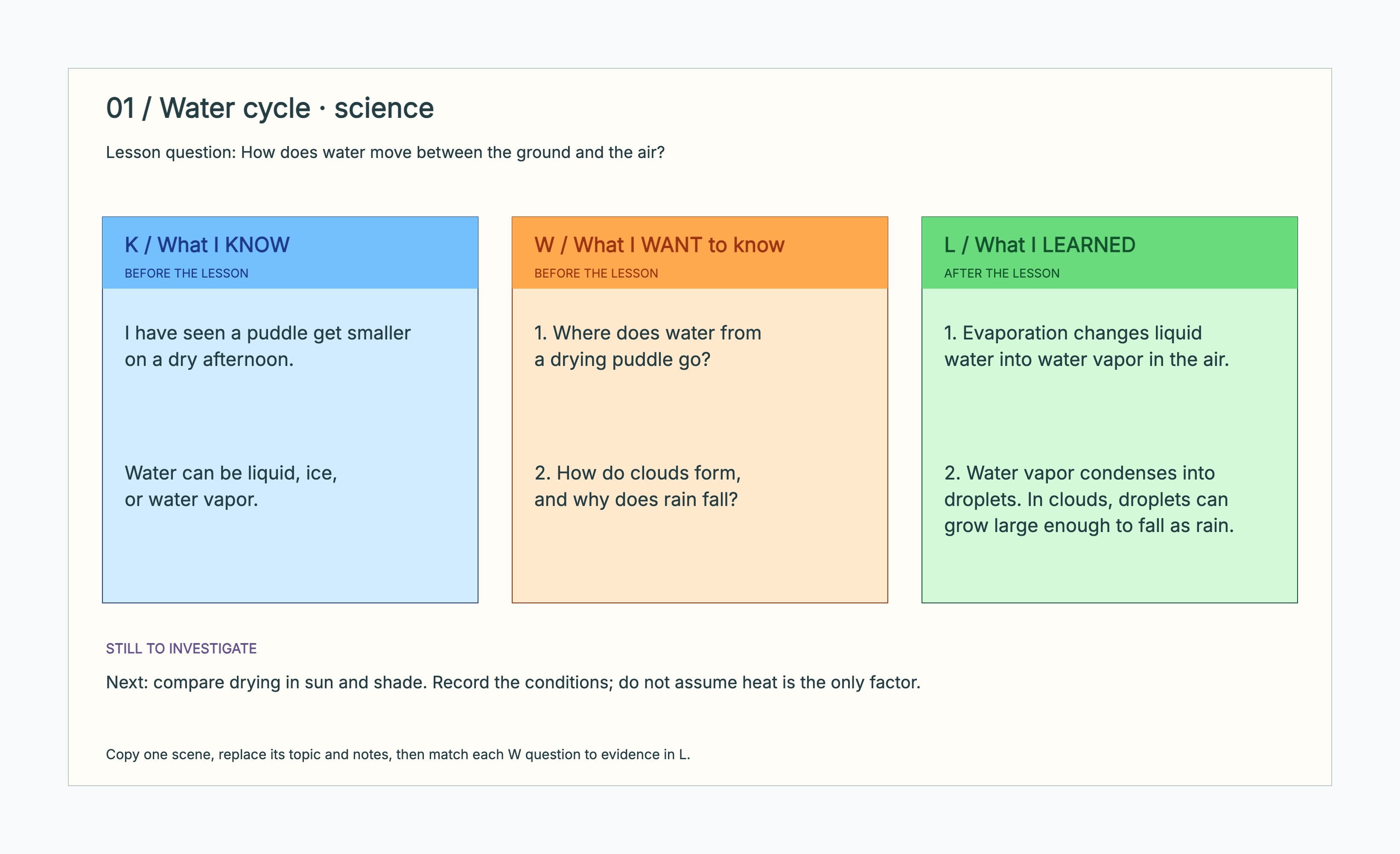
01 / Water cycle · science
Who uses it: A science teacher and students revisiting a water-cycle lesson
K: I have seen a puddle get smaller on a dry afternoon. Water can be liquid, ice, or water vapor.
W: 1. Where does water from a drying puddle go? 2. How do clouds form, and why does rain fall?
L: 1. Evaporation changes liquid water into water vapor in the air. 2. Water vapor condenses into droplets. In clouds, droplets can grow large enough to fall as rain.
Why this works: Next: compare drying in sun and shade. Record the conditions; do not assume heat is the only factor.
02 / A missing key · reading
Who uses it: A reading group tracing evidence in a short fictional story
K: The opening tells us Jo finds a key beside the gate. The opening does not identify the key’s owner.
W: 1. Who owns the key? 2. What does Jo do when she finds the owner?
L: 1. The later scene identifies the caretaker as its owner. 2. Jo returns the key. That action supports a claim that she is honest.
Why this works: Next: find another action before making a broader claim about Jo. Add page numbers from your own text.
03 / A local station · source inquiry
Who uses it: History learners comparing what two practice sources can establish
K: Source A is a photograph of the station, dated 1910. Source B lists two daily passenger departures in 1920.
W: 1. What can the photograph show about the station? 2. Did passenger service change between 1910 and 1920?
L: 1. Source A shows a platform and station building in 1910; it does not count passengers. 2. Source B gives a 1920 schedule. Without a 1910 schedule, we cannot establish a change.
Why this works: Next: locate a comparable 1910 timetable. Keep an unanswered question open rather than inventing a conclusion.
04 / Learning a handoff process
Who uses it: A new teammate reviewing a documented work process
K: The sample request includes a named owner.
W: 1. What happens if that owner is absent?
L: 1. In this fictional training guide, the team lead assigns a backup. This has not been verified against a real policy.
Next: check the current team guide and ask its owner to confirm.
Why this works: Keep a training example separate from the actual process you are trying to learn.
05 / Exploring an API
Who uses it: A developer testing a fictional sandbox endpoint
K: One sample request returned a success response.
W: 1. What response does an invalid field produce? 2. Are repeated submissions safe?
L: 1. The practice test returned a field error. 2. Repeated submissions have not been tested; safety remains unknown.
Next: read the endpoint contract and test retries in an authorized sandbox.
Why this works: A successful first request does not establish error or retry behavior. Replace illustrative observations with real results.
06 / Researching a picture-book setting
Who uses it: An illustrator studying a coastal setting
K: Reference photos show small boats resting near the shore.
W: 1. Does the water level change across the selected references?
L: 1. The sample references lack matching dates and times, so a tidal comparison is not yet supported.
Next: obtain dated references from the same location.
Why this works: A visible difference can be a research question without becoming an unsupported factual conclusion.