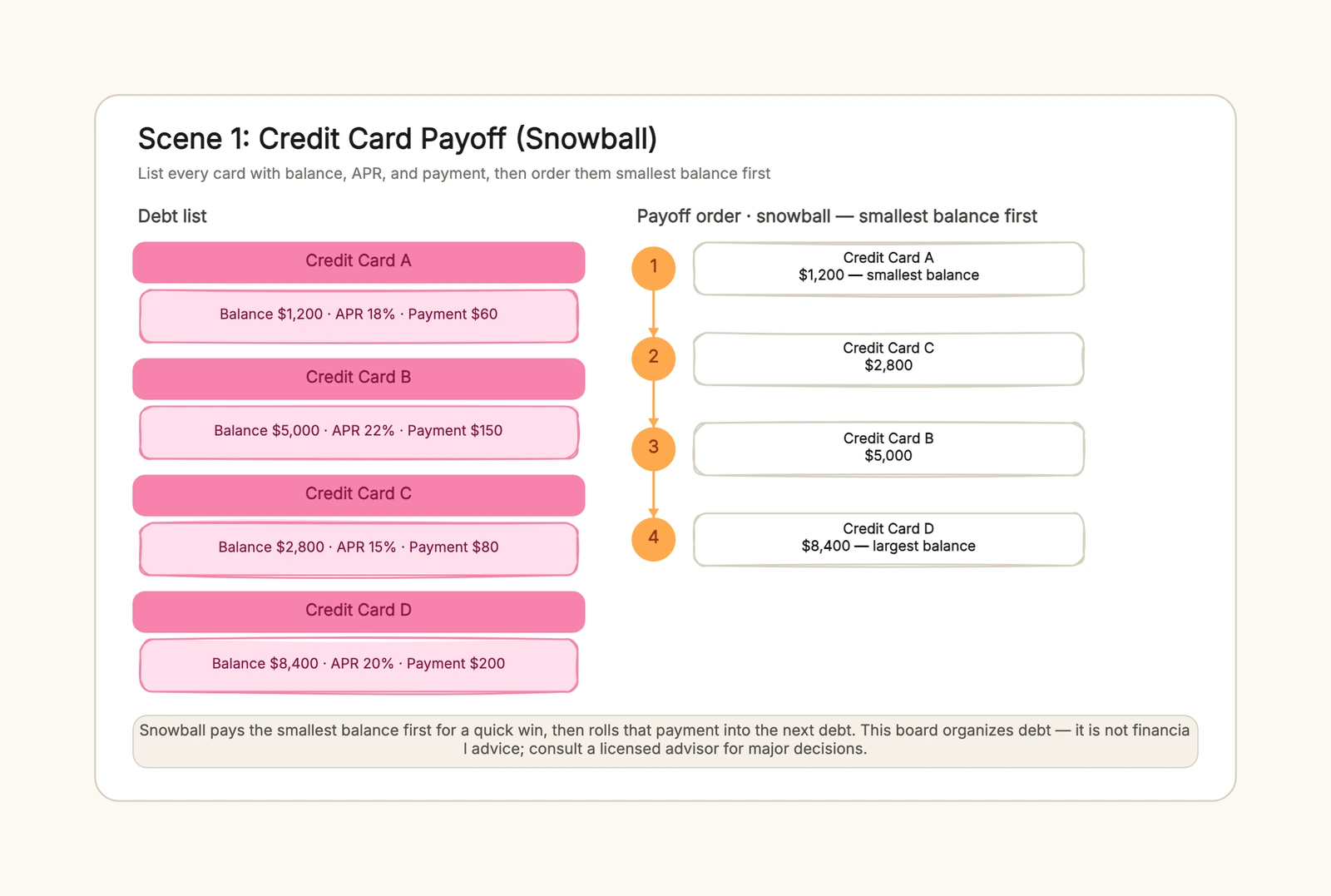
A debt payoff plan is the difference between paying debt off and just feeding minimum payments forever. It is one list of every balance you owe — with its APR and monthly payment — arranged in the order you will attack them, so every extra dollar has a job. Without that order, extra money drifts into minimums and the balances barely move; with it, each debt gets paid in turn until the last one closes.
This guide walks through how to build a debt payoff plan, then shows the two orders it can take — the snowball method and the avalanche method — for credit cards, student loans, and mixed debts. You can adapt the debt payoff plan template and replace the balances, rates, and payments directly in the browser.
What a debt payoff plan should achieve
A debt payoff plan is not the same as a budget. A budget tracks everything you spend; a payoff plan tracks only what you owe and the order you will pay it. A workable plan answers four questions: what every debt's balance is, what its APR is, what its minimum payment is, and which debt gets attacked first.
A useful plan should produce five outcomes:
- every balance is written down with its APR and minimum payment, nothing left off the list;
- the debts are arranged in one clear order, not a pile of "which one do I pay this month";
- the minimum is covered on every account so nothing falls behind;
- all the extra money goes to a single target debt, not spread thinly across everything;
- the freed payment rolls into the next debt each time one closes.
Avoid treating every debt as the same size. A store card at 0% and a credit card at 22% deserve different places in the order, and the method you choose decides which one goes first. Start from the same list-and-order backbone and branch where your real numbers differ.
How to build a debt payoff plan
The most useful plan is organized around a single order, not around a category like "cards" and "loans." When every debt has a place in the sequence, you stop deciding from scratch each month and just follow the list.
1. List every debt with its numbers
Write down each debt's balance, APR, and minimum monthly payment. Include the small ones — a forgotten store card or a medical bill breaks the order if it is not on the list. The point is completeness, not neatness.
2. Choose snowball or avalanche
Snowball sorts debts smallest balance first; avalanche sorts them highest APR first. Pick one before you arrange anything, because the order depends entirely on this choice. Write it down so you are not re-deciding every month.
3. Arrange the debts in that order
Put the debts into a numbered order track so the sequence reads at a glance — 1, 2, 3, 4. The order is the whole plan; if it is not visible, it is not a plan yet, just a list of balances.
4. Cover the minimum on everything
Pay at least the minimum on every debt so nothing falls behind or accrues fees. The plan only works if the debts you are not attacking yet stay current.
5. Send all extra money to the first debt
Every spare dollar goes to the first debt in the order. This is where the plan stops being a list and becomes a payoff: concentrated effort closes one debt at a time instead of nibbling at all of them.
6. Roll the payment forward
When the first debt closes, take the payment you were sending it — minimum plus extra — and add it to the next debt's payment. Repeat until the last one closes. This roll-forward is the engine that makes both methods accelerate.
Snowball example: four credit cards
The snowball method pays the smallest balance first. The reason is psychological: closing an account quickly gives you a win that keeps you going, and it frees a full minimum payment you can roll into the next debt.
Take four cards. Card A is $1,200 at 18% with a $60 payment; Card C is $2,800 at 15% with an $80 payment; Card B is $5,000 at 22% with a $150 payment; and Card D is $8,400 at 20% with a $200 payment. Snowball ignores the rates and orders them A → C → B → D, smallest balance first.
You pay the minimum on all four, then send every spare dollar to Card A. When A closes, the $60 minimum plus the extra you were sending it all flows to Card C, and so on down the line. The key snowball mistake is stopping after the first win — the method only works if the freed payment keeps rolling instead of being absorbed back into spending.
Avalanche: what changes
The avalanche method pays the highest APR first. The reason is mathematical: every dollar sent to the highest rate stops more interest than the same dollar sent to a lower rate, so over the full payoff you pay less total interest.
Take a mixed set: a credit card at $5,000 and 22%, a personal loan at $9,000 and 12%, an auto loan at $12,000 and 7%, and a student loan at $15,000 and 5%. Avalanche orders them by rate — card, personal, auto, student — even though the card is not the largest balance.
The avalanche trade-off is patience. The highest-rate debt is rarely the smallest, so you do not get the early "closed account" win that snowball provides. If you can stay consistent without that win, avalanche is usually the cheaper route. If you will drift off without an early win, snowball keeps you in the game — paying a little more interest but actually finishing.
Snowball vs avalanche: how to choose
The two methods move the same dollars; they only change the order. Choose by which failure you are more likely to hit:
- If you tend to quit when progress feels slow, choose snowball — the first closed account is the motivation that carries the rest.
- If you can follow a plan without early rewards and want to minimize interest, choose avalanche.
- If you are genuinely split, run the same debts through both orders on the debt payoff plan template and look at the two sequences side by side before committing.
The mistake that costs the most is switching. Flipping between snowball and avalanche every month resets the roll-forward and turns a plan back into month-to-month guessing. Pick one and stay with it until the last debt is gone.
How often to review your payoff plan
A debt payoff plan is not a set-and-forget document. Review it on the same day you make payments each month — the order rarely changes, but the numbers do. When a balance drops to zero, roll that payment into the next debt on the list and update the order. Revisit the whole plan quarterly, and whenever your income, interest rates, or a new debt changes, rebuild the list from scratch rather than patching it.
Common debt payoff mistakes
Only paying the minimum
Minimum payments keep accounts alive for years. The plan only works if one debt receives all the extra money while the rest get the minimum. Spread extra money across everything and nothing closes.
Leaving a debt off the list
A forgotten store card, a medical bill, or a small personal loan breaks the sequence when it surfaces. List everything with a balance, even the small ones — a small debt is also a fast snowball win.
Switching methods every month
Snowball one month and avalanche the next means no debt is ever truly the target. Pick one, write it down, and stop re-deciding.
Ignoring the interest rate
If your debts carry very different APRs, the order matters. Avalanche exists because a 22% card compounds faster than a 5% loan — ignoring that while you chase a small balance can cost more than the win is worth.
Treating the plan as financial advice
A payoff plan organizes what you owe; it does not tell you whether to consolidate, refinance, or use savings to clear a balance. Those are decisions for a licensed advisor. The plan is a visualization tool, not financial advice, and it promises no rate or result.
Keep the plan useful over time
Review the plan each month and update the balances. As debts close, the order should shrink, and the roll-forward should speed up. If your income changes — a lean month or a good one — adjust the extra payment, not the method, so the sequence stays intact.
Start with the debt payoff plan template, replace the balances, rates, and payments with your own, and commit to one order. For turning the payoff into a longer goal, the goal setting template frames the debt as a milestone you track month by month. And remember the disclaimer that belongs on every plan: this board organizes debt — it is not financial advice; for consolidation, refinancing, or any major money decision, talk to a licensed advisor.