A camping checklist is the difference between a trip where the first night is easy and a trip where you drive back out at ten o'clock for a headlamp battery. It turns "did we pack the stove fuel?" into a list you check zone by zone, so gear goes into the car once and nothing gets bought twice at the last gas station before the campsite.
This guide walks through how to build a camping checklist around four zones — shelter, cooking, safety, and clothing — then shows how the same list changes for car camping, tent camping, RV camping, and camping with kids. You can adapt the camping checklist template and edit the zones and gear directly in the browser.
What a camping checklist should cover
A camping checklist is not the same as a trip packing list. A packing list is a flat list of things to throw in a bag; a camping checklist is organized around where gear lives at the campsite, so each zone is complete before it goes in the car. A workable list answers four questions: what you sleep in, what you cook with, what keeps you safe, and what you wear when the temperature drops.
Every campsite — a car site, a backcountry tent site, an RV pad — needs the same four zones:
- Shelter and sleep — the tent or vehicle bed, sleeping bags rated for the coldest night you expect, and a pad or air mattress to keep you off the ground.
- Cooking and kitchen — the stove, its fuel, cookware, utensils, and the water and food for the whole stay.
- Safety and first aid — a restocked first aid kit, a headlamp with fresh batteries, sun and bug protection, and a way to charge your phone.
- Clothing and layers — a warm layer for the evening, rain gear, shoes that are already broken in, and a change of clothes.
On top of the four zones, add a pre-trip check: fuel, ice or water, weather, and the campsite confirmation. These are the four things people skip while packing and pay for at the last stop.
The point of the zones is that a forgotten item shows up as an empty slot. If the cooking bin has a stove and a pot but no fuel, you see it before you leave the driveway. If the list is one long column, you feel the gap in your gut instead.
How to build a camping checklist
The most useful checklist is grouped by zone, not by where you bought the gear. When each bag or bin is complete on its own, you load the car once and unpack in one trip.
1. Pick your camping style first
Car, tent, or RV decides how much you can carry, and that decides the gear. A car trip can take an air mattress and a two-burner stove; a tent trip trims to what fits in a pack. Choosing the style first stops you from building a list you will never lift.
2. List the four zones
Write the four zone names — shelter, cooking, safety, clothing — and fill each with the real items for this trip. Grouping by zone is the whole trick: a stove without fuel is an empty slot in the cooking zone, not a vague worry.
3. Fill each zone with real gear
One card per piece of gear, with the detail that matters. "Sleeping bag" is less useful than "sleeping bag rated for the low." The detail is what lets you check it off without guessing whether you actually packed it.
4. Add the pre-trip check
Above or below the zones, add fuel, ice or water, weather, and campsite confirmation. These sit outside the four gear zones because they are not gear — they are the things that go wrong between the house and the campsite.
5. Tick as you load
Check the list while the gear goes into the car or pack, not after. An empty slot is visible only if you are looking at the list at the same moment the bin is being closed.
6. Keep the list after the trip
Note what stayed unused and what you wished you had. Next trip starts from a list that already knows you, instead of one rebuilt from memory.
Car camping: what to bring
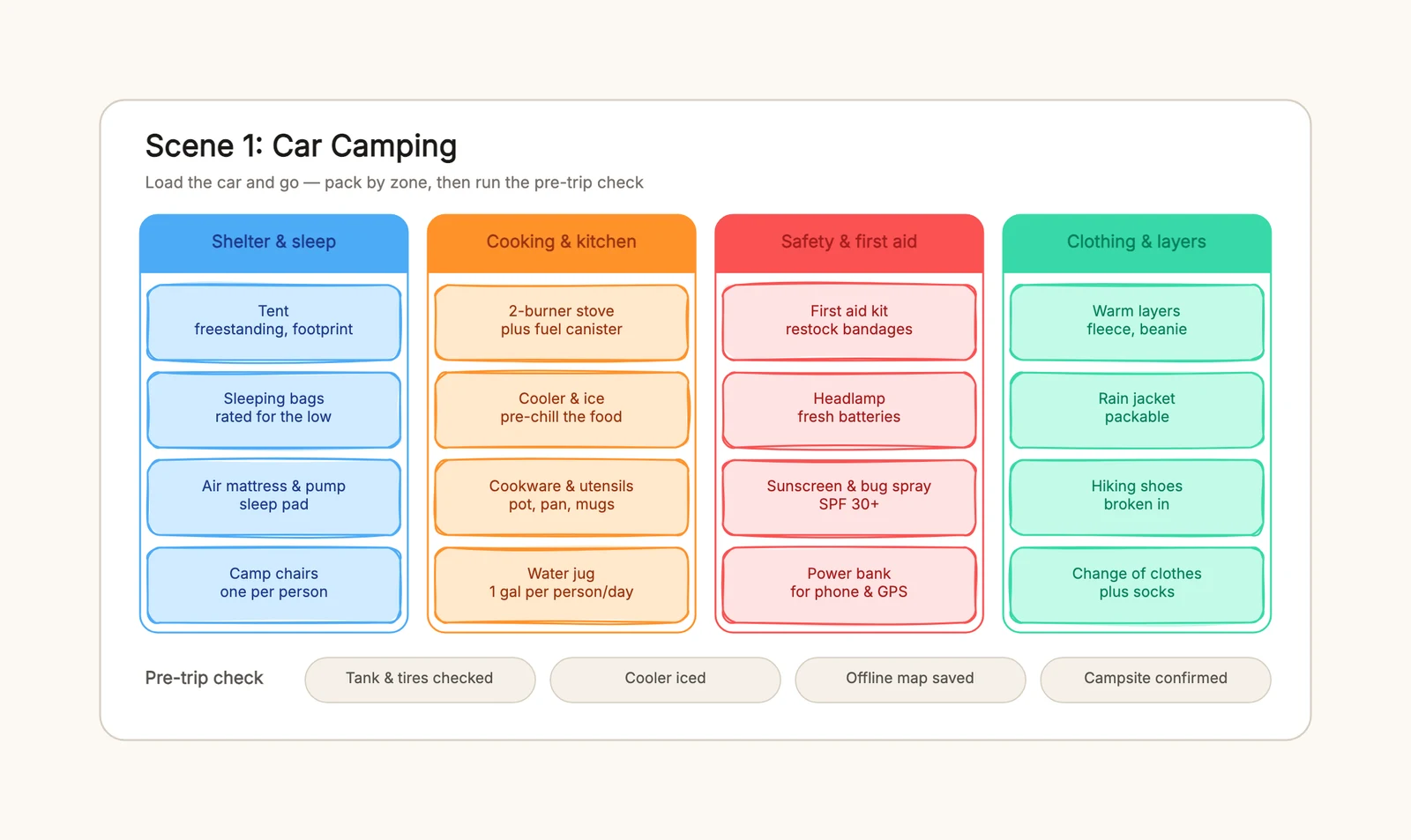
Car camping is the roomiest version because the car carries the comfort gear. Shelter means a full freestanding tent with a footprint, sleeping bags rated for the low, an air mattress with a pump, and a camp chair per person. Cooking means a two-burner stove with a spare fuel canister, a cooler with enough ice to pre-chill the food, cookware and utensils, and a water jug holding about a gallon per person per day.
Safety for a car trip is a full first aid kit with fresh bandages, a headlamp with spare batteries, sunscreen and bug spray, and a power bank for the phone and GPS. Clothing is warm layers for the evening — a fleece and a beanie — a packable rain jacket, hiking shoes that are already broken in, and a change of clothes plus socks.
The car mistake that costs the most is packing by store. Gear bought together gets packed together and forgotten together. Pack the four zones into four bins and check each bin before it closes. One more habit pays off on a car trip: keep a first-night bag on top of the load — headlamp, toothbrush, phone charger, and tomorrow's clothes — so you can pitch the tent or make the bed after dark without digging through every bin. Load the heavy gear low and the first-night bag last, so the thing you need first is the thing you reach first. For the meal planning side of a car trip, the weekly meal planner template covers the breakfasts and dinners before you leave.
Tent camping: what changes
Tent camping takes the same four zones and trims each one to what you can carry in. Shelter becomes a lightweight two- or three-person tent, a sleeping bag packed dry, a foam pad instead of an air mattress, and a tarp with a groundsheet for rain. Cooking drops the two-burner stove to a single-burner with screw-on fuel, a nested pot, a water filter or purification tabs, and a fire starter.
Safety shrinks to a trail-sized first aid kit, a headlamp with a red-light mode, a map and compass backed by GPS, and a whistle on a lanyard. Clothing shifts to quick-dry layers instead of cotton, an insulation layer, a waterproof shell, and two pairs of wool socks.
The tent mistake that ends trips is borrowing from the car list. A car list stays heavy because the car carries it; the moment you carry it, every extra pound counts. Trim each zone on purpose, and keep the four-zone structure so nothing critical disappears in the trimming.
RV camping: what changes again
RV camping adds the vehicle itself as a system to check before the gear zones. Fresh water is filled, waste tanks are emptied, tires and lights are checked, and hookups are confirmed. The vehicle is part of the gear, and it is the part a normal gear list never mentions.
After the vehicle, the four zones fill with drive-up comfort: RV bedding, an awning with poles and stakes, a camp table and chairs, and extra blankets for cold nights. Cooking uses the RV stove with propane checked, a fridge and freezer set to cold, cookware and dishes for the galley, and a potable fresh-water hose. Safety adds a fire extinguisher that is mounted and charged, a tire gauge and toolkit with a spare, and a flashlight in the glovebox.
The RV mistake that costs the most is skipping the vehicle check. A campsite an hour away is a bad place to discover a flat spare or an empty fresh-water tank. Check the vehicle first, then pack the zones.
Family camping with kids: the add-ons
Camping with kids does not change the four zones — it multiplies them. Shelter becomes sleeping bags per person plus extra blankets, cooking adds kids' snacks to the food bin, safety adds headlamps for small hands and stronger sunscreen, and clothing adds a change of clothes per child because a wet afternoon should not end the trip.
The family-specific add-on is a per-person count. Every zone scales by headcount, and the pre-trip check gains a headcount line so you pack enough food and water for everyone. Kids also break the "pack once" rule — plan a small first-night bag per child so bedtime is not a dig through the car in the dark.
For the drive itself, the travel itinerary template helps plan the route and the days around the campsite, and the packing checklist template covers the clothes and toiletries that live outside the camping gear.
Common camping mistakes
Packing by store, not by zone
Gear bought together gets packed together and forgotten together. Pack by zone so each bin is complete before it closes, and a forgotten item shows up as an empty slot.
No pre-trip check
Fuel, ice, water, and campsite confirmation are skipped while packing and paid for at the last stop. A short pre-trip check bar catches them before you leave the driveway.
Over-packing for a tent trip
A tent list that borrows from the car list gets heavy fast. Trim each zone to what you can carry and swap the comfort gear for lighter versions.
Skipping the first aid restock
The kit gets used and put back half-empty. Restock bandages, tape, and blister pads before the trip, not after someone needs them.
Not checking the vehicle
For car and RV trips the vehicle is part of the gear. Check tires, fuel, water tanks, and lights before packing, not at the campsite.
Keep the checklist useful over time
After the trip, note what stayed unused and what you wished you had, so the next trip starts from a list that already knows you. Keep a short version — the four zones and the pre-trip check — in your notes, and reuse the full list each season, swapping gear as the weather changes.
Start with the camping checklist template, replace the zones and gear with your own, and run the pre-trip check before you load. For the clothes and toiletries that sit outside the camping gear, see the packing checklist template, and for the drive and the days around the campsite, the travel itinerary template.